Fort Lauderdale’s rideshare crash pattern is shaped by three demand concentrations that do not exist in the same combination in any other South Florida city. The first is the Las Olas late-night entertainment surge: the concentration of restaurants, bars, and nightlife venues along Las Olas Boulevard generates a predictable post-midnight rideshare demand spike that floods a one-way commercial corridor with Uber and Lyft drivers competing for pickup positions in a street environment designed for normal traffic, not for rideshare staging. The second is the Brightline station interface at 200 W. Broward Blvd., where intercity rail passengers arriving from Miami or Orlando immediately open their rideshare apps, creating sudden demand spikes that concentrate dozens of drivers in a compressed pickup zone on Broward Boulevard adjacent to high-volume surface street traffic. The third is spring break’s massive volume surge on the beach corridor streets, where inexperienced seasonal rideshare drivers flood A1A and Sunrise Boulevard with cars that have no muscle memory for Fort Lauderdale’s traffic patterns. The National Highway Traffic Safety Administration and state crash data document the crash patterns these demand concentrations produce.
Mesin & Co. represents Fort Lauderdale rideshare accident victims, pursuing recovery from both the platform companies and the individual drivers who cause crashes through negligence. Attorney Eugene Mesin, a Marine Corps veteran and University of Florida Levin College of Law graduate, understands that rideshare cases require a specialized investigation into the platform’s coverage structure, the driver’s app status at the moment of the crash, and the digital evidence that neither Uber nor Lyft will produce voluntarily. Call (786) 944-6446 for a free consultation.
The Las Olas Late-Night Surge Economy and Its Crash Dynamics
How Surge Pricing Concentrates Distracted Drivers
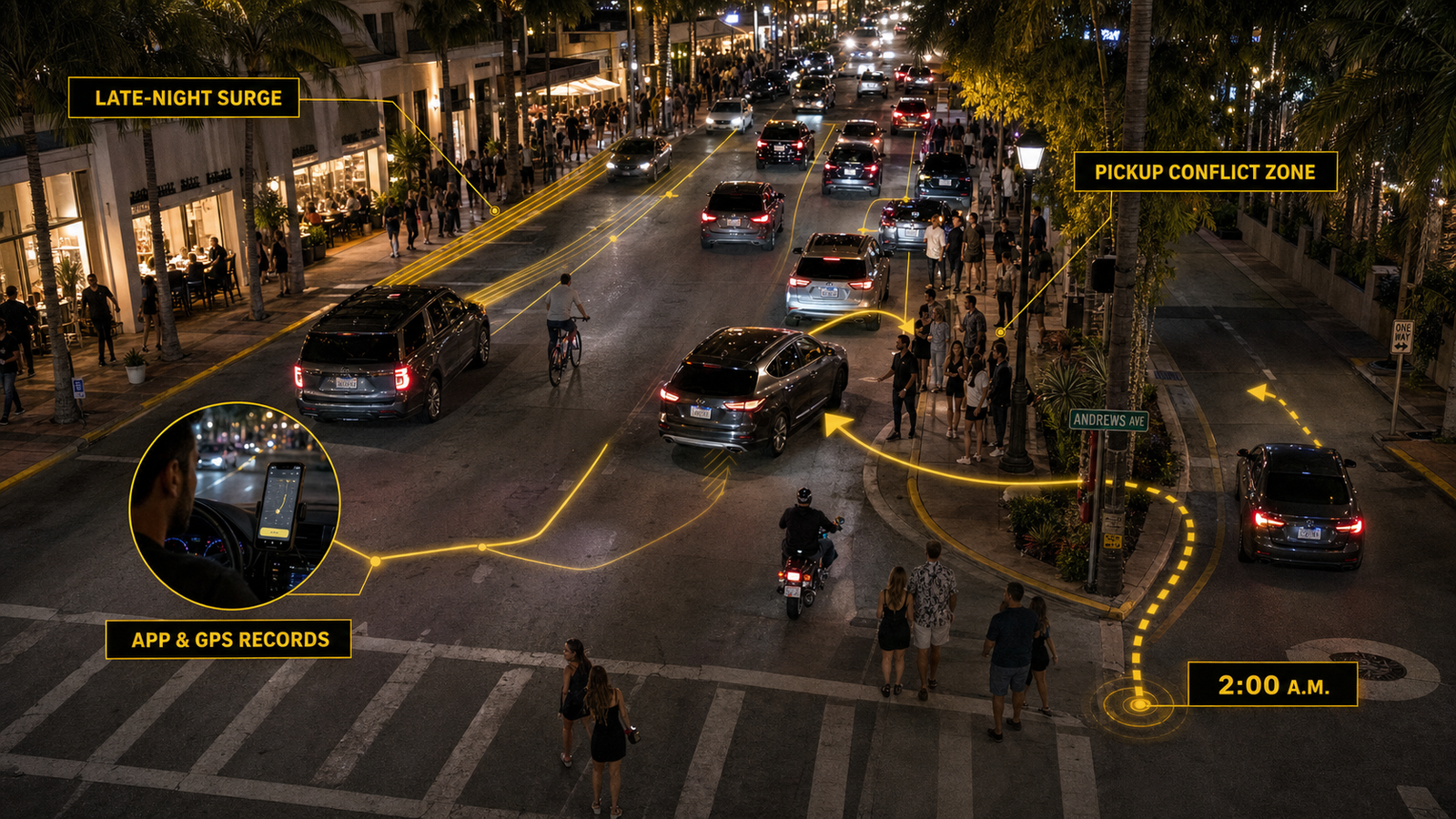
Rideshare surge pricing triggers during periods of high demand, offering drivers elevated per-trip earnings that incentivize them to converge on the high-demand zone as quickly as possible. On Las Olas Boulevard during late-night hours on weekends, surge pricing creates a concentration of Uber and Lyft drivers entering the corridor from Andrews Avenue, Federal Highway, and the adjacent side streets simultaneously, all looking at their apps for the next ping rather than watching the road ahead of them. A driver who is monitoring their app display while driving at 25 to 30 mph on Las Olas is not paying adequate attention to the pedestrians, cyclists, and other vehicles sharing the corridor. The economics of surge pricing, where the driver who accepts the next trip first earns the elevated rate, create a structural incentive for app-focused driving that is incompatible with safe operation in a dense urban entertainment environment.
Establishing that a rideshare driver was distracted by their app at the moment of a Las Olas crash requires the driver’s phone records, the platform’s trip log showing the time sequence of trip requests and acceptances, and in some cases forensic analysis of the phone’s data to reconstruct its screen state in the seconds before the crash. Uber and Lyft will not produce their internal platform records voluntarily: they require formal litigation discovery, including subpoenas served on the platform’s legal department under Florida’s rules for non-party discovery. An attorney who understands how to obtain and interpret this data builds a significantly stronger case than one who relies solely on the police report and the driver’s account of the crash.
The 2 A.M. Las Olas Conflict Zone
The closing time dynamics on Las Olas create a specific crash window between midnight and 2 a.m., when bar-closing crowds flood the sidewalks and street crossings simultaneously with the peak density of rideshare vehicles circling for pickup. Pedestrians who have been drinking move less predictably than sober pedestrians: they may enter the roadway at unexpected points, stop suddenly in a crosswalk, or step off the curb into traffic without checking for approaching vehicles. Rideshare drivers in this environment face a genuine operational challenge, but that challenge does not reduce their legal duty of care: it elevates it. A professional driver who chooses to operate on Las Olas during the closing time window is choosing to operate in one of the most demanding driving environments in Fort Lauderdale, and that choice requires correspondingly elevated attention and reduced speed.
Driver Competition for Pickup Position on a One-Way Corridor
Las Olas Boulevard through the restaurant district operates as a one-way street in portions, with rideshare drivers who miss a passenger’s pickup location needing to circle the block through the adjacent street grid to attempt another approach. This creates a pattern of drivers executing rapid lane changes, abrupt U-turns on adjacent streets, and aggressive acceleration to reach the next ping before another driver accepts it. A rideshare vehicle that makes an aggressive U-turn on SE 2nd Street or Andrews Avenue to return to a Las Olas pickup creates a lateral hazard for cyclists, motorcyclists, and pedestrians in those streets. When this maneuver causes a crash, the driver’s app records, which document the trip request location, the driver’s GPS position at the time of the maneuver, and the timing of the trip acceptance, are critical evidence of the operational pressure that motivated the dangerous driving behavior.
The Brightline Station: A New Rideshare Crash Zone
The Train-to-Rideshare Demand Spike Pattern
The Brightline station at 200 W. Broward Blvd. generates rideshare demand spikes that are temporally precise: they occur when trains arrive, and the arrival schedule is publicly known. Riders who use Brightline from Miami or Orlando to Fort Lauderdale frequently book their rideshare connection in advance or open the app as the train approaches the station. When a 350-passenger Brightline train arrives at the Fort Lauderdale station, 50 to 100 or more passengers may simultaneously request rideshare vehicles within a two-to-three-minute window. That concentrated demand spike pulls Uber and Lyft drivers from across downtown Fort Lauderdale toward the Broward Boulevard pickup zone simultaneously, creating a rapid increase in vehicle density on Broward Boulevard and the adjacent streets in the moments after a train arrival.
The crash risk created by this pattern is greatest in the first five minutes after a Brightline train arrival, when the maximum number of rideshare drivers are converging on the station area simultaneously while the maximum number of rideshare passengers are attempting to identify their assigned vehicle on the Broward Boulevard curbside. Drivers circling the station area waiting for a match, drivers who just accepted a match and are navigating toward the pickup location, and drivers who completed a dropoff and are repositioning for the next trip all share the same compressed Broward Boulevard corridor during this demand spike. Add to this the Brightline construction activity that has periodically reduced curb space and pedestrian clearance in the station area, and the crash risk profile of the station’s immediate vicinity is significant.
Pickup Congestion on Broward Boulevard
Broward Boulevard, the primary surface street fronting the Brightline station, is a four-lane divided arterial that carries substantial through-traffic connecting I-95 to the west with US-1 and the downtown core to the east. Rideshare pickup activity on Broward Boulevard creates conflict between rideshare vehicles stopping at the curb or in the travel lane to load passengers and the through traffic that does not anticipate stationary vehicles in an arterial travel lane. A rideshare driver who stops in the travel lane on Broward Boulevard rather than pulling to the designated pickup zone, or who accelerates abruptly from a curbside position without checking for adjacent traffic, creates a crash risk for following vehicles and for cyclists who may be using the shoulder or bike facility adjacent to the station. These crashes frequently occur between a rideshare vehicle and a following passenger vehicle whose driver did not expect the rideshare vehicle to stop in the travel lane.
Phase Coverage at the Moment of a Station-Adjacent Crash
Determining which insurance coverage applies to a rideshare crash near the Brightline station requires identifying the driver’s app status with precision at the moment of the crash, not at the moment the crash was reported or at some other time. Florida law establishes a three-phase coverage structure for rideshare drivers. Phase 1 is when the app is offline and the driver is using the vehicle for personal purposes: only the driver’s personal automobile policy applies. Phase 2 is when the app is on but no trip has been accepted: the platform provides $50,000 per person and $100,000 per occurrence in bodily injury liability coverage. Phase 3 is when the driver has accepted a trip and is en route to the passenger or has the passenger in the vehicle: the platform provides $1 million in bodily injury liability coverage. A rideshare driver circling the Brightline station with the app on but no trip accepted is in Phase 2, with significantly lower coverage than a driver who has already accepted a passenger pickup.
Spring Break and the Fort Lauderdale Rideshare Overload
Volume Surge and the Inexperienced Driver Problem
Spring break brings tens of thousands of visitors to Fort Lauderdale Beach, and that volume surge creates a parallel surge in rideshare demand from visitors who need transportation between the beach, the Las Olas corridor, the airport, and the hotel districts along A1A and Sunrise Boulevard. The platform companies respond to this demand surge by accepting new drivers, reactivating inactive drivers, and incentivizing drivers from adjacent markets, including Miami-Dade County and Palm Beach County, to work the Fort Lauderdale market during peak days. These drivers may have adequate rideshare driving experience in their home markets but limited or no familiarity with Fort Lauderdale’s specific road network: the one-way streets of the downtown grid, the drawbridge timing on the Intracoastal crossings, the seasonal pedestrian density on A1A, and the traffic signal timing on Sunrise Boulevard and Las Olas.
An inexperienced driver navigating Fort Lauderdale’s beach corridor for the first time while monitoring the rideshare app for the next trip request is a driver who is simultaneously managing two unfamiliar cognitive tasks: learning a new road environment and managing platform-specific navigation. The resulting attention deficit, where neither the road environment nor the platform interface receives full attention, is a documented cause of rideshare crashes in high-demand tourist markets. Establishing that an out-of-market driver was navigating unfamiliar roads while monitoring their rideshare app requires the driver’s platform account records, which will show their market of primary operation, the Florida Department of Highway Safety and Motor Vehicles records for their Florida driving history, and the app’s GPS data showing the navigation route and any deviations from it.
Intoxicated Passengers and Driver Distraction
A rideshare driver who accepts a trip from the Las Olas corridor or the Fort Lauderdale Beach area during spring break peak hours is likely to pick up passengers who have been drinking. Intoxicated passengers create in-vehicle distraction events: arguments about the route, attempts to change the destination mid-trip, physical activity in the rear seat, and requests for the driver to stop or slow down in locations that do not match the programmed navigation route. A driver who is managing an intoxicated passenger dispute while driving on A1A at 30 to 40 mph is not giving the road the attention that operating a vehicle requires, and when a crash results from that divided attention, the driver’s negligence is established. The platform’s in-trip audio data, if preserved, can document the in-vehicle distraction event, and the driver’s braking and acceleration data from the app’s GPS records can show the erratic driving behavior that preceded the crash.
Evidence Preservation During Peak-Season Crashes
Rideshare crash evidence during spring break has a short shelf life because the drivers involved may be in Fort Lauderdale only for the peak season and may leave before formal litigation discovery compels their participation. The platform’s trip records for a spring break crash, including the driver’s entire trip history for the day, the GPS track of the trip in question, and the digital communications between the driver and the platform in the period surrounding the crash, exist in the platform’s servers but are not automatically preserved when a crash is reported. An attorney who issues a formal litigation hold notice to the platform company immediately upon engagement preserves the platform’s obligation to retain these records, and a failure to preserve after proper notice creates spoliation liability that can be raised with the court.

Insurance Coverage in Your Fort Lauderdale Rideshare Case
The Phase System and Why It Determines Everything
The three-phase insurance structure that Florida law imposes on rideshare operations means that a crash victim’s potential recovery depends critically on which phase the driver was in at the moment of impact, and that determination is made from the platform’s internal records rather than from the driver’s account. A driver who tells the police they were “on the way to pick someone up” may be describing Phase 3 activity that triggers the platform’s $1 million policy, or may be describing Phase 2 activity where they had not yet accepted a specific trip. The distinction matters enormously to the injured victim. An attorney who knows how to read the platform’s trip log, identify the timestamp of the trip acceptance, and compare it to the crash timestamp from the police report and the EMS dispatch record can establish the driver’s phase with precision that no police report can provide.
When the Platform Disputes Phase Status
Uber and Lyft have financial incentives to argue that their drivers were in Phase 1 rather than Phase 2 or Phase 3 at the time of a crash, because Phase 1 crashes are covered only by the driver’s personal insurance and impose no obligation on the platform. A platform that argues Phase 1 status when the driver was actually logged into the app and available for trips is attempting to shift the entire financial burden of the crash to the driver’s personal insurer, which may have lower limits and different coverage terms than the platform policy. Countering a Phase 1 characterization argument requires the platform’s complete login and logout records for the driver on the day of the crash, the trip request queue data showing whether any trips were available in the area at the time of the crash, and the GPS data showing whether the driver’s location and routing were consistent with personal use or with rideshare availability behavior.
Pursuing Additional Coverage When Phase Two Limits Are Insufficient
The $50,000 per person bodily injury limit available under Phase 2 rideshare coverage is, for serious injury cases, frequently inadequate to compensate the injured victim for medical expenses, lost wages, and pain and suffering. When the Phase 2 limit is insufficient, the injured victim’s options include pursuing the driver’s personal assets if the driver has assets worth pursuing, making a claim under the victim’s own underinsured motorist coverage if they carry UM/UIM coverage with limits above the rideshare platform’s Phase 2 policy, or pursuing other coverage sources identified in a comprehensive insurance investigation at the outset of the case. An attorney who evaluates all available coverage sources from the beginning, rather than simply accepting the first policy offered by the rideshare company, consistently achieves better outcomes for clients in insufficient-coverage scenarios.
Mesin & Co. handles the full spectrum of Fort Lauderdale rideshare accident claims: passengers injured in the rideshare vehicle, pedestrians and cyclists struck by rideshare vehicles, and occupants of vehicles struck by rideshare drivers. For related crash types, see the Fort Lauderdale car accident lawyer page for general personal injury law in Broward County and the Hollywood rideshare accident lawyer page for claims arising in the adjacent municipality. Call (786) 944-6446. There is no fee unless the firm recovers for you.

Russian-Speaking Services
Eugene Mesin is fluent in Russian and welcomes inquiries from Russian-speaking clients throughout Florida