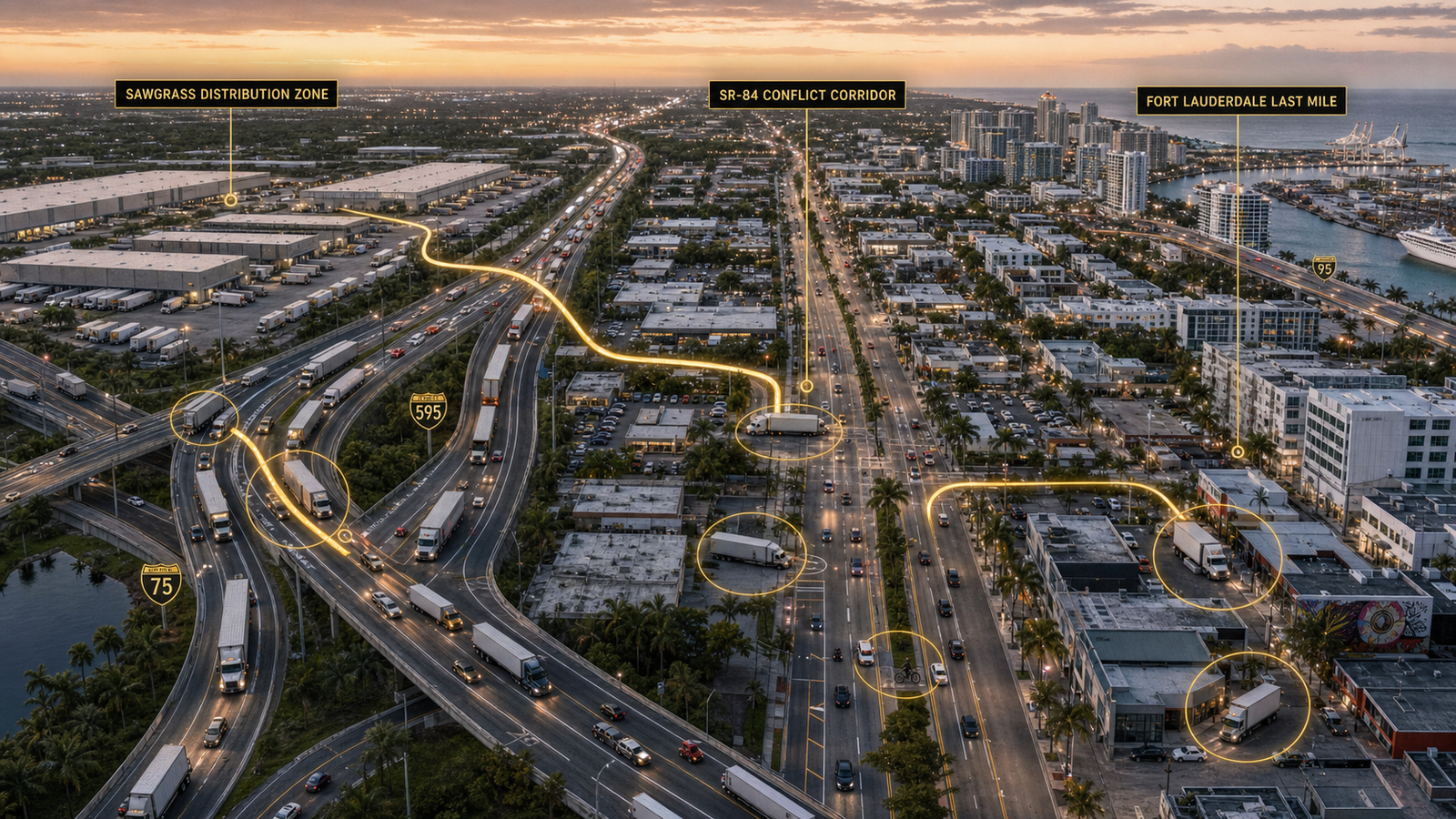
Fort Lauderdale sits at the eastern terminus of one of the most commercially significant freight corridors in South Florida. Interstate 595 runs east-west through the heart of Broward County, connecting I-95 and Port Everglades in the east to the Sawgrass Expressway and the vast industrial and distribution infrastructure of western Broward in the west. Every day, thousands of commercial trucks carry goods from Port Everglades container terminals through Fort Lauderdale’s I-595 interchange to the distribution centers in Davie, Dania Beach, and along the Sawgrass Corridor. The Federal Motor Carrier Safety Administration reported 168,320 large truck injury crashes nationally in 2022, and Florida’s share of that total is disproportionately high given its port activity, freight volume, and year-round road use by commercial carriers.
When a commercial truck crash happens on I-595, on SR-84, or on the surface streets of Fort Lauderdale’s industrial and commercial zones, the injuries are typically severe and the liability picture is typically complex. Mesin & Co. represents Fort Lauderdale truck accident victims, building cases that go beyond the driver’s conduct to examine the carrier’s safety culture, the shipper’s loading practices, the freight broker’s vetting decisions, and the maintenance contractor’s inspection records. Attorney Eugene Mesin, a Marine Corps veteran and University of Florida Levin College of Law graduate, understands how to pursue every available source of recovery in a commercial truck case. Call (786) 944-6446 for a free consultation.
I-595 and the Western Broward Distribution Network
Why the Sawgrass Corridor Produces Commercial Vehicle Crashes
The Sawgrass Expressway and the industrial zones that flank it in western Broward County represent one of the highest concentrations of distribution center activity in South Florida. The Amazon fulfillment operations, the Home Depot regional distribution center, the grocery and retail distribution facilities that supply Broward and Palm Beach Counties: all of them generate constant commercial truck traffic that flows through the I-595/Sawgrass interchange and then onto I-595 headed east toward I-95, Port Everglades, and Fort Lauderdale’s surface streets. The I-595/I-75/Sawgrass interchange is one of the most geometrically complex interchanges in Broward County, requiring commercial drivers to navigate multiple weave sections, managed lane entry and exit ramps, and tight interchange geometry that demands attentiveness even from experienced operators.
Driver fatigue is a persistent problem on this corridor. Commercial drivers delivering to the Sawgrass distribution zone often make multiple trips per shift between the distribution center and Port Everglades or the I-95 corridor, accumulating hours-of-service exposure that approaches or exceeds federal limits by the end of a shift. When a fatigued driver enters the complex I-595 managed lanes section or merges into the high-speed I-95 interchange, the risk of a crash that would not have occurred with a rested, attentive driver increases substantially. Federal hours-of-service regulations exist precisely to address this risk, and a carrier whose scheduling practices push drivers past those limits is liable for crashes that result.
SR-84 as the Surface Street Relief Valve
State Road 84 runs parallel to I-595 as a surface street alternative through Fort Lauderdale and Davie, carrying commercial truck traffic that cannot use the managed express lanes or that is headed to destinations along the corridor rather than through it. SR-84 passes through a mix of industrial, commercial, and residential zoning, with businesses fronting directly onto a two-lane arterial that was not designed for the volumes and vehicle classifications it now carries. Commercial trucks making left turns across oncoming traffic on SR-84, trucks backing into driveways that open directly onto the travel lane, and trucks double-parked during deliveries to strip commercial properties create conflict zones that produce pedestrian, cyclist, and passenger vehicle crashes with regularity.
Unlike the limited-access I-595, SR-84 intersects with side streets, driveways, and bicycle routes at grade level, creating far more interaction points between large commercial vehicles and the smaller vehicles and unprotected users they can injure severely. When a crash occurs on SR-84 between a commercial truck and a passenger vehicle or a vulnerable road user, the investigation must address not only driver conduct but also the adequacy of the commercial operation’s routing decisions. A carrier that routes heavy vehicles through SR-84’s commercial corridor when safer alternatives exist may bear partial responsibility for the crash on the theory that the routing decision itself was unreasonably dangerous.
The Last-Mile Delivery Problem in Fort Lauderdale
Fort Lauderdale’s downtown core, the Las Olas corridor, and the Flagler Village development zone present a different but equally hazardous commercial vehicle environment: the last-mile delivery problem. Smaller delivery trucks, sprinter vans, and box trucks serving the dense commercial and residential properties in these zones operate under extreme time pressure in streets designed for passenger vehicles. Double-parking in travel lanes, partially blocking intersections during delivery unloading, and reversing into loading zones from moving traffic lanes are routine behaviors for last-mile delivery drivers operating under dispatch pressure. When a delivery vehicle maneuver causes a crash, the delivering company, the dispatching company, and the company that contracted for the delivery may all bear liability depending on how the commercial relationship was structured.
Federal Safety Standards and Where Carriers Fall Short
Hours of Service Violations in Deadline-Driven Distribution
Federal Motor Carrier Safety Administration hours-of-service regulations limit commercial truck drivers to 11 hours of driving time within a 14-hour on-duty window, followed by a mandatory 10-hour off-duty period. Carriers serving the Sawgrass distribution zone and Port Everglades operate under intense schedule pressure from shippers and logistics managers who treat delivery windows as non-negotiable. That pressure creates a structural incentive for drivers to compress their off-duty rest, falsify logbooks, or accept dispatch assignments that their legitimate hours remaining cannot legally accommodate. When a driver who has exceeded their hours-of-service allowance causes a crash on I-595 or SR-84, the carrier faces liability not just for the driver’s negligent act but for the carrier’s own negligence in allowing or encouraging the hours violation.
Electronic Logging Devices have made hours-of-service enforcement more reliable since the federal ELD mandate took effect for most carriers in 2017, but carriers still find ways to manipulate the data or to structure work schedules in ways that technically comply with the daily limit while undermining the rest requirement’s protective purpose. An attorney handling a Fort Lauderdale truck crash investigation must know how to read an ELD record, what anomalies in the data suggest manipulation, and how to cross-reference the ELD data against fuel purchase records, toll records, and GPS data to identify inconsistencies that reveal true driving patterns.
Vehicle Maintenance Requirements and Inspection Records
Federal regulations require commercial carriers to conduct pre-trip and post-trip vehicle inspections, maintain written inspection records for each vehicle in the fleet, and repair identified defects before the vehicle returns to service. Brake systems, tire condition, steering components, lighting, and coupling devices are among the critical safety systems that must be inspected and maintained to federal standards. A carrier that allows a truck with documented brake wear, a leaking air line, or worn steering components to continue in revenue service is operating a rolling violation of federal safety law, and when that defect contributes to a crash, the carrier’s failure to maintain the vehicle becomes a direct source of liability independent of driver negligence.
Obtaining maintenance and inspection records in a Fort Lauderdale truck crash case requires moving quickly. Carriers are required by federal regulation to maintain inspection records for only 90 days, and some carriers purge records on the first day they are legally permitted to do so. An attorney who sends a spoliation letter and a formal litigation hold notice to the carrier within days of the crash preserves the carrier’s obligation to retain all records related to the vehicle involved in the crash. Failure to preserve records after receiving proper notice can result in adverse inference instructions that tell the jury to presume the destroyed records contained evidence unfavorable to the carrier.
The ELD and What It Proves in a Broward County Crash
The Electronic Logging Device installed in a commercial truck records far more than simply the hours the driver was on and off duty. Modern ELD systems capture GPS position data at regular intervals, engine RPM, vehicle speed, hard braking events, and sudden acceleration that can reconstruct the driver’s behavior in the minutes and seconds before a crash with precision that was unavailable in the paper logbook era. In a Fort Lauderdale crash where the truck driver claims they were maintaining a safe speed and following distance, the ELD’s event data recorder records can either confirm or decisively refute that claim. This data belongs to the carrier, and it will not be produced voluntarily if it is damaging to the carrier’s defense.
Preserving ELD data requires a litigation hold notice sent to the carrier before the data is overwritten. Some ELD systems retain event data for only a limited period, and a carrier that allows data to be overwritten after a crash and after receiving notice of a potential claim faces severe sanctions including evidence preclusion and adverse inference instructions. The National Highway Traffic Safety Administration publishes standards for event data recorder retention and access, and an attorney familiar with the federal regulatory framework can use those standards to compel production of all electronic data generated by the truck in the period surrounding the crash.
Expanding the Liability Circle Beyond the Driver
The Freight Broker and Load Planner
The freight broker that arranged the load, selected the carrier, and coordinated the delivery schedule occupies a position of significant responsibility in the commercial trucking supply chain. Freight brokers have a legal duty to exercise reasonable care in selecting carriers, which includes verifying that the carrier holds the required FMCSA operating authority, maintains current insurance, and has a safety rating that does not disqualify them from being used for interstate or intrastate freight. A broker who selects a carrier with a history of safety violations, expired insurance, or a conditional or unsatisfactory safety rating and then dispatches a load that results in a crash may face negligent hiring or negligent entrustment liability that expands the pool of available recovery beyond what the carrier’s own policy provides.
The Third-Party Maintenance Contractor
Many commercial carriers outsource vehicle maintenance to third-party service providers rather than maintaining a full in-house maintenance staff. The third-party maintenance contractor who performs brake service, tire replacement, or steering repair on a commercial truck in the Fort Lauderdale area may be independently liable if defective repair work or a failure to identify a known defect contributes to a crash. The maintenance contractor’s work order records, the technician certifications, the parts used in the repair, and the quality control inspection conducted after the work was completed are all relevant evidence. When the maintenance contractor’s negligence is established, the injured victim has an additional source of recovery, which is particularly valuable in catastrophic injury cases where a single carrier’s $750,000 minimum policy may be insufficient to cover the full scope of damages.
The Shipper’s Role When Improper Loading Causes the Crash
The company that loaded the cargo onto the truck bears legal responsibility for ensuring that the load is properly secured, balanced, and within federal weight limits. An improperly balanced load can shift during transit, altering the truck’s center of gravity and making it prone to rollover on curved highway ramps like those at the I-595/I-95 interchange. A load that exceeds federal axle weight limits places excessive stress on brakes and tires, increasing the risk of brake fade and tire blowout at highway speeds. Federal regulations set standards for cargo securement by cargo type, and a shipper who violates those standards and causes a crash may be jointly liable with the carrier for the resulting injuries. Identifying the shipper’s role requires a load planning analysis and a review of the bill of lading and weight tickets from the load’s origin.

Investigating a Fort Lauderdale Truck Accident
Evidence That Exists in the First 72 Hours
The first 72 hours after a commercial truck crash are the most critical window for evidence preservation, and every hour that passes without legal intervention reduces the total volume of recoverable evidence. The crash scene itself is temporary: skid marks weather, debris is cleared, and the road surface is repaired. The truck is potentially repaired or sent to a salvage yard. The cargo manifest and shipping documents are filed and then may be discarded. The carrier’s dispatch records for the day of the crash, the GPS data from the fleet management system, the dashcam footage from the cab-facing and road-facing cameras, and the driver’s electronic logbook data from the days preceding the crash are all evidence that exists in the first 72 hours and may not exist on day 73.
Spoliation Letters and Carrier Preservation Obligations
A spoliation letter is a formal written communication from your attorney to the carrier, the broker, the shipper, and any other potentially responsible party, identifying the crash and demanding immediate preservation of all documents, electronic records, physical evidence, and communications related to the vehicle, the driver, the load, and the trip that ended in the crash. Under Florida law and federal discovery standards, a party that receives a spoliation letter and then destroys or allows the destruction of evidence it knew was relevant to potential litigation faces sanctions ranging from adverse inference instructions to default judgment. Sending the letter within hours or days of the crash, rather than waiting for formal litigation to begin, is one of the most important things an attorney can do to protect the injured client’s evidentiary position.
Expert Witnesses in Broward County Truck Cases
Commercial truck crash litigation in Broward County regularly requires expert witnesses across multiple disciplines. An accident reconstructionist with FMCSA regulatory expertise can calculate pre-crash speeds, braking distances, and the sequence of events from the physical evidence and electronic data. A trucking safety expert who has audited commercial carrier safety management systems can explain to a jury what standard industry safety practices look like and how the defendant carrier departed from them. A forensic engineer can analyze the truck’s mechanical systems to determine whether a defect contributed to the crash. A forensic economist can calculate the lifetime economic impact of catastrophic injuries on a working Fort Lauderdale resident. Building and coordinating this expert team from the earliest stages of the case is how Mesin & Co. prepares to achieve maximum recovery. Call (786) 944-6446 to begin the process.
Truck accident cases involving Fort Lauderdale’s I-595 commercial corridor can also give rise to wrongful death claims when crashes are fatal. The Fort Lauderdale wrongful death lawyer page addresses the specific legal framework that governs those cases under Florida law. For crash victims who survived but suffered serious injuries, the Fort Lauderdale car accident lawyer page explains the general personal injury legal framework in Broward County. The firm’s results page provides context for the outcomes these cases produce when prepared and litigated thoroughly. There is no fee unless the firm recovers for you.

Russian-Speaking Services
Eugene Mesin is fluent in Russian and welcomes inquiries from Russian-speaking clients throughout Florida