Fort Lauderdale-Hollywood International Airport (FLL) sits at Hollywood’s northern border, processing more than 35 million passengers annually and operating as one of the busiest airports in the southeastern United States. The rideshare pickup and drop-off zones at FLL generate continuous Uber and Lyft activity through Hollywood’s northern neighborhoods, on US-1 approaching the airport from the south, and on Griffin Road and Stirling Road connecting the airport to I-95 and the city’s surface street network. The Seminole Hard Rock Hotel and Casino creates a second dense rideshare demand zone where guests who have been gambling and drinking use rideshare as their planned alternative to driving, creating peak surge events that attract large numbers of drivers simultaneously and produce the rushed, distracted driving behavior that comes with competing for high-demand surge fares. Hollywood’s beach corridor adds a third rideshare concentration along A1A and Hollywood Boulevard where pickup and drop-off activity overlaps constantly with pedestrian and bicycle traffic.
These three rideshare demand zones create a crash pattern that is specific to Hollywood’s geography and that differs materially from the rideshare accident landscape in cities without major airports or casino operations. When a rideshare crash occurs in any of these zones, the legal questions that follow involve platform insurance coverage, driver qualification history, and, in airport and casino contexts, specific operational practices that may create liability independent of the driver’s individual negligence. Mesin & Co. handles rideshare accident cases in Hollywood and throughout Broward County with full command of how Uber and Lyft structure their insurance exposure and what evidence is required to maximize recovery. Call (786) 944-6446 for a free consultation.
FLL Airport: Hollywood’s Highest-Intensity Rideshare Zone
The Airport Staging Area and the Crash Risk It Creates
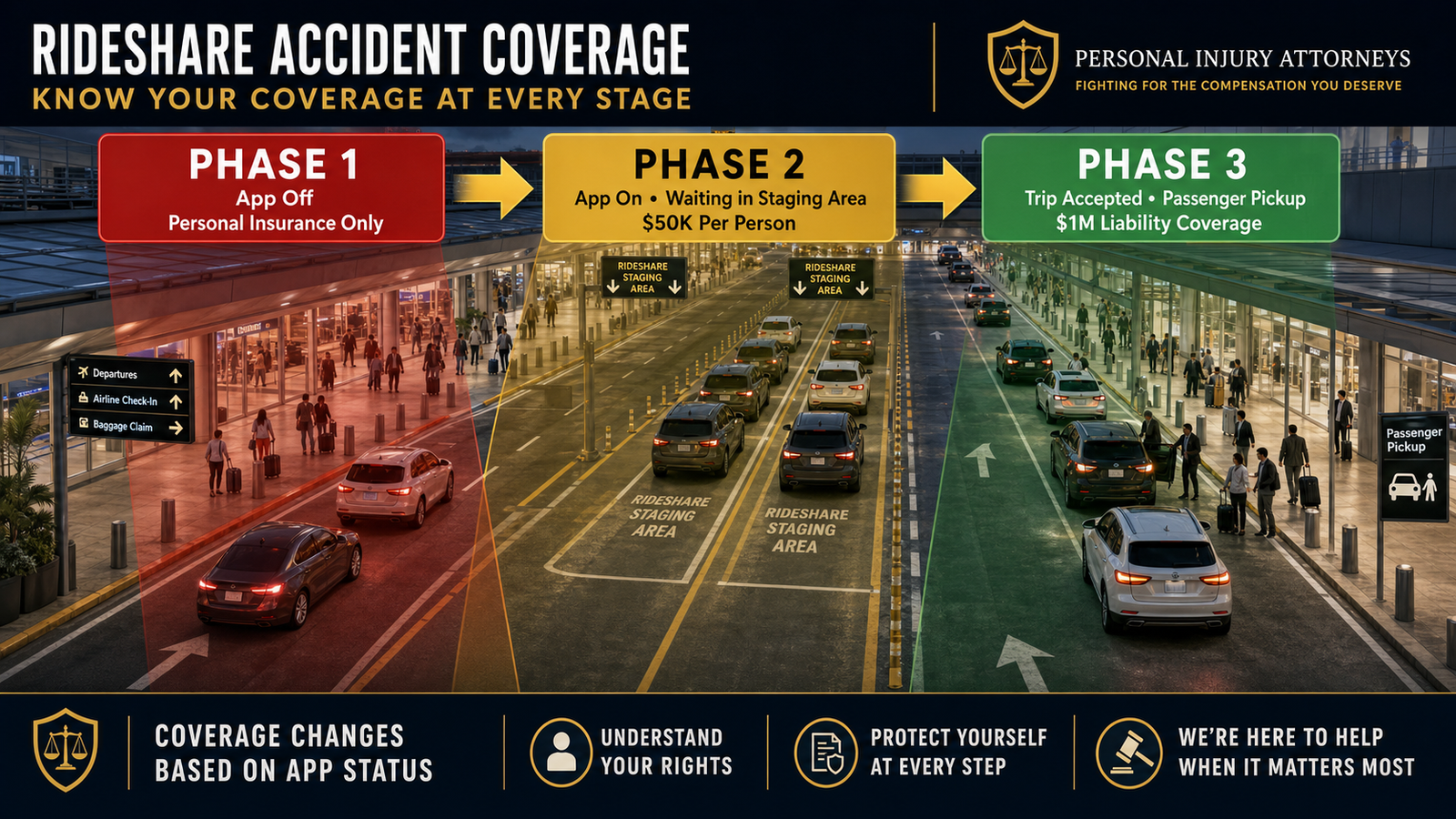
FLL’s rideshare pickup operation requires drivers to stage in a designated waiting area until a passenger match is made through the app. Drivers waiting in the staging queue are in Phase Two of the rideshare insurance structure, with Uber and Lyft’s contingent $50,000 per person coverage active. The moment a driver accepts a trip and begins moving toward the terminal, they enter Phase Three and the $1 million liability policy activates. This transition happens in a high-pressure environment where drivers are competing to be first to accept trips, monitoring multiple app notifications, and navigating the complex access roads of an active airport simultaneously. Distracted driving in the staging-to-pickup transition is a documented factor in FLL-adjacent rideshare crashes, and the precise app status at the moment of any crash in this zone requires immediate investigation through platform data subpoena.
The Fatigue Problem in Long-Haul Airport Rideshare Shifts
FLL airport shifts are among the most grueling in the rideshare economy. Drivers who rely on airport trips for income frequently begin their day at peak morning hours, work through the afternoon connecting trips, and queue for late-night airport pickups to maximize daily earnings. Unlike FMCSA-regulated commercial truck drivers who are subject to hours-of-service limits and electronic logging, rideshare drivers have no federally mandated rest requirement. Uber and Lyft both have internal policies addressing driver fatigue, including in-app prompts asking drivers to confirm they are rested after extended sessions, but these prompts are self-reported and easily dismissed. A driver who has been behind the wheel for 14 hours before picking up a passenger at FLL at midnight presents a fatigue risk comparable to a commercial truck driver operating in violation of hours-of-service rules, without any of the regulatory documentation that makes those cases straightforward to prove.
Using App Data to Establish Fatigue in Hollywood Airport Cases
The platform’s trip log is the primary tool for establishing driver fatigue in FLL-area rideshare cases. Every trip accepted and completed by the driver is time-stamped in the platform’s records, creating a continuous driving history that documents how many consecutive hours the driver was operating before the crash occurred. This data is not available through public records. It requires a litigation subpoena directed to Uber or Lyft’s legal department. Mesin & Co. sends preservation demands for this data within days of being retained on any Hollywood rideshare case involving a driver who may have been operating on an extended shift. The driving history record, combined with the specific time of the crash, establishes a timeline that supports fatigue arguments independently of the driver’s own account of their condition.
The Seminole Hard Rock Surge Zone and Its Crash Dynamics
How Surge Pricing Concentrates Distracted Drivers Near the Casino
Uber and Lyft’s surge pricing algorithm responds to demand spikes by raising fares in the affected zone, which simultaneously attracts drivers toward the area. At the Seminole Hard Rock, surge events occur regularly on weekend nights and after major events, drawing dozens of rideshare vehicles into the casino access roads and surrounding streets simultaneously. Drivers navigating to the surge zone while monitoring the app for the best pickup opportunity are performing two cognitively demanding tasks at once: driving in a complex environment and making real-time decisions about which pickup to accept. This distracted driving pattern is unique to the surge environment and creates crash risk on the casino approach roads, including Seminole Way and the connectors to US-441 and I-595, that does not exist at the same level in other parts of Hollywood.
Intoxicated Rideshare Passengers and Driver Distraction
Rideshare drivers picking up guests from the Seminole Hard Rock and from Hollywood’s beach bars frequently transport passengers who are significantly intoxicated. Intoxicated passengers are statistically more likely to be distracting, to argue with the driver about the route, to reach forward into the front seat, or to behave in ways that pull the driver’s attention from the road. A rideshare crash caused by driver distraction originating from passenger behavior creates a complex liability analysis: the driver is primarily liable for maintaining control of the vehicle, but the circumstances that created the distraction are relevant to the full causation picture. Mesin & Co. investigates passenger behavior as a contributing factor in Hollywood rideshare cases where in-vehicle dynamics may have played a role, using the platform’s trip rating records and any available in-vehicle camera footage.
The Phase Coverage Structure in Hollywood Rideshare Cases
Phase One, Two, and Three: What Each Means for Your Claim
As in all rideshare cases, the coverage available to an injured victim in Hollywood depends entirely on which phase the driver was in at the moment of impact. Phase One, when the app is completely off, provides no platform coverage and leaves the victim dependent on the driver’s personal auto insurance alone. Phase Two, when the app is on and the driver is waiting for a match, activates Uber and Lyft’s contingent $50,000 per person coverage. Phase Three, when a trip has been accepted or is in progress, triggers the full $1 million liability policy as primary coverage. In Hollywood’s FLL airport staging environment, Phase Two is the most frequent coverage status when crashes occur in the waiting area, and the $50,000 limit is often insufficient for serious injury cases. Mesin & Co. investigates whether the driver’s own policy provides gap coverage and whether any additional coverage sources are available to supplement Phase Two limits. For the full phase coverage analysis, the firm’s Hollywood car accident lawyer page covers the general Florida insurance framework.
Disputing the Platform’s Phase Characterization
Uber and Lyft have financial incentives to characterize crashes as occurring in Phase Two or Phase One rather than Phase Three whenever the facts are at all ambiguous. A driver who was technically between a completed trip and a newly accepted trip at the moment of a crash may be characterized as Phase Two even if the interval was only seconds. The platform’s own data, including the timestamp of the previous trip’s completion, the timestamp of the new trip’s acceptance, and the GPS track of the vehicle during the interval, tells the true story. Mesin & Co. subpoenas this full data record and, when necessary, retains platform data analysis experts to establish the precise phase status at the moment of impact. The platform’s characterization in its own investigation report is a starting point for dispute, not a concession.
Platform Direct Liability in Hollywood Rideshare Cases
Driver Screening Failures in a High-Volume Market
FLL’s continuous demand for rideshare drivers, combined with the Hard Rock’s surge events, creates sustained pressure on Uber and Lyft to maintain large driver populations in the Hollywood-Fort Lauderdale market. High driver volume increases the probability that screening process gaps will allow drivers with disqualifying histories onto the platform. Background check databases used by both platforms miss certain county-level records, juvenile offenses, and crimes committed after initial onboarding if continuous monitoring is not applied. When a driver with a history that should have resulted in disqualification causes a Hollywood rideshare crash, the platform’s screening methodology is itself a subject of direct negligence litigation. Mesin & Co. pursues platform direct liability claims in Hollywood rideshare cases where driver qualification failures are supported by the evidence.
TNC Permit Requirements and Airport Operational Safety Standards
Transportation Network Companies operating at FLL must comply with Broward County Aviation Department permit requirements that impose vehicle safety standards, insurance verification requirements, and operational protocols on rideshare vehicles in the airport access zone. Violations of permit requirements that contribute to a crash, such as operating an uninspected vehicle or allowing a driver with a suspended license to work the airport queue, create regulatory compliance claims alongside the standard negligence analysis. These permit requirements are public records and are part of Mesin & Co.’s standard investigation in every Hollywood FLL-area rideshare case.
What Injured Hollywood Rideshare Victims Are Entitled to Recover
Rideshare accident victims in Hollywood, whether passengers, pedestrians, or other drivers struck by a rideshare vehicle, are entitled to recover the full range of compensatory damages: medical bills including treatment at Memorial Regional Hospital, lost wages and earning capacity, pain and suffering, and all other losses documented by the evidence. When platform direct negligence is established, additional recovery from the platform independent of insurance policy limits may be available. Mesin & Co. builds every Hollywood rideshare case with the full scope of recovery in view, consulting the firm’s Hollywood wrongful death page framework when rideshare crashes produce fatal outcomes. Eugene Mesin handles all cases on a contingency fee basis. Call (786) 944-6446 or visit mesinco.com to get started today.

Russian-Speaking Services
Eugene Mesin is fluent in Russian and welcomes inquiries from Russian-speaking clients throughout Florida