
Fort Lauderdale has invested more in cycling infrastructure than most South Florida cities. Protected lanes along portions of Broward Boulevard, shared-use paths along the New River and the Riverwalk, and sharrow markings on several secondary streets reflect a municipal commitment to making the city more bikeable. But cycling infrastructure investment is only as protective as its implementation, and Fort Lauderdale’s cycling network has a characteristic failure mode that is more dangerous than no infrastructure at all: protected lanes that end without warning, leaving cyclists who were riding confidently in a protected environment suddenly exposed in a travel lane at highway-adjacent speeds with no advance notice that the protection was about to end. Florida recorded 161 bicyclist fatalities in 2022, and the Florida Department of Highway Safety and Motor Vehicles data shows that urban mid-block and intersection conflicts are the most common crash patterns.
Mesin & Co. represents Fort Lauderdale cyclists who have been injured through driver negligence, infrastructure failure, or both. Attorney Eugene Mesin, a Marine Corps veteran and University of Florida Levin College of Law graduate, understands that bicycle cases require aggressive investigation precisely because the physical disparity between a cyclist and a motor vehicle means that the injuries are severe and the stakes are high. If you or a family member has been injured in a Fort Lauderdale bicycle crash, call (786) 944-6446 for a free consultation.
The Protected Lane Gap: When Infrastructure Creates False Security
Where Fort Lauderdale’s Protected Lanes End Without Warning
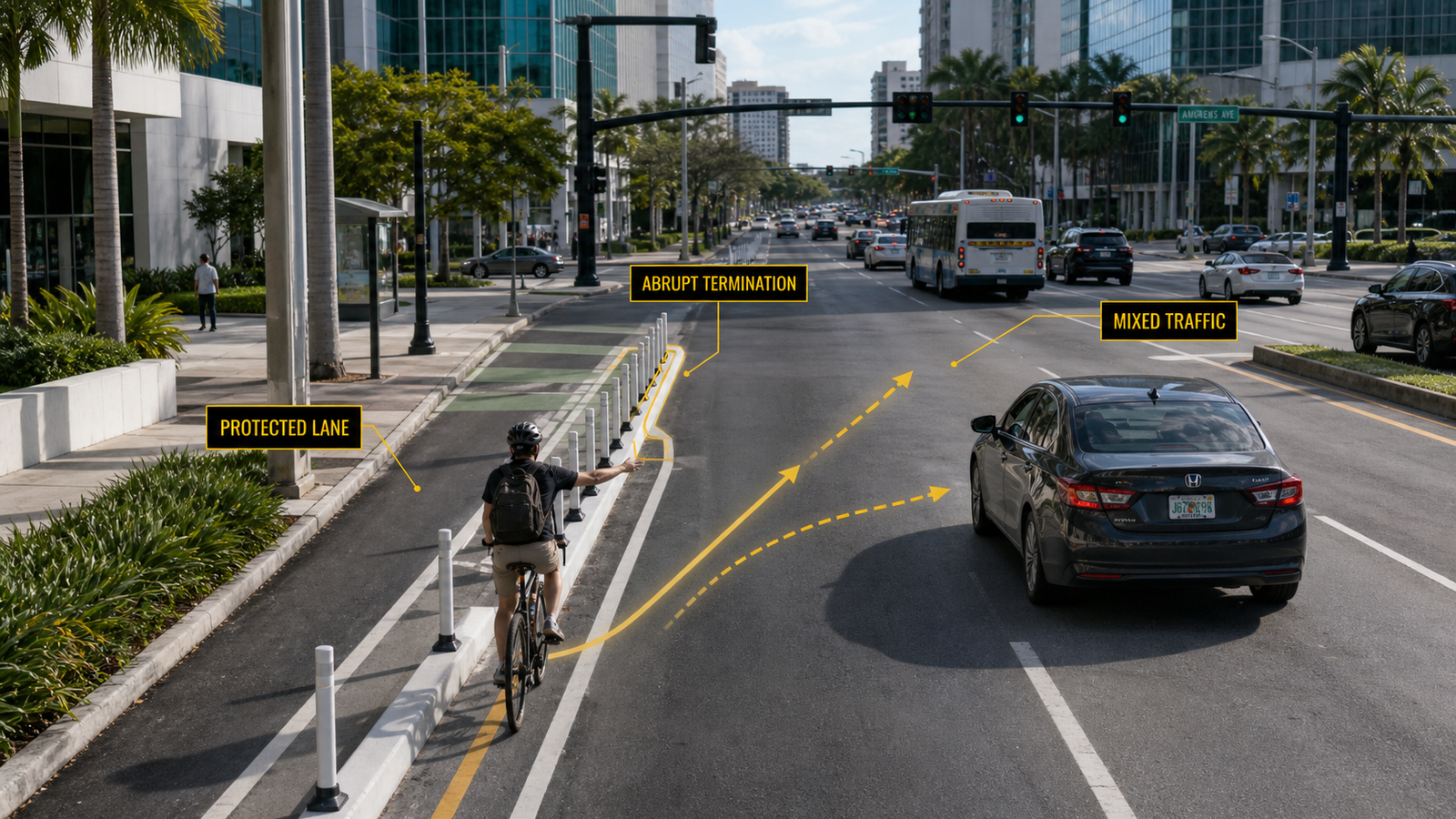
Fort Lauderdale’s protected bicycle lane network is fragmented by design and by budget: protected lanes exist on some segments of major corridors but not others, and the transitions between protected segments and unprotected roadway are often abrupt and inadequately signed. A cyclist who enters a protected lane on Broward Boulevard at Andrews Avenue and rides west may find that the lane protection ends before they reach the next major intersection, dropping them into a travel lane used by vehicles at 40 mph with no protected space, no advance warning, and no time to evaluate the transition before they are in it. This infrastructure gap problem, where the design creates a false expectation of continuing protection that ends without warning, is arguably more dangerous than simply not having a protected lane at all, because the cyclist has adjusted their positioning and riding behavior to match the protected environment they expected to continue.
The legal question raised by a protected lane gap crash is whether the government entity that designed and installed the infrastructure had a duty to warn cyclists of the termination point and provide them with a safe transition back to mixed traffic. Under Florida law, government entities have sovereign immunity from suit but have waived that immunity for negligent maintenance of public roads under Florida Statute 768.28. Whether the design of an inadequate infrastructure termination point constitutes negligent maintenance or design defect within the scope of that waiver is a question that varies by the specific facts of the lane design, and an attorney who has litigated government road defect claims in Broward County will know how to frame the argument most effectively.
The Transition Zone Crash Pattern
The transition zone between protected cycling infrastructure and unprotected roadway is the single most dangerous point in Fort Lauderdale’s cycling network for the cyclists who use it. At the moment a protected lane ends, the cyclist must simultaneously recognize that the protected space is ending, assess the position and speed of adjacent traffic, signal their intention to merge into the travel lane, and execute the merge while maintaining bicycle control. Drivers in the adjacent travel lane are not always aware that a bicycle lane is about to merge into their lane, and they may not yield the space the cyclist needs to complete the transition safely. The result is a conflict that occurs in a compressed time and space window where neither the cyclist nor the adjacent driver has adequate information to act safely.
Government Liability for Abrupt Infrastructure Termination
When a cyclist is injured at a Fort Lauderdale bicycle lane termination point, the claim against the government entity that designed and maintains the infrastructure requires establishing that the termination was unreasonably dangerous, that the government had or should have had knowledge of its dangerous character, and that the government’s failure to correct the design or install adequate warning and transition signage was a proximate cause of the crash. Prior crashes at the same termination point documented in FLHSMV crash data, prior complaints from cyclists submitted to the city or county, and any internal traffic engineering analysis that identified the termination point as dangerous but failed to generate a timely design correction are all evidence of constructive knowledge that supports the liability claim.
Bridge Crossings and the Cyclist’s Canal City Problem
Narrow Bridge Lanes and No Dedicated Bike Facilities
Fort Lauderdale’s waterway geography requires cyclists to cross drawbridges that were designed for vehicle traffic before bicycle accommodation was a design consideration. Many of these bridges have lane widths that are marginal for two vehicles passing in opposite directions and that are entirely inadequate for a vehicle to safely pass a cyclist while maintaining a three-foot clearance as required by Florida law. The choice facing a cyclist who needs to cross one of these bridges is to either occupy the full lane and force following traffic to wait behind them, or to ride in the narrow available space to the right and hope that passing drivers respect the statutory clearance distance. Neither option eliminates the risk, and bridges that funnel cyclists and vehicles into the same narrow lane over a water hazard create crashes with consequences that are compounded by the bridge elevation, the hard deck surface, and the potential for the crash to send a rider over the bridge railing.
Metal Grating and Wet Expansion Joints on Older Bridges
The older drawbridges in Fort Lauderdale’s canal network present the specific surface hazards described in the motorcycle accident context, but with important differences in how those hazards affect cyclists. A bicycle tire, being narrower than a motorcycle tire and operating with lower ground contact pressure, is even more susceptible to catching in the gaps of a parallel-running metal grating deck. A cyclist who rides parallel to the grating orientation on an older Fort Lauderdale drawbridge may find their front tire suddenly deflecting laterally, causing a loss of control that is difficult or impossible to correct in the narrow bridge lane with traffic immediately behind. The responsible entity for these bridge surface conditions is identifiable through the Florida Department of Transportation‘s bridge ownership database, and the maintenance records for the specific bridge will show whether prior inspections identified the surface hazard and whether any corrective action was taken.
Three-Foot Law Enforcement at Bridge Chokepoints
Florida Statute 316.083 requires motorists to provide a minimum three-foot clearance when passing a bicycle operating on a roadway. At the chokepoints created by Fort Lauderdale’s narrow drawbridge lanes, maintaining three feet of clearance while passing a cyclist is often physically impossible within the existing lane width, yet drivers attempt it anyway rather than waiting behind the cyclist until the bridge crossing is complete. A driver who passes a cyclist on a bridge with insufficient clearance and causes a crash has violated this statutory duty, and that violation constitutes negligence per se in the subsequent civil case. Establishing the clearance distance at the specific bridge requires photogrammetric analysis of the crash scene and expert testimony on vehicle and bicycle positioning from a reconstruction specialist who has worked on bicycle crash cases in Broward County courts.
East Las Olas and the Restaurant Corridor Cyclist Hazard
Valet Lanes, Double-Parked Deliveries, and the Door Zone
The East Las Olas corridor between Andrews Avenue and the Intracoastal Waterway is one of the most hazardous cycling environments in Fort Lauderdale for cyclists who must share the roadway with vehicles. The concentration of restaurant and bar establishments along this corridor generates continuous valet, delivery, and customer vehicle activity that creates three specific hazard types for cyclists: valet vehicles pulling from the right-hand lane into the travel lane without checking for cyclists in the bike lane or shoulder, delivery vehicles double-parked in the bike lane or shoulder forcing cyclists into the travel lane, and vehicle doors opening into the bike lane as drivers exit parallel-parked vehicles without checking for approaching cyclists. Any of these conflicts can produce a crash with no warning and no time for the cyclist to react.
Restaurant Loading Conflicts and the Mid-Block Crash
Deliveries to Las Olas restaurants occur throughout the day and into the late afternoon, with food service trucks, produce vendors, and beverage distributors making loading stops at service entrances and curbside locations along the corridor. These delivery vehicles frequently stop in the travel lane or the bike lane without setting up adequate warning or flagging, forcing cyclists to make lateral movements into adjacent traffic that they have not had time to assess. A delivery driver who blocks the bike lane without providing advance warning to cyclists approaching from behind has created a hazard analogous to an unmarked construction zone obstruction, and the liability analysis is similar: the company responsible for the delivery is liable for crashes caused by its driver’s failure to maintain safe delivery practices.
Nighttime Visibility and Las Olas After Dark
Cyclists on Las Olas after dark face an additional hazard created by the contrast between the brightly lit restaurant storefronts and the relatively darker roadway between them. A cyclist with appropriate front and rear lighting may be visible to drivers looking directly at the bike lane, but a driver who is focused on finding a parking space, looking for the valet lane, or watching for pedestrians crossing mid-block may not perceive a cyclist in their peripheral vision. The National Highway Traffic Safety Administration data shows that nighttime bicycle crashes are disproportionately fatal compared to daytime crashes, and the Las Olas corridor’s mix of vehicle activity, pedestrian traffic, and limited dedicated bicycle infrastructure creates a nighttime cycling environment that requires both cyclist vigilance and a higher standard of care from drivers who know they are in an active entertainment district.

Insurance, Liability, and Legal Rights for Fort Lauderdale Cyclists
Florida’s Three-Foot Passing Law (Section 316.083)
Florida Statute 316.083 is one of the most important statutory tools available to injured cyclists in Broward County. The statute’s requirement that motorists provide at least three feet of clearance when passing a bicycle on a roadway creates an affirmative obligation that is violated in a significant proportion of Fort Lauderdale bicycle crashes. Establishing the violation requires a crash reconstruction analysis that can determine the approximate clearance distance between the vehicle and the bicycle at the moment of impact, which typically relies on the physical evidence from the crash scene, the vehicle damage patterns, the bicycle damage and deformation, and the cyclist’s injuries. When the violation is established, the negligence per se doctrine removes the question of breach from the jury’s consideration and focuses the trial on causation and damages.
PIP Does Not Follow the Bicycle
Florida’s no-fault Personal Injury Protection system covers passengers in registered motor vehicles, but a cyclist injured in a collision with a motor vehicle is not a passenger in a motor vehicle and does not have automatic access to PIP benefits from their own insurance unless they also own a car and their automobile policy’s PIP coverage extends to their bicycle crash under applicable policy terms. In most cases, an injured cyclist must pursue recovery through the at-fault driver’s bodily injury liability coverage, their own health insurance, or their bicycle insurance policy if they purchased one. This makes the tort recovery pathway, and the attorney who pursues it, the primary mechanism for a Fort Lauderdale cyclist to access compensation for medical expenses, lost wages, and pain and suffering.
UM Coverage and the Hit-and-Run Problem
Hit-and-run crashes involving cyclists are not uncommon on Fort Lauderdale’s roads, particularly at night in the Las Olas and beach corridor areas where drivers who may be impaired leave the scene before they can be identified. When the at-fault driver is never identified, the cyclist’s only recovery pathway is through their own uninsured motorist coverage, either on a motor vehicle policy they hold or on a specific bicycle insurance policy with UM coverage. An attorney reviewing the available coverage at the outset of representation will identify all policies under which a UM claim may be pursued and will ensure that the claim is properly filed within the time limits applicable to each policy. Mesin & Co. reviews every available coverage source for injured Fort Lauderdale cyclists. For pedestrian accident claims arising in the same corridors, see the Fort Lauderdale pedestrian accident lawyer page. For motorcycle crash claims in similar environments, see the Fort Lauderdale motorcycle accident lawyer page. Call (786) 944-6446 for a free consultation.

Russian-Speaking Services
Eugene Mesin is fluent in Russian and welcomes inquiries from Russian-speaking clients throughout Florida