
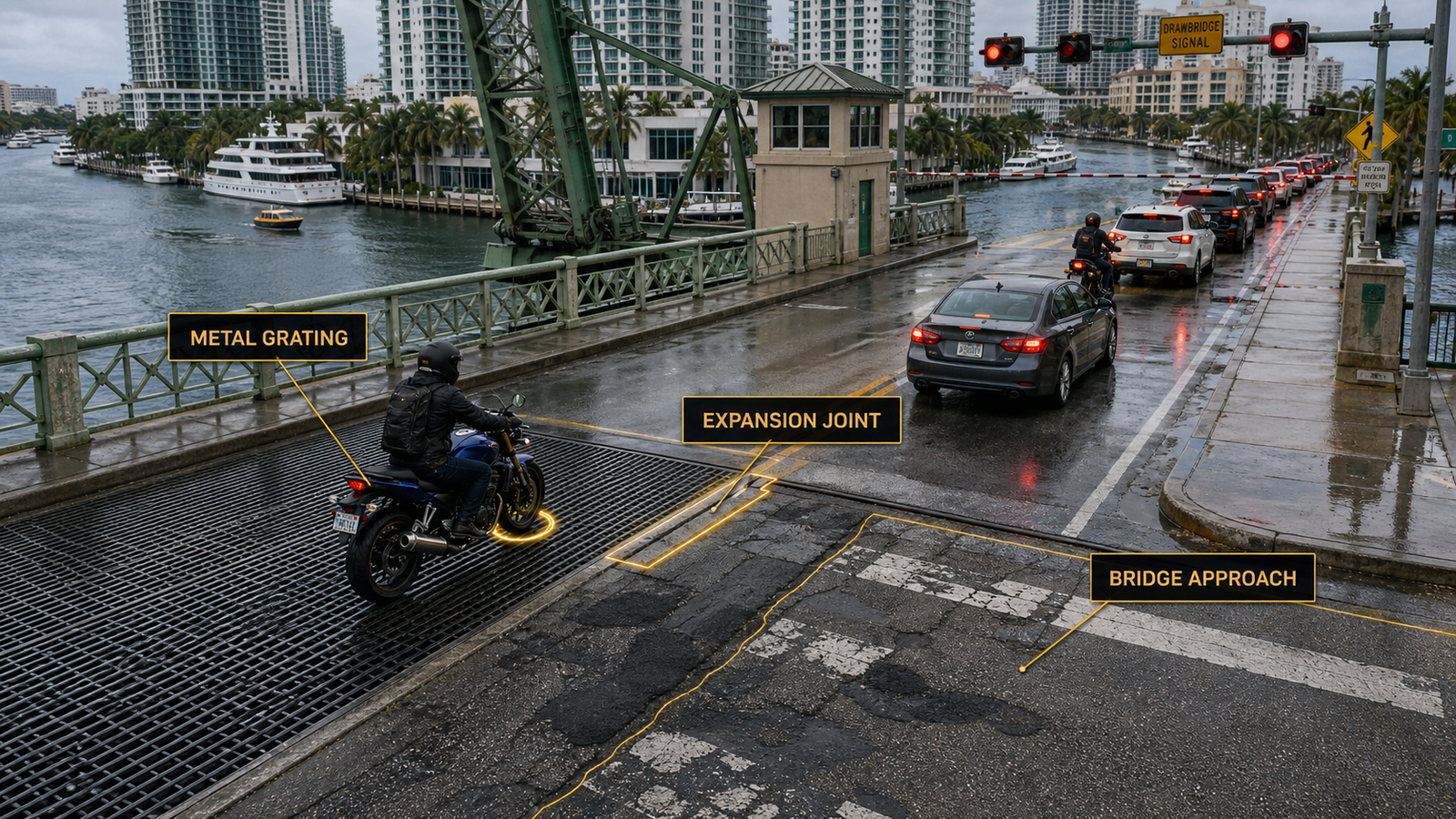
Fort Lauderdale’s identity as the “Venice of America” is built on more than 165 miles of inland waterways and canals that wind through the city’s residential and commercial districts. That geography requires dozens of drawbridges, and those drawbridges create a hazard unique to Fort Lauderdale’s motorcycle crash landscape: metal grating deck surfaces, abrupt pavement transitions at bridge approaches, and periodic bridge-lift interruptions that concentrate stopped traffic on approaches where motorcyclists are disproportionately vulnerable to rear-end impacts. Florida recorded 657 motorcycle fatalities in 2022 according to the Florida Department of Highway Safety and Motor Vehicles, and Fort Lauderdale’s combination of drawbridge infrastructure, a nationally recognized nightlife corridor on Las Olas Boulevard, and a spring break tourism surge that injects tens of thousands of unfamiliar drivers onto beach corridor streets makes it one of the state’s more hazardous environments for motorcyclists.
Mesin & Co. represents Fort Lauderdale motorcycle accident victims with an understanding of the specific liability issues that define this city’s crash landscape. Attorney Eugene Mesin, a Marine Corps veteran and University of Florida Levin College of Law graduate, knows that motorcycle cases require a different investigative approach because the physical evidence is different, the insurance landscape is different, and the bias against riders that defense attorneys exploit must be countered from the first day of investigation. Call (786) 944-6446 for a free consultation.
The Bridge Deck Problem in a Canal City
Metal Grating, Expansion Joints, and Traction Loss
Many of Fort Lauderdale’s older drawbridges use open metal grating for some or all of the bridge deck surface. This design choice reduces the deck’s weight and allows water to drain, but it creates a traction environment fundamentally different from asphalt or concrete pavement. Motorcycle tires, which are narrower and have a smaller contact patch than car tires, are especially sensitive to the orientation of metal grating relative to the direction of travel. Grating that runs parallel to the direction of travel allows a tire to track in the gaps, pulling the front wheel laterally and triggering a loss of directional control that a car driver would not experience at all. The New River drawbridges on Las Olas Boulevard, the Andrews Avenue bridge, and the smaller canal bridges throughout the downtown and Flagler Village areas all present this hazard to riders who are not already familiar with the specific bridge surface conditions.
Expansion joints create a related but distinct hazard at the transitions between the bridge deck and the approach roadway. A raised or misaligned expansion joint can catch a motorcycle front tire, particularly when the rider is braking or when the joint is wet, sending the bike into a sudden wobble or causing the front wheel to deflect from its intended line. Bridge maintenance responsibility in Fort Lauderdale is divided among the city, Broward County, and the Florida Department of Transportation depending on the bridge’s classification and ownership. Identifying the responsible entity is the first step in assessing a potential government liability claim arising from a bridge deck defect.
The Bridge Approach Transition Zone
The bridge approach is often as hazardous as the bridge deck itself. Traffic signal timing at drawbridge approaches creates stop-and-go queues that expose waiting motorcyclists to rear-end crashes from following drivers who are not paying attention to the stopped traffic ahead. When a bridge opens for marine traffic and then closes again, the traffic signal cycle changes and drivers who were not expecting the resumption of movement may accelerate unpredictably through a gap that has just reopened, creating lateral conflict with motorcyclists who were already moving. The abrupt pavement transition between the approach roadway and the bridge deck surface, where elevation changes or texture changes occur without adequate visual warning, also causes tire tracking issues for riders who are not anticipating the surface change.
The approach pavements on several of Fort Lauderdale’s older drawbridges have documented surface conditions that create disproportionate risk for motorcyclists, including ruts from repeated heavy vehicle crossings, patched sections with varying surface heights, and painted surface markings that become slick when wet. These conditions may constitute a government-maintained road defect for which the responsible entity can be held liable if the defect has persisted long enough that the government had or should have had knowledge of it and failed to repair it. Documenting the surface condition at the time of the crash, before any repair is made, is critical to preserving a bridge approach defect claim.
Government Liability for Unsafe Bridge Surfaces
Bringing a claim against the government entity responsible for a Fort Lauderdale drawbridge requires compliance with the pre-suit notice procedures of Florida Statute 768.28. Written notice of the claim must be filed with the appropriate state or local agency within three years of the crash, and the government entity has a statutory period to investigate and respond before a lawsuit can be filed. The notice requirement is strictly construed: failure to file notice in the correct form, to the correct entity, within the applicable time period can permanently bar the claim. An attorney who handles government liability cases in Broward County will know which entity owns and maintains each specific bridge in the Fort Lauderdale network, and will file the appropriate notice immediately upon identifying a potential government defect claim.
Las Olas Boulevard and the Nightlife Corridor Risk
Valet Operations and Mid-Block Pedestrian Crossings
Las Olas Boulevard between Andrews Avenue and SE 11th Avenue is one of the most commercially active nightlife corridors in South Florida, hosting dozens of restaurants, bars, and boutique hotels within a compact urban corridor. The valet operations that serve these businesses create a specific hazard for motorcyclists and other road users. Valet attendants retrieve vehicles from parking structures and return them to the curb lane at unpredictable times, often accelerating across the travel lane to reach a staged vehicle before the customer arrives. Vehicles being delivered to valet pickup points may pause partially in the travel lane while the driver exits. On a street with as much pedestrian activity as Las Olas after 9 p.m., these valet movements create lateral obstructions that motorcyclists in the inside lane may not be able to avoid with the stopping distances available at normal travel speeds.
Mid-block pedestrian crossings on Las Olas, where restaurant patrons cross from one side of the street to the other without using marked intersections, create additional conflict. Florida law prohibits pedestrians from crossing mid-block where traffic signals control adjacent intersections, but the prohibition is rarely enforced, and a motorcyclist who strikes a jaywalking pedestrian on Las Olas may face a comparative fault defense even if the pedestrian was unlawfully in the road. Documenting the crash scene promptly, obtaining surveillance footage from adjacent business security cameras, and identifying witnesses who observed the pedestrian’s movement are all essential to rebutting a comparative fault argument in a Las Olas nightlife corridor crash.
Late-Night DUI Drivers and the Impairment Window
Las Olas Boulevard is a documented concentration zone for impaired driving after midnight. Fort Lauderdale Police Department DUI enforcement data shows a predictable spike in DUI arrests in the Las Olas corridor and the adjacent downtown area on weekend nights and during the spring break season. Motorcyclists are extraordinarily vulnerable to crashes caused by impaired drivers because the evasive maneuvers available to a car driver, lane changes, steering around an erratic vehicle, are more limited on a motorcycle and more likely to cause the rider to lose control even when the avoidance attempt succeeds. When a DUI driver causes a crash that injures a motorcyclist on Las Olas, the criminal prosecution and the civil personal injury claim proceed on parallel tracks, and the DUI arrest record, field sobriety test results, and blood alcohol content measured after the arrest are all admissible in the civil case.
The Crash Pattern East of Andrews Avenue
East of Andrews Avenue, Las Olas transitions from the most heavily trafficked commercial section to a quieter residential corridor approaching the Intracoastal Waterway. But this stretch presents its own hazards for motorcyclists, including the Las Olas bridge over the Intracoastal, which has a metal grating deck surface that combines with the nighttime lighting conditions along that corridor to create visibility and traction challenges. Drivers leaving the restaurant district headed east may be impaired or distracted, and the relative quiet of Las Olas east of the commercial zone can create a false sense that the road ahead is clear when in fact a motorcyclist on the bridge deck has reduced traction and limited ability to maneuver. Crashes on this stretch of Las Olas between the commercial zone and the Intracoastal bridge are documented in Broward County crash records.
Spring Break and the Tourist Driver Problem
Rental Cars, Unfamiliar Roads, and Distracted Navigation
Fort Lauderdale’s spring break season, which runs from mid-February through mid-April, brings tens of thousands of visitors who may have never driven in South Florida and who navigate using smartphone GPS applications while driving unfamiliar rental vehicles through unfamiliar streets at night. The specific hazards this creates for motorcyclists are numerous. A driver who is watching their phone map while crossing the Las Olas/A1A intersection, who makes a turn without checking for motorcycle traffic coming from the direction the phone did not warn them about, or who unexpectedly stops in a travel lane because the navigation application gave an incorrect direction is a crash risk that does not exist with the same frequency outside tourist season. Broward County crash reports document a consistent spike in multi-vehicle crashes during spring break season, with tourist-originating vehicles prominently represented.
The Peak Season Crash Surge on A1A and Sunrise Blvd
Fort Lauderdale Beach along A1A and the Sunrise Boulevard connector from US-1 to A1A carry dramatically higher volumes during spring break than at any other time of year. The concentration of tourist pedestrians crossing A1A between their hotels and the beach creates an environment where drivers are frequently braking for pedestrians in marked and unmarked crossings, leading to rear-end chains that motorcyclists in the flow of traffic cannot predict or avoid. Sunrise Boulevard in both directions experiences a similar dynamic, with vehicles making U-turns to access parking, pedestrians crossing mid-block, and bicycles occupying the rightmost lanes in ways that push motorcyclists into traffic positions where they are more vulnerable to being struck from behind or from the side.
Out-of-State Insurance and Coverage Complications
When a spring break visitor from Georgia, Ohio, or any other state causes a crash that injures a Fort Lauderdale motorcyclist, the at-fault driver’s insurance policy is an out-of-state policy that may provide different coverage than Florida policies. Florida law requires at-fault drivers to carry bodily injury liability coverage, but Florida does not mandate BI coverage for its own residents, meaning the at-fault driver’s home state coverage requirements apply. An attorney handling a crash caused by an out-of-state tourist must identify the applicable coverage, determine whether the coverage limits are adequate for the injuries sustained, and evaluate whether the rental car company’s insurance policy provides supplemental coverage under the rental agreement terms and applicable state law. The National Highway Traffic Safety Administration publishes data on rental vehicle crash patterns that can support the liability narrative in these cases.

Florida’s Insurance Landscape for Motorcycle Riders
PIP Does Not Cover Motorcycles
One of the most consequential distinctions in Florida motorcycle law is the exclusion of motorcycles from the state’s Personal Injury Protection system. Every registered passenger vehicle in Florida is required to carry $10,000 in PIP coverage that pays for the driver’s and passengers’ medical expenses and lost wages without regard to fault. Motorcycles are statutorily excluded from the PIP requirement, which means that a Fort Lauderdale rider injured in a crash caused by another driver has no automatic first-dollar medical coverage from their own motorcycle policy. The injured rider must either rely on their health insurance, access the at-fault driver’s bodily injury liability coverage through the civil claims process, or use their own uninsured/underinsured motorist coverage if they purchased it. This makes the tort recovery pathway more important for injured motorcyclists than for any other category of motor vehicle crash victim.
Uninsured Motorist Coverage and Its Critical Role
Uninsured and underinsured motorist coverage, which a motorcyclist can purchase as an optional addition to their Florida motorcycle policy, provides coverage when the at-fault driver has no insurance, insufficient insurance, or is a hit-and-run driver who cannot be identified. In Fort Lauderdale, where the spring break tourist driver volume includes a significant proportion of underinsured and uninsured out-of-state drivers, and where the Las Olas nightlife corridor produces hit-and-run crashes from drivers who flee the scene, UM coverage is not an optional luxury for motorcyclists: it is the safety net that determines whether an injured rider can access any recovery at all when the at-fault driver is uninsured. An attorney who reviews the motorcyclist’s policy at the outset of representation will identify all available coverage sources and maximize the total recovery available across all of them.
Helmet Law, Comparative Fault, and the Defense Argument
Florida law permits motorcyclists over the age of 21 to ride without a helmet if they carry at least $10,000 in medical benefits coverage. A rider who was not wearing a helmet at the time of a crash can expect the defense to argue that the head and brain injuries the rider sustained would have been less severe, or would not have occurred at all, with a helmet in place. Under Florida’s modified comparative negligence framework, if the jury finds that riding without a helmet contributed to the severity of the injuries, it may reduce the damages award by the percentage of fault attributed to that decision. An attorney representing an unhelmeted rider must be prepared to challenge the defense’s causation argument with expert medical testimony establishing whether and to what degree helmet use would have altered the injury outcome given the specific mechanics of the crash.
Mesin & Co. handles Fort Lauderdale motorcycle accident claims with an understanding of how rider bias and the helmet law defense must be countered from the earliest stages of investigation. If a family member lost their life in a Fort Lauderdale motorcycle crash, the Fort Lauderdale wrongful death lawyer page addresses the distinct legal framework that governs those claims. The Fort Lauderdale pedestrian accident lawyer page addresses another category of vulnerable road user claim that frequently arises in the same Fort Lauderdale crash environments. Call (786) 944-6446 for a free consultation. There is no fee unless the firm recovers for you.

Russian-Speaking Services
Eugene Mesin is fluent in Russian and welcomes inquiries from Russian-speaking clients throughout Florida