
Truck accidents in Coral Gables and the surrounding Miami-Dade County corridors can result in some of the most devastating collisions on South Florida roads. A fully loaded tractor-trailer may weigh as much as 80,000 pounds, roughly 20 times the weight of an average passenger vehicle. The substantial difference in size and weight means that even a moderate-speed collision can cause catastrophic injuries. Truck accident claims are also frequently more complex than ordinary car accident cases because federal trucking regulations, multiple insurance policies, commercial operations, and potential corporate liability may all come into play.
Mesin & Co. represents individuals injured in commercial truck accidents throughout Coral Gables and Miami-Dade County. We investigate collisions involving tractor-trailers, delivery trucks, box trucks, and other commercial vehicles, working to identify responsible parties and pursue the compensation available under Florida law. Our firm handles truck accident claims throughout Miami and surrounding South Florida communities on a contingency fee basis, meaning you pay no attorney’s fees unless we recover compensation for you. Call (786) 944-6446 for a free consultation.
Why Truck Accidents Near Coral Gables Are Especially Complex
Coral Gables is located near several major commercial transportation corridors serving Miami-Dade County. Miami International Airport (MIA), a major international air cargo hub, generates substantial freight activity throughout the surrounding region. Commercial vehicles transport goods along SR-826 (Palmetto Expressway), SR-836 (Dolphin Expressway), US-1, and other major routes connecting industrial facilities, warehouses, businesses, and residential communities. These same roads carry commuters alongside tractor-trailers, refrigerated trucks, box trucks, and other commercial vehicles, creating situations where differences in vehicle size, stopping distance, and maneuverability can contribute to serious accidents.
Within Coral Gables itself, delivery trucks serving the Miracle Mile retail district, Merrick Park, and Bird Road’s restaurant and business corridor must navigate streets shared with passenger vehicles, pedestrians, and cyclists. Large commercial vehicles require additional room to turn and may have substantial blind spots that make nearby vehicles difficult to detect. Double-parking, improper lane changes, unsafe turns, and failures to yield can create dangerous conditions, particularly near intersections, parking entrances, and commercial loading areas. When a collision occurs, determining liability may require examining the driver’s conduct, the truck’s mechanical condition, applicable safety requirements, and the responsibilities of the company operating the vehicle.
Federal Trucking Regulations: What They Require and Why Violations Matter
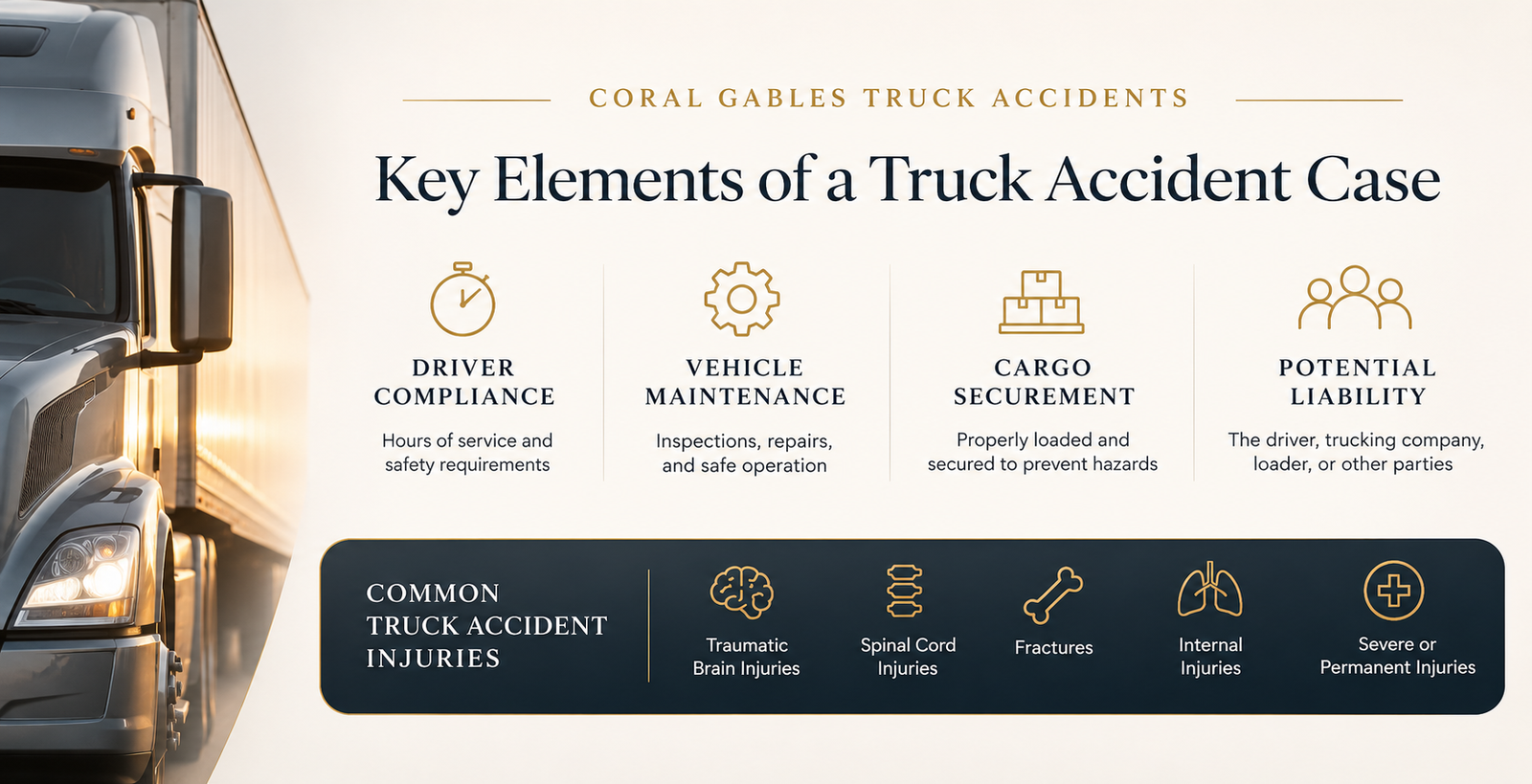
Many commercial trucking operations are regulated by the Federal Motor Carrier Safety Administration (FMCSA), which establishes safety standards governing driver qualifications, operating hours, vehicle maintenance, cargo securement, and other aspects of commercial transportation. Florida also regulates commercial motor vehicles through state law. The particular requirements depend on the vehicle, type of operation, and applicable exemptions. When a truck driver or motor carrier violates a safety regulation and that violation contributes to a collision, it may provide important evidence supporting a negligence claim.
Hours of Service Rules
FMCSA hours-of-service regulations limit the amount of time certain commercial drivers may operate their vehicles before obtaining required rest. For most covered property-carrying commercial drivers, federal rules generally permit up to 11 hours of driving after 10 consecutive hours off duty, subject to a 14-hour driving window and other applicable restrictions. These requirements are designed to address fatigue-related safety risks, although exceptions apply to certain operations. The FMCSA Hours of Service Regulations explain the applicable driving limits, rest requirements, and exceptions.
Many covered drivers must maintain records of duty status using Electronic Logging Devices (ELDs), although certain short-haul operations and other qualifying drivers are exempt from the ELD requirement. When fatigue or excessive driving hours may have contributed to an accident, driver logs, dispatch records, trip information, and electronic data can become important evidence. We investigate whether the driver complied with applicable hours-of-service requirements and whether any violation contributed to the collision.
Vehicle Maintenance and Pre-Trip Inspection Requirements
Federal regulations require covered motor carriers to systematically inspect, repair, and maintain commercial vehicles, while drivers have specific responsibilities concerning vehicle condition and safety inspections. Brake failures, defective tires, steering problems, and lighting deficiencies can create serious hazards when vehicles are not properly maintained. Under 49 CFR Part 396, carriers must comply with applicable inspection, repair, and maintenance requirements, including maintaining records and addressing defects under the circumstances specified by the regulations.
When a mechanical failure contributes to a truck accident along SR-836, SR-826, US-1, or another Miami-Dade roadway, an investigation may involve maintenance records, inspection reports, repair histories, and the vehicle’s condition before the collision. Depending on the evidence, potential liability may extend beyond the driver to a motor carrier, maintenance contractor, or another party whose negligence contributed to the mechanical failure.
Cargo Securement Standards
Improperly secured cargo can create dangerous conditions when loads shift during transport, equipment becomes unstable, or debris falls onto the roadway. The FMCSA establishes cargo securement requirements under 49 CFR Part 393, including standards for securing different types of commercial loads. These requirements are particularly important for trucks carrying heavy equipment, construction materials, machinery, and other cargo that may shift or become dislodged during transportation.
If unsecured cargo causes a driver to lose control or strikes another vehicle, responsibility may involve the truck driver, motor carrier, cargo loading company, or another party involved in preparing or transporting the shipment. Along commercial routes such as SR-836 and Bird Road, examining cargo placement, securement equipment, loading procedures, and relevant shipping records may help establish whether improper cargo handling contributed to the collision.
Multiple Defendants in a Coral Gables Truck Accident Case
One of the most important differences between a truck accident claim and a conventional automobile collision is the possibility that multiple parties contributed to the crash. Depending on the circumstances, potentially responsible parties may include the truck driver for negligent operation; the motor carrier for negligent hiring, supervision, training, or maintenance; a cargo loading company for improperly secured freight; a maintenance contractor for defective repairs; or a manufacturer if a defective vehicle component caused or contributed to the accident. A freight broker or trailer owner may also face potential liability when the facts establish a recognized legal basis for responsibility.
Identifying the appropriate defendants requires examining the relationships between the driver, motor carrier, vehicle owner, and other companies involved in the transportation operation. Relevant evidence may include available event data recorder information, electronic logging records, driver qualification files, maintenance histories, dispatch records, bills of lading, and applicable insurance policies. Not every commercial truck records the same electronic information, making it important to determine what evidence exists and request its preservation promptly. At Mesin & Co., we investigate these issues and pursue available evidence before important records are lost or destroyed. Our Coral Gables car accident lawyers page discusses how these cases differ from collisions involving privately operated passenger vehicles.
Common Injuries in Coral Gables Truck Accidents
Truck accidents can cause particularly severe injuries because of the substantial difference in size and weight between commercial trucks and passenger vehicles. Common injuries include traumatic brain injuries, cervical and lumbar spine injuries, herniated discs, spinal cord damage, fractures, and partial or complete paralysis. High-impact collisions may also cause chest trauma, broken ribs, internal organ injuries, crush injuries, severe burns, or injuries requiring extensive surgery and rehabilitation. In the most serious cases, victims may experience permanent physical limitations or require long-term medical assistance.
The financial consequences of these injuries can be substantial. Medical expenses, future treatment, rehabilitation, lost wages, diminished earning capacity, and pain and suffering may all form part of a truck accident claim when supported by the evidence and permitted under applicable law. Some injuries require ongoing care or prevent victims from returning to their previous employment. We evaluate both the immediate and long-term consequences of serious injuries to identify the full extent of the compensation potentially available. When a commercial truck collision results in a fatality, eligible family members may also have claims under Florida’s Wrongful Death Act. Learn more about our Coral Gables wrongful death representation.
Steps to Take After a Truck Accident in Coral Gables
- Call 911 immediately. Report the collision and request emergency assistance when necessary. The Coral Gables Police Department, Florida Highway Patrol, or another agency with jurisdiction may investigate the accident. Obtain the crash report number and responding agency’s information when available.
- Photograph everything you safely can. Document the vehicles, road conditions, visible damage, and surrounding traffic controls. If possible, photograph the commercial truck’s USDOT number, license plate, trailer identification, and cargo. This information may help identify the motor carrier and relevant records.
- Seek prompt medical attention. Serious injuries, including internal trauma and traumatic brain injuries, may not be immediately apparent. Prompt medical evaluation protects your health and helps document the injuries. If you qualify for Florida PIP benefits, Florida Statute § 627.736 generally requires initial services and care within 14 days for covered medical benefits.
- Be cautious when communicating with insurers. Trucking companies and their insurers may begin investigating collisions quickly. Avoid speculation about fault or the extent of your injuries, and do not sign a release or accept a final settlement before understanding your legal rights and the available coverage.
- Contact Mesin & Co. Commercial truck accident evidence may include electronic vehicle data, driver logs, maintenance records, and other materials requiring prompt preservation. Our firm can investigate the collision, identify potentially responsible parties, and pursue the available evidence.
Frequently Asked Questions: Coral Gables Truck Accident Lawyer
What is the black box in a commercial truck and why does it matter?
Some commercial trucks contain electronic control modules or event data recording systems that may preserve information concerning vehicle speed, braking, engine operation, and other conditions surrounding a collision. The type and amount of information available depend on the truck’s equipment and system configuration. This evidence may help investigators determine whether the driver attempted to brake, whether the vehicle was traveling at an unsafe speed, or whether mechanical issues contributed to the crash. However, electronic data alone does not necessarily establish fault or driver fatigue. When relevant information may exist, we seek its preservation and evaluate it alongside other physical and documentary evidence.
Can I sue the trucking company, not just the driver?
Potentially, yes. A trucking company may be legally responsible for a driver’s negligence under applicable employment and agency principles. The company may also face direct liability where negligent hiring, supervision, training, maintenance, or another recognized basis of negligence contributed to the collision. Determining responsibility requires examining the driver’s relationship with the company, the circumstances of the accident, and the applicable legal standards. Commercial motor carriers may also maintain substantial liability insurance, making it important to identify the responsible entities and all potentially available coverage.
A truck from a delivery company (like Amazon, FedEx, or UPS) hit me near Merrick Park. Who is liable?
Liability depends on the driver, the company operating the vehicle, and the circumstances of the collision. Some delivery companies use employees, while others rely on independent contractors or separate delivery service businesses. For example, Amazon uses delivery service partners for certain deliveries, which can create additional questions concerning employment relationships, operational control, and responsibility for the driver’s conduct. The presence of a company’s name or logo on a truck does not automatically establish that company’s direct liability. We investigate the driver’s employment or contractual relationship, vehicle ownership, insurance coverage, and any evidence supporting a claim against the driver, carrier, or another responsible entity.
What is the statute of limitations for a truck accident case in Florida?
Under Florida Statute § 95.11, negligence actions governed by Florida’s current general limitations provision generally must be filed within two years of the date the claim accrues, ordinarily the accident date in an injury case. Different deadlines or exceptions may apply depending on when the claim arose, the parties involved, and other circumstances. Claims involving governmental entities may also require compliance with separate notice and procedural requirements. Because truck accident investigations may involve extensive records, multiple defendants, and complex liability questions, it is important to investigate potential claims promptly rather than approaching the filing deadline without sufficient evidence.
How much insurance does a commercial truck carry?
Commercial truck insurance requirements depend on the type of carrier, vehicle, cargo, and transportation operation. Under 49 CFR Part 387, certain interstate for-hire motor carriers transporting nonhazardous property in vehicles with a gross vehicle weight rating of at least 10,001 pounds generally must maintain at least $750,000 in public liability coverage. Higher federal minimums, including $1 million or $5 million, apply to certain transportation operations involving specified hazardous materials. However, these requirements do not apply uniformly to every commercial truck or local delivery vehicle. Some carriers maintain insurance above the statutory minimums, and additional policies may be available depending on the circumstances. We examine the applicable carrier classification, insurance requirements, and available policies to determine the coverage potentially available for a claim.
Truck Accident Attorneys Serving All of South Florida
Mesin & Co. represents truck accident victims throughout Miami-Dade, Broward, and Palm Beach Counties. In addition to Coral Gables, our firm serves individuals injured in commercial truck collisions in Aventura, Fort Lauderdale, Hollywood, North Miami, Boca Raton, and surrounding South Florida communities.
- Aventura Truck Accident Lawyer
- Fort Lauderdale Truck Accident Lawyer
- Hollywood Truck Accident Lawyer
- North Miami Truck Accident Lawyer
- Boca Raton Truck Accident Lawyer
Explore our South Florida service locations or learn more about our Coral Gables personal injury services. If you or a loved one has been injured in a commercial truck accident, call Mesin & Co. at (786) 944-6446 or contact our firm for a free consultation. We handle truck accident cases on a contingency fee basis, meaning you pay no attorney’s fees unless we obtain a recovery.

Russian-Speaking Services
Eugene Mesin is fluent in Russian and welcomes inquiries from Russian-speaking clients throughout Florida