Hollywood, Florida borders one of the most commercially active stretches of coastline in the United States. Port Everglades, located just north of Hollywood’s city limits in Fort Lauderdale, is among the ten largest seaports in the nation by cargo tonnage and the second-largest container port in Florida. Fort Lauderdale-Hollywood International Airport (FLL), which sits at Hollywood’s northern border, processes millions of passengers annually and generates a continuous flow of cargo aircraft operations. The trucks serving both facilities, hauling marine containers northbound on I-95 and moving airport freight through the surface streets of Hollywood and Dania Beach, are a constant presence on Hollywood’s roads. When one of these vehicles is involved in a crash, the consequences are severe and the legal questions are complex.
The Federal Motor Carrier Safety Administration reported that large trucks were involved in 168,320 injury crashes nationally in 2022. Florida’s role in that total is outsized given the state’s freight activity. Hollywood’s position between Port Everglades and the Broward-Miami-Dade county line makes it a high-density zone for commercial vehicle traffic in both directions. Mesin & Co. handles truck accident cases in Hollywood and throughout Broward County with a complete understanding of the federal regulations governing commercial carriers and the multi-defendant liability structure that port and airport corridor crashes produce. Call (786) 944-6446 for a free consultation.
Port Everglades, FLL, and Hollywood’s Commercial Vehicle Overload
Marine Container Traffic and the I-95 Hollywood Corridor
Port Everglades handles approximately 25 million tons of cargo annually, including petroleum products, containerized goods, and cruise ship operations. The trucks transporting marine containers from the port to distribution centers throughout South Florida primarily use I-95 southbound, entering Hollywood at the SR-820 and Hollywood Boulevard interchanges. These vehicles are frequently operating at or near the federal gross vehicle weight limit of 80,000 pounds, and many port loads involve heavy equipment, steel, or dense consumer goods that push the physics of braking and maneuvering to their limits. The I-95 corridor through Hollywood between the SR-820 interchange and the Hallandale Beach Boulevard exit is a primary zone for port-related commercial vehicle crashes.
FLL Airport Cargo Operations and Surface Street Traffic
Fort Lauderdale-Hollywood International Airport processes significant air cargo volume in addition to its passenger operations. Ground support vehicles, cargo transport trucks, and fuel tankers operate on the airport perimeter roads and transition onto US-1, Stirling Road, and Griffin Road to reach their destinations. These vehicles move on tight operational schedules connected to flight arrivals and departures, creating time pressure that increases the risk of rushed merges, inadequate checks at intersections, and decisions to push yellow lights on arterial roads near the airport perimeter. Crashes involving airport-related commercial vehicles can involve the airline, the cargo handler, the ground services company, and the trucking contractor as separate potentially liable parties.
I-95 as Hollywood’s Primary Commercial Freight Spine
Even beyond port and airport traffic, I-95 through Hollywood carries commercial truck traffic connecting the Miami-Dade logistics network to Broward County distribution centers and onward to Palm Beach and the Treasure Coast. Truck drivers on I-95 through Hollywood are frequently operating under hours-of-service pressure after long hauls from Miami or beyond, and the I-95 corridor through Hollywood has specific geometric challenges including a narrowing of travel lanes near the Golden Arrow interchange that creates merge conflicts for wide commercial vehicles. Mesin & Co. investigates every contributing factor in Hollywood truck accident cases, including route selection decisions that place fatigued drivers on suboptimal road segments.
The Federal Regulatory Framework and Where Carriers Fail
Hours of Service Violations in Port-to-Warehouse Delivery Operations
The delivery pressure in port-corridor trucking operations is significant. Marine container pickup windows are narrow, port congestion causes delays, and delivery appointment times at warehouses are set before the driver leaves the port. This scheduling structure creates systematic pressure to compress rest periods and extend driving time beyond what FMCSA Hours of Service rules permit. An 11-hour driving limit and mandatory 10-hour rest periods exist precisely because fatigued driving causes crashes. Carriers that book delivery appointments without adequate time for legal rest periods are not just operationally aggressive. They are institutionally negligent, and that institutional negligence is documented in the Electronic Logging Device data that Mesin & Co. subpoenas in every Hollywood truck accident case. For a full explanation of the FMCSA regulatory framework, see the firm’s Hollywood car accident lawyer page alongside the specific federal standards that apply to commercial carriers.
Marine Container Cargo Securement and Load Distribution
Marine containers present specific cargo securement challenges distinct from over-the-road freight. Contents shift during the ocean voyage, and a container that was properly secured at origin may have experienced significant internal movement by the time it arrives at Port Everglades. Improperly distributed weight affects vehicle stability and braking, and cargo that has shifted to one side can cause a rollover during lane changes or emergency maneuvers. Federal regulations under 49 CFR Part 393 require verification of cargo condition before transportation, but port operators under time pressure do not always conduct adequate inspections. When shifted or improperly secured cargo contributes to a Hollywood crash, the cargo loader, the shipping company, and the port agent may all share liability with the carrier.
FMCSA Safety Ratings and the Pre-Crash Warning Signs
The FMCSA’s Safety Measurement System assigns Behavior Analysis and Safety Improvement Category (BASIC) scores to commercial carriers based on inspection violations, crash history, and hours of service compliance. Carriers with elevated BASIC scores in categories like unsafe driving, hours of service, and vehicle maintenance present a documented pattern of safety noncompliance. When a carrier with elevated scores is involved in a Hollywood truck crash, those scores are evidence in the civil case: they establish that the company had prior warning of its safety problems and failed to correct them. Mesin & Co. pulls FMCSA records on every carrier involved in a Hollywood truck accident case as a standard step in the initial investigation.

Who Bears Liability in a Hollywood Port-Corridor Truck Crash
The Motor Carrier and Its Insurance Requirements
FMCSA requires interstate motor carriers to maintain minimum liability insurance of $750,000 for general freight and $5 million for hazardous materials. Most commercial carriers operating in the Port Everglades corridor carry policies well above these minimums given the cargo values involved. The carrier is the primary liability target in most truck crash cases, both for the driver’s negligence under respondeat superior and for the company’s independent institutional negligence. Insurance carriers for large commercial trucking operations retain specialized defense firms immediately after any serious crash, which is why Mesin & Co. begins its own investigation and evidence preservation as quickly as possible after being retained.
The Chassis Provider, Freight Forwarder, and Equipment Lessor
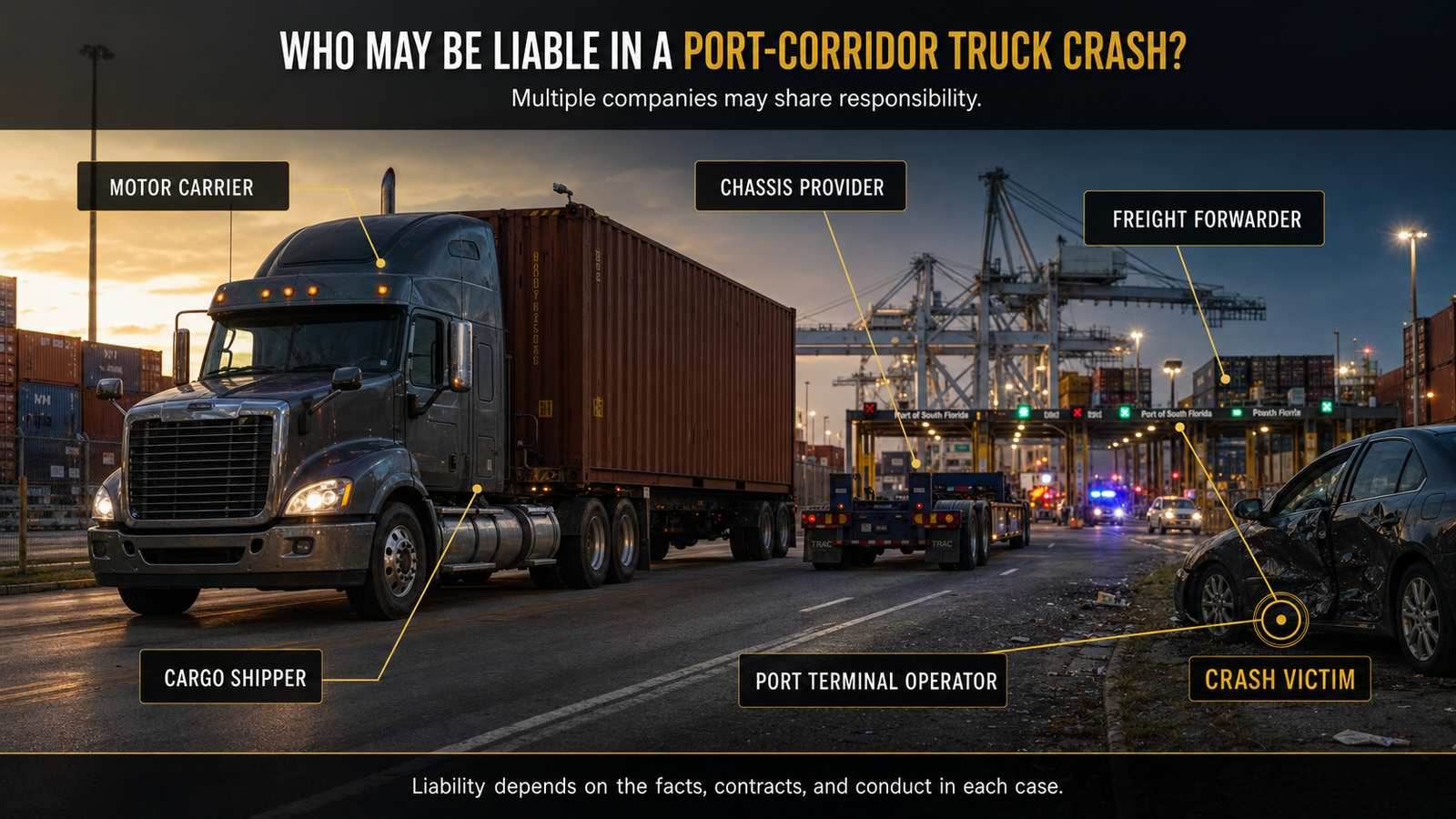
Marine container transport involves a chain of separate entities that is longer than most clients expect. The motor carrier drives the truck. The chassis provider owns the trailer on which the container is mounted. The ocean carrier or freight forwarder controls the container. The terminal operator at Port Everglades manages the handoff. Any of these parties can be liable if the component they controlled was defective or improperly maintained. A chassis with defective brakes, a container mounted on a chassis with a worn locking mechanism, or a container released from the terminal without adequate documentation of its cargo condition can each create liability for the entity responsible for that component. Identifying all of these parties early and preserving evidence across the entire supply chain is a task that requires an attorney with commercial trucking experience.
Direct Claims Against the Shipper or Consignee
When a cargo shipper or receiver set unrealistic delivery schedules that forced the carrier to violate hours of service rules, or when a shipper improperly loaded or declared the weight of the cargo, those parties can face direct negligence claims. Freight contracts and bill of lading records document the weight representations and delivery terms that governed the shipment. These records are discoverable in litigation and can establish that the shipper’s operational demands created the conditions that led to the crash. Mesin & Co. demands these records as part of its standard truck accident investigation in Hollywood and Broward County cases.
Injuries, Treatment, and the Long Road to Recovery
Truck accident victims in Hollywood are treated at Memorial Regional Hospital, Broward County’s Level I Trauma Center, which handles the most serious motor vehicle injuries in the county. The injury profile in commercial vehicle crashes is categorically different from standard car accidents: polytrauma, multiple organ injury, severe orthopedic fractures, and traumatic brain injury are common outcomes when a vehicle weighing up to 80,000 pounds strikes a passenger car. The lifetime economic cost of injuries in serious truck accident cases routinely reaches into the millions when future medical care, rehabilitation, lost earning capacity, and home modification costs are properly calculated. Mesin & Co. works with medical, economic, and life care planning experts to build a complete damages picture in every Hollywood truck accident case it handles, consistent with the firm’s approach across all Hollywood personal injury matters.
Eugene Mesin handles truck accident cases in Hollywood, Dania Beach, Hallandale Beach, Miramar, and throughout Broward County on a contingency fee basis with no upfront costs. Call (786) 944-6446 or visit mesinco.com to schedule your free consultation.

Russian-Speaking Services
Eugene Mesin is fluent in Russian and welcomes inquiries from Russian-speaking clients throughout Florida