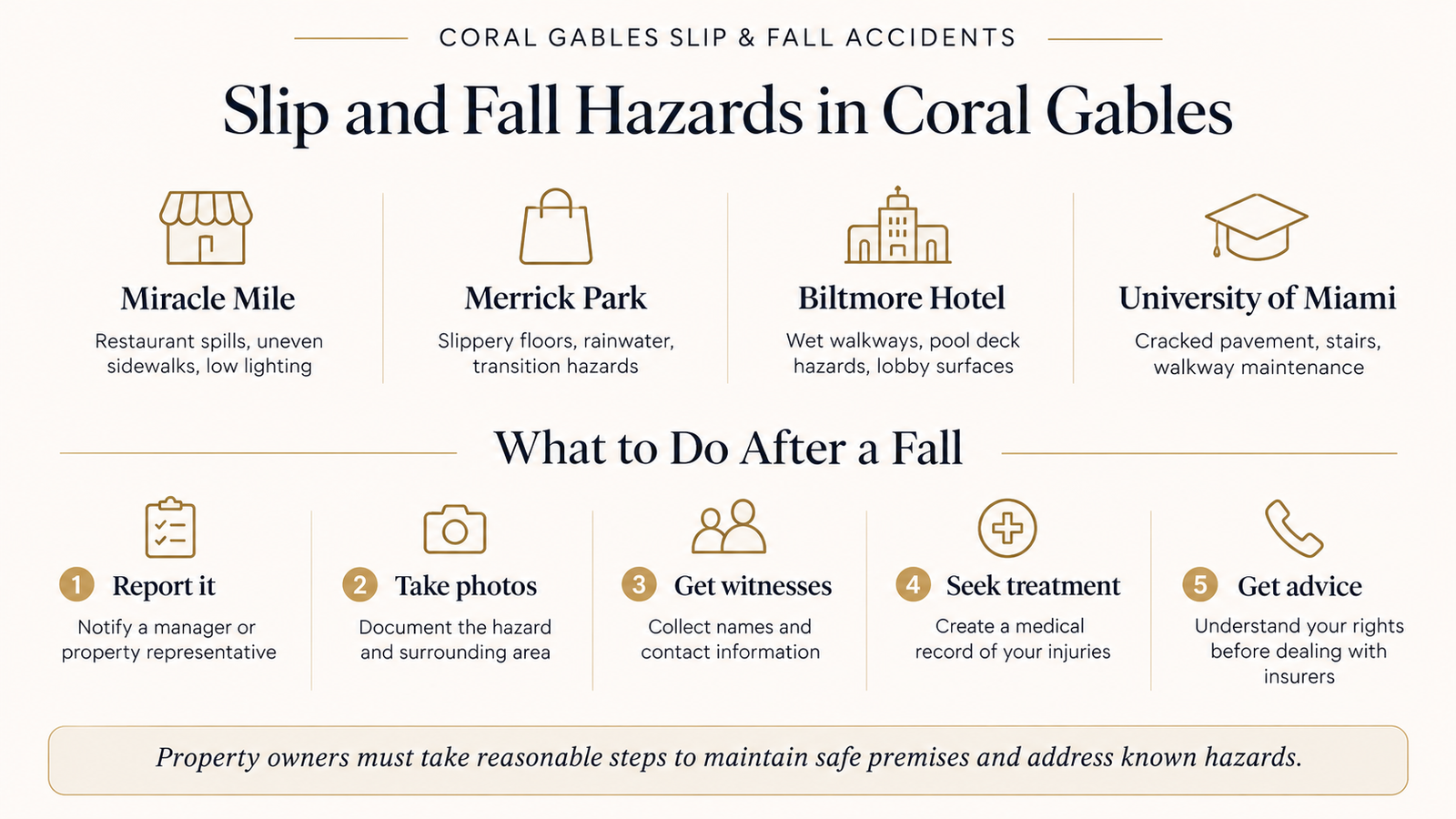
Coral Gables is home to some of the most recognizable retail, dining, and hospitality properties in Miami-Dade County, where unsafe conditions can lead to serious slip and fall accidents. Miracle Mile concentrates restaurants and retail establishments within a busy commercial corridor. The Shops at Merrick Park attracts visitors to its upscale stores and outdoor shopping areas. The Biltmore Hotel hosts guests attending events, conferences, and other functions throughout the year, while the University of Miami campus brings thousands of students, employees, and visitors to its buildings and walkways. Each of these properties presents different premises liability concerns when dangerous conditions are not properly addressed.
When property owners or operators negligently maintain their premises, visitors can suffer serious injuries. Mesin & Co. represents slip and fall victims throughout Coral Gables and Miami-Dade County, investigating hazardous conditions, identifying responsible parties, and pursuing compensation under Florida law. Our firm handles slip and fall accident claims throughout Miami and surrounding South Florida communities on a contingency fee basis, meaning you pay no attorney’s fees unless we recover compensation for you. Call (786) 944-6446 for a free consultation.
High-Risk Properties in Coral Gables
The Miracle Mile: Restaurant and Retail Corridor
Miracle Mile (SW 22nd Street), located in the heart of Coral Gables’ commercial district, is lined with restaurants, shops, and other businesses that attract substantial pedestrian activity. Wet floors near restaurant entrances and restrooms, uneven sidewalk panels affected by tree roots, inadequate lighting in outdoor dining areas, and slippery surfaces on patios after rainfall can create dangerous conditions for visitors. These hazards are particularly concerning when spills are not promptly addressed, walking surfaces are poorly maintained, or customers are not adequately warned of dangers that may not be readily apparent. Responsibility may depend on whether the accident occurred inside a business, on a privately maintained walkway, or along a public sidewalk.
Commercial property owners and operators in Coral Gables generally owe customers a duty to exercise reasonable care in maintaining their premises. When a customer slips on a spilled liquid or another transitory foreign substance, Florida law imposes additional requirements concerning the business’s knowledge of the condition. Establishing liability requires examining the nature of the hazard, how it developed, and whether the responsible party knew or reasonably should have known about it.
Merrick Park: Upscale Mall Liability
Merrick Park is an open-air luxury shopping center along Ponce de Leon Boulevard near SW 32nd Street. Polished stone and tile flooring, common in upscale retail environments, can become slippery when exposed to tracked-in rainwater, spills, or cleaning products. Inadequate wet-floor warnings, poorly maintained walkway transitions between indoor and outdoor sections, damaged flooring, and improperly maintained stairs or escalators can also contribute to serious falls. These conditions do not automatically establish negligence, but they may support a premises liability claim when a property owner or operator fails to exercise reasonable care.
Determining responsibility at a shopping center often requires identifying who controlled or maintained the area where the fall occurred. Individual retailers may be responsible for conditions inside their stores, while property owners or management companies may maintain common areas. Surveillance footage, inspection records, cleaning logs, and witness statements can help establish whether a dangerous condition existed and whether the responsible party had sufficient notice or otherwise breached an applicable duty of care.
The Biltmore Hotel and Hospitality Properties
The Biltmore Hotel and other hospitality properties throughout Coral Gables welcome guests attending weddings, conferences, dining events, and recreational activities. Pool decks, spa areas, lobby floors, banquet facilities, and outdoor walkways all present potential slip and fall hazards. Wet surfaces, inadequate lighting, improperly maintained flooring, and insufficient warnings may contribute to injuries when these conditions are not reasonably addressed. Hotels generally owe lawful guests a duty of reasonable care, which may include appropriate inspections, maintenance, and warnings depending on the circumstances.
When a hotel fails to exercise reasonable care and a guest is injured as a result, the property owner, operator, or another responsible entity may face liability. However, the existence of a wet surface or other hazard does not automatically establish negligence. The investigation must consider the condition, its duration, the property’s maintenance practices, and the circumstances surrounding the fall. The same principles apply to other Coral Gables personal injury claims involving unsafe commercial premises.
University of Miami Campus
The University of Miami campus occupies a substantial area of Coral Gables and includes academic buildings, residential facilities, sidewalks, parking areas, and staircases used by students, faculty, staff, and visitors. Cracked sidewalks, uneven pavement near construction areas, poorly maintained staircases, and inadequate exterior lighting may create dangerous conditions. Whether a premises liability claim exists depends on who controlled the location, the nature of the hazard, and whether an applicable duty of care was breached.
The University of Miami is a private university, meaning injuries occurring on university-controlled property are not automatically subject to the sovereign immunity provisions governing Florida public entities. However, accidents occurring on adjacent public sidewalks or roadways may involve the City of Coral Gables, Miami-Dade County, or another responsible entity. Identifying the property owner and the party responsible for maintenance is essential to determining liability.
What You Must Prove in a Florida Slip and Fall Case
Florida premises liability law imposes specific requirements for certain slip and fall claims. Under Florida Statute § 768.0755, a person who slips on a transitory foreign substance in a business establishment must prove that the establishment had actual or constructive knowledge of the dangerous condition and should have taken action to remedy it. Constructive knowledge may be established through circumstantial evidence showing that the condition existed long enough that it should have been discovered through ordinary care, or that the condition occurred with sufficient regularity to make it foreseeable.
Evidence supporting a claim may include maintenance logs, inspection records, prior incident reports, surveillance footage, witness statements, and photographs of the hazardous condition. For example, evidence showing that a spill remained on the floor for an extended period may support an argument that the business should have discovered it. However, the presence of a spill alone does not necessarily establish constructive notice. Gathering evidence promptly is important because businesses may clean the area shortly after an incident and surveillance recordings may be overwritten during normal retention cycles.
Florida’s transitory foreign substance statute does not govern every premises liability claim. Falls involving broken stairs, defective flooring, uneven pavement, or other structural hazards may require a different analysis under general negligence principles. Property owners and operators generally must exercise reasonable care toward lawful visitors, but liability depends on the applicable duty, the nature of the dangerous condition, notice where required, causation, and the evidence supporting the claim.
Under Florida Statute § 95.11, negligence actions governed by Florida’s current general limitations provision generally must be filed within two years. Different deadlines may apply depending on when the claim arose and the circumstances involved.
Steps to Take After a Slip and Fall in Coral Gables
Report the incident before leaving. Notify a manager, property representative, or appropriate employee and request that an incident report be prepared. Ask for a copy or obtain confirmation that the incident was documented.
Photograph the scene immediately. If you can safely do so, photograph the condition that caused your fall, the surrounding area, any warning signs or their absence, and visible injuries. Conditions may change quickly after an accident.
Obtain witness information. Anyone who observed the fall or noticed the dangerous condition beforehand may provide important evidence. Obtain names and contact information when possible.
Seek prompt medical attention. Falls can cause fractures, head injuries, spinal injuries, and other conditions that may not be immediately apparent. Prompt medical evaluation protects your health and helps document your injuries.
Contact Mesin & Co. Before providing a detailed recorded statement to a property insurer or accepting a settlement, consider obtaining legal advice. We can evaluate the circumstances, investigate potential liability, and identify available insurance coverage.
Frequently Asked Questions: Coral Gables Slip and Fall Lawyer
I fell in a restaurant on the Miracle Mile. The manager gave me an incident report but denied liability. What do I do?
An incident report can provide valuable evidence that an accident was reported at a particular location, but it does not necessarily establish what caused the fall or whether the business was negligent. A manager’s denial of liability also does not automatically defeat your claim. We investigate the circumstances by seeking available surveillance footage, inspection records, cleaning logs, witness statements, and other evidence concerning the dangerous condition. If the fall involved a transitory foreign substance, proving actual or constructive knowledge under Florida Statute § 768.0755 may be essential.
I fell at Merrick Park on a polished floor that had no wet floor sign. Is the mall liable?
Possibly. A polished floor that becomes slippery because of tracked-in rainwater, spills, or cleaning operations may present a dangerous condition. However, the absence of a wet-floor sign does not automatically establish liability. The claim may depend on whether the responsible business knew or should have known about the condition, whether a warning or other corrective action was reasonably required, and whether the hazard caused your injuries. Surveillance footage, maintenance records, witness statements, and photographs may help determine whether the mall, an individual retailer, or another party failed to exercise reasonable care.
How does Florida’s slip and fall law affect my case?
Florida Statute § 768.0755 requires a person injured by a transitory foreign substance in a business establishment to establish that the business had actual or constructive knowledge of the dangerous condition and should have addressed it. Constructive knowledge may be proven through evidence showing the condition existed for a sufficient period or occurred with enough regularity to be foreseeable. This requirement can make evidence concerning inspections, cleaning practices, and the condition’s duration particularly important. However, the statute does not govern every fall. Claims involving broken stairs, defective flooring, or other structural conditions may involve different premises liability principles.
I fell on a broken sidewalk near the Miracle Mile. Is the City of Coral Gables liable?
Potentially. The City of Coral Gables may have responsibility for certain public sidewalks, but ownership and maintenance obligations must be established before determining whether the city is a proper defendant. If a dangerous sidewalk defect caused the fall, liability may depend on the condition’s nature, whether the responsible entity had actual or constructive notice where required, and whether it failed to exercise reasonable care. Claims against governmental entities are also subject to additional procedural requirements under Florida Statute § 768.28, including applicable presuit notice provisions and statutory limitations. The notice period should not be confused with the deadline for filing a lawsuit, and the applicable requirements must be evaluated based on the claim’s circumstances.
How much is a slip and fall case worth in Coral Gables?
The value of a slip and fall case depends on the severity of the injuries, the evidence of liability, medical expenses, lost income, future treatment needs, and the long-term effects on the injured person’s life. A relatively minor injury with a complete recovery may result in a smaller claim, while fractures requiring surgery, traumatic brain injuries, spinal injuries, or permanent disabilities may support substantially greater damages. However, the location or reputation of a commercial property does not independently determine a case’s value. We evaluate the available evidence, applicable insurance coverage, and legally recoverable damages before assessing the potential value of a claim.
Slip and Fall Attorneys Serving All of South Florida
Mesin & Co. handles slip and fall and premises liability cases throughout Miami-Dade, Broward, and Palm Beach Counties. In addition to Coral Gables, we represent individuals injured on commercial, residential, and other properties in surrounding South Florida communities.
- Aventura Slip & Fall Lawyer
- Fort Lauderdale Slip & Fall Lawyer
- Hollywood Slip & Fall Lawyer
- North Miami Slip & Fall Lawyer
- Boca Raton Slip & Fall Lawyer
Explore our South Florida service locations or learn more about our Coral Gables personal injury services. If you or a loved one has been injured in a slip and fall accident, call Mesin & Co. at (786) 944-6446 or contact our firm for a free consultation. We handle personal injury cases on a contingency fee basis, meaning you pay no attorney’s fees unless we recover compensation for you.

Russian-Speaking Services
Eugene Mesin is fluent in Russian and welcomes inquiries from Russian-speaking clients throughout Florida