
Coral Gables is a significant market for Uber and Lyft services in Miami-Dade County. The Miracle Mile restaurant district generates rideshare demand from diners, shoppers, and visitors, particularly during evenings and weekends. University of Miami students regularly rely on Uber and Lyft for transportation between campus, surrounding neighborhoods, and nearby entertainment destinations. Miami International Airport also generates rideshare traffic traveling through Coral Gables, while the city’s proximity to Brickell and Coconut Grove brings additional drivers navigating local streets between passenger pickups and drop-offs. These overlapping travel patterns create frequent interactions between rideshare vehicles, pedestrians, cyclists, and other motorists.
A rideshare accident is not always the same as a standard car accident claim. Different insurance requirements may apply depending on whether the Uber or Lyft driver’s application was turned off, whether the driver was logged in and waiting for a request, or whether a ride had already been accepted. Identifying the driver’s exact status at the time of the collision can be essential to determining available insurance coverage. Mesin & Co. represents individuals injured in Uber and Lyft accidents throughout Miami and surrounding South Florida communities. We handle rideshare accident cases on a contingency fee basis, meaning you pay no attorney’s fees unless we recover compensation for you. Call (786) 944-6446 for a free consultation.
The Three Phases of Rideshare Insurance Coverage
One of the most important factors in an Uber or Lyft accident is the driver’s application status at the time of the collision. Florida regulates transportation network companies through Florida Statute § 627.748, which establishes different insurance requirements depending on whether the driver is logged into the rideshare network and whether a prearranged ride is underway. Although claims are commonly discussed in three phases, determining the applicable coverage may require reviewing the driver’s personal insurance policy, the transportation network company’s policy, and electronic records documenting the driver’s activities.
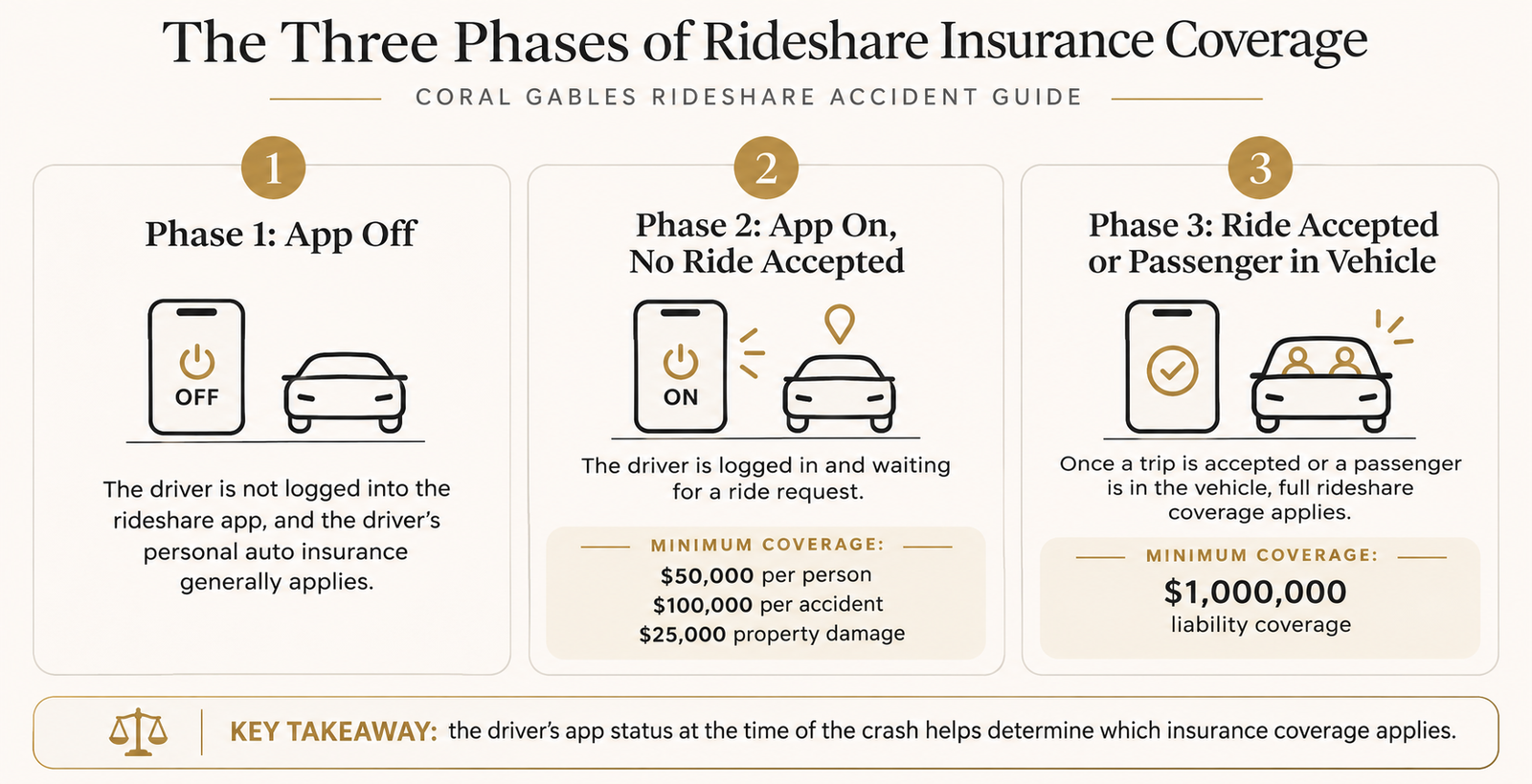
Phase 1 (App Off): Personal Auto Insurance Only
When an Uber or Lyft driver is not logged into the rideshare application and is operating the vehicle for personal purposes, the driver’s personal automobile insurance ordinarily governs the accident. Florida generally requires qualifying private passenger vehicles to maintain Personal Injury Protection (PIP) and property damage liability coverage, subject to applicable statutory requirements and exceptions. However, Florida does not universally require ordinary private passenger vehicle owners to carry bodily injury liability insurance, although additional requirements may apply in certain circumstances.
If an off-duty rideshare driver causes a collision, an injured person may pursue compensation through available bodily injury liability coverage and other applicable sources. Depending on the circumstances, these may include the injured person’s own PIP benefits, uninsured or underinsured motorist coverage, or other insurance policies. If the driver carries insufficient liability coverage, identifying additional available insurance becomes particularly important. For a broader discussion of conventional automobile insurance claims, see our Coral Gables car accident lawyers page.
Phase 2 (App On, No Ride) Accepted: Limited Rideshare Coverage
When a driver is logged into the Uber or Lyft application and available to accept ride requests but has not yet accepted a trip, Florida law imposes specific insurance requirements. Under Florida Statute § 627.748(7)(b), the required primary automobile liability coverage is at least $50,000 for bodily injury or death per person, $100,000 per incident, and $25,000 for property damage. The statute also addresses PIP and uninsured or underinsured motorist coverage requirements during this period.
These statutory minimums do not necessarily establish the full amount of insurance available in every accident. Coverage may be maintained by the driver, the transportation network company, or through an authorized combination of policies, subject to Florida law. A personal automobile insurer may also exclude certain rideshare activities under the policy’s terms. As a result, identifying which policy responds to the accident requires examining the relevant insurance documents and determining whether the driver was actually logged into the rideshare network when the collision occurred.
Phase 3 (Ride Accepted or Passenger In Vehicle): $1 Million Coverage
Once a rideshare driver accepts a trip request, Florida’s insurance requirements increase substantially. Under Florida Statute § 627.748(7)(c), a transportation network company driver engaged in a prearranged ride must be covered by primary automobile liability insurance providing at least $1 million for death, bodily injury, and property damage. The statutory requirements apply during the prearranged ride, which generally begins when the driver accepts a request and continues until the passenger exits the vehicle.
This coverage can be particularly important when a rideshare passenger suffers serious injuries or when an active rideshare driver causes a collision involving another motorist, pedestrian, or cyclist. However, the existence of a $1 million liability policy does not mean every injured person automatically qualifies for that amount. Recovery depends on establishing liability, the extent of legally recoverable damages, available policy limits, and the applicable coverage terms. Uninsured and underinsured motorist coverage must also be evaluated separately rather than assumed to provide the same limits. Additional information about Uber’s insurance framework is available through its driver insurance resources, while Lyft publishes information about its rideshare insurance coverage.
Why Rideshare Accident Claims Are Contested in Miami-Dade
Uber and Lyft accidents can involve more complicated insurance and liability questions than collisions between privately operated vehicles. Both companies generally use independent-contractor arrangements with their drivers, and Florida’s transportation network company statute expressly addresses their regulatory status. However, the driver’s classification does not eliminate potential liability arising from the driver’s negligence, nor does it resolve every possible claim involving the transportation network company itself. An injured person must still determine which parties owed applicable legal duties, whose conduct caused the accident, and which insurance policies provide coverage.
Insurance disputes may arise over whether the driver was logged into the application, whether a ride had already been accepted, and whether the collision occurred during a covered period. We investigate those issues by seeking available application records, trip information, insurance documents, electronic communications, and other relevant evidence. Where necessary and legally available, records may be requested through formal discovery to help establish the driver’s status and the timing of the accident. In appropriate circumstances, additional claims may warrant investigation if evidence supports negligence independent of the driver’s operation of the vehicle. Such claims require a legally recognized duty, a breach of that duty, and proof of causation; they cannot be established merely because the driver was using Uber or Lyft.
The insurance issues can become particularly important when injuries are severe or multiple people were involved in the collision. Identifying the correct coverage and evaluating all potentially responsible parties are essential steps in determining the compensation available. Our broader Coral Gables personal injury practice includes investigating complex motor vehicle accidents and claims involving disputed liability.
High-Risk Rideshare Areas in Coral Gables
Rideshare activity intersects with several of Coral Gables’ busiest commercial, university, and transportation corridors. Although accident risk depends on the specific circumstances rather than a location alone, certain roadway environments present recurring challenges involving passenger pickups, drop-offs, turning vehicles, and pedestrian activity.
Miracle Mile at night: Miracle Mile and surrounding streets, including Ponce de Leon Boulevard, Salzedo Street, and Giralda Avenue, attract restaurant patrons, shoppers, and visitors seeking transportation during evening hours. Rideshare drivers stopping near restaurants, entering curbside loading areas, or searching for passengers may create conflicts with surrounding traffic. Unsafe stopping, prohibited turns, and failure to observe pedestrians using nearby crosswalks can contribute to serious collisions. When an accident occurs in this area, business surveillance footage, parking facility recordings, and electronic trip records may provide valuable evidence.
University of Miami campus perimeter: San Amaro Drive, Red Road (SW 57th Avenue), and Stanford Drive serve areas surrounding the University of Miami where students, employees, visitors, and rideshare vehicles regularly interact. Drivers may be unfamiliar with campus entrances, pedestrian crossings, and designated pickup locations. Unexpected stops, turning movements, and failure to yield can create hazards for pedestrians and cyclists traveling near campus. Related roadway safety concerns are discussed on our Coral Gables pedestrian accident lawyers and Coral Gables bicycle accident lawyers pages.
Miami International Airport corridor (SW 8th Street and SR 836): Travel between Miami International Airport and Coral Gables places rideshare drivers on major routes connecting the airport with nearby neighborhoods, hotels, and commercial destinations. Drivers may navigate unfamiliar interchanges, changing traffic conditions, and congested pickup or drop-off areas. Following too closely, unsafe lane changes, distraction, and failure to account for surrounding traffic can contribute to collisions along these routes. When investigating an airport-related rideshare accident, the driver’s trip status, route, vehicle movements, and available electronic records may be particularly relevant.
Steps to Take After a Rideshare Accident in Coral Gables
1. Call 911 and report the accident. If anyone is injured or emergency assistance is needed, call 911. The Coral Gables Police Department or another agency with jurisdiction may investigate the collision. Obtain the responding agency’s information and the crash report number when available. The report may help identify the vehicles, drivers, witnesses, and circumstances documented at the scene.
2. Preserve your rideshare trip information. If you were an Uber or Lyft passenger, take screenshots of the trip receipt, driver’s name, vehicle information, route, pickup and drop-off locations, and relevant application messages. A trip record may help establish that a ride was accepted or underway when the collision occurred. If you were another motorist, pedestrian, or cyclist, document any rideshare identification visible on the vehicle, but remember that a placard alone does not establish the driver’s application status.
3. Obtain the driver’s information. Record the rideshare driver’s name, license plate, contact information, and available insurance details. If other vehicles were involved, obtain their information as well. Photographs of the scene, visible damage, traffic controls, and surrounding roadway conditions may help preserve evidence before vehicles are moved.
4. Seek prompt medical attention. Accept emergency medical treatment when appropriate and follow up with a qualified healthcare provider. Florida PIP benefits may apply depending on your status, the vehicles involved, and the applicable insurance policies. Under Florida Statute § 627.736, eligible PIP medical benefits generally require initial services and care within 14 days of the accident. Because coverage and priority rules can vary, injured passengers and other claimants should not assume that a particular policy automatically applies. Report the incident through the rideshare application when appropriate and retain confirmation of the report.
5. Be cautious about early settlement offers. An insurer may seek to resolve a claim before the full extent of the injuries and future treatment needs are known. Accepting a settlement that includes a release can prevent additional recovery for the claims being released, even if further medical problems develop. Before signing a release or accepting payment intended as a final settlement, it is important to understand the injuries, available coverage, and legal consequences. Contact Mesin & Co. if you have questions about a rideshare accident claim.
Frequently Asked Questions: Coral Gables Rideshare Accident Lawyer
I was a passenger in an Uber near Miracle Mile and we were hit by another car. Who do I claim against?
If another driver caused the collision, that driver’s bodily injury liability insurance may provide a source of compensation. However, the rideshare vehicle’s insurance and other applicable policies should also be examined. Under Florida law, a qualifying active rideshare trip generally requires at least $1 million in primary automobile liability coverage, but that coverage does not automatically make the rideshare insurer responsible for injuries caused solely by an unrelated negligent driver. Uninsured or underinsured motorist benefits, if available under an applicable policy, may provide an additional source of recovery when the responsible driver lacks sufficient coverage. We evaluate the fault of each driver, the rideshare trip status, and all potentially applicable insurance policies before determining how to pursue the claim.
My Uber driver caused an accident while taking me from the University of Miami to Miracle Mile. Is Uber responsible?
If your Uber driver negligently caused a collision during an accepted ride, Florida’s rideshare insurance requirements generally provide at least $1 million in primary automobile liability coverage during the covered trip. This may provide an important source of compensation for injured passengers. However, the existence of that policy does not automatically establish that Uber itself is directly liable for the driver’s negligence. The distinction between the transportation network company, the driver, and the insurer must be considered. We investigate the driver’s actions, available trip records, applicable insurance policies, and any facts that may support claims against additional responsible parties.
I was hit by a Lyft driver who was waiting near the Biltmore Hotel for a ride request. Which insurance applies?
If the Lyft driver was logged into the application and available to accept a ride but had not yet accepted a request, the accident generally falls within the waiting-period coverage requirements of Florida Statute § 627.748. That provision requires primary liability coverage of at least $50,000 per person for bodily injury or death, $100,000 per incident, and $25,000 for property damage, together with other insurance requirements specified by the statute. The particular insurer responsible for providing coverage must be determined from the policies and the driver’s status. If the driver had already accepted a request, the higher coverage requirements applicable to a prearranged ride may instead govern. We investigate the application status and available records to identify the appropriate coverage.
Uber offered me a settlement two weeks after my accident. Should I take it?
An early settlement offer should be evaluated carefully, particularly when medical treatment is ongoing or the long-term effects of the injuries remain uncertain. A payment offered shortly after an accident may not account for additional medical treatment, future expenses, lost income, or other recoverable losses. However, whether an offer is reasonable depends on the specific facts, documented injuries, liability, and available insurance. Before accepting a settlement, review the proposed release because it may waive additional claims even if injuries later become more serious than initially anticipated. Our firm evaluates the available evidence and the potential value of the claim before advising clients about settlement options.
Can I sue Uber or Lyft directly in Florida?
Potentially, but direct claims against a transportation network company require a legally supported basis for liability. Florida law recognizes the distinction between rideshare companies and drivers operating through their platforms, and the existence of a rideshare relationship alone does not automatically make the company liable for every negligent act of the driver. Nevertheless, a company may face potential liability where the particular facts establish an independent legal duty, a breach of that duty, and resulting damages, or where another recognized basis for liability applies. Allegations involving negligent screening, retention, or other company conduct must be evaluated under applicable Florida law and supported by evidence. We investigate these possibilities when the facts justify doing so, while separately pursuing available insurance coverage and claims against negligent drivers.
Rideshare Accident Attorneys Serving All of South Florida
Mesin & Co. represents rideshare accident victims throughout Miami-Dade, Broward, and Palm Beach Counties. In addition to Coral Gables, our firm serves individuals injured in Uber and Lyft accidents in Aventura, Fort Lauderdale, Hollywood, North Miami, Boca Raton, and surrounding South Florida communities.
- Aventura Rideshare Accident Lawyer
- Fort Lauderdale Rideshare Accident Lawyer
- Hollywood Rideshare Accident Lawyer
- North Miami Rideshare Accident Lawyer
- Boca Raton Rideshare Accident Lawyer
Explore our South Florida service locations or learn more about our Coral Gables personal injury services. If you or a loved one has been injured in a rideshare accident, call Mesin & Co. at (786) 944-6446 or schedule a free consultation. We handle rideshare injury cases on a contingency fee basis, meaning you pay no attorney’s fees unless we recover compensation for you.

Russian-Speaking Services
Eugene Mesin is fluent in Russian and welcomes inquiries from Russian-speaking clients throughout Florida