Falls are the leading cause of injury-related emergency room visits in the United States. The Centers for Disease Control and Prevention estimates that fall-related injuries cost the American healthcare system more than $50 billion annually, and the National Safety Council reported 42,114 fall deaths in 2022. For adults 65 and older, falls are the leading cause of both fatal and non-fatal injury. In North Miami, a city with a significant senior population and a dense concentration of commercial properties ranging from grocery stores and pharmacies along Biscayne Boulevard to sprawling apartment complexes throughout the city’s residential corridors, slip and fall accidents happen in environments that people visit as routine parts of daily life. The gap between a routine errand and a serious injury can be a single unmarked wet floor or a broken step that a property owner knew about and did nothing to fix.
Florida premises liability law is among the most defendant-friendly frameworks in the country for slip and fall cases. A 2010 statutory reform created a notice requirement that significantly increased the burden on injured plaintiffs, and the 2023 modification of Florida’s comparative negligence standard added another layer of risk for victims. Navigating these legal requirements is not optional. Cases that might seem straightforward at the scene can unravel in litigation if the legal prerequisites are not met with precision. Mesin & Co. handles slip and fall and premises liability cases in North Miami with a thorough understanding of what Florida law requires and what evidence must be preserved to meet that standard. Call (786) 944-6446 for a free consultation.
The Legal Framework Florida Built Around Slip and Fall Cases
Unlike a car accident case where negligence turns primarily on how the vehicles were operated, a premises liability case requires the injured victim to prove something specific about what the property owner knew or should have known before the fall occurred. This notice requirement is the central legal hurdle in most slip and fall cases, and it is where the majority of claims that are not handled carefully fall apart.
Florida Statute 768.0755 and the Notice Requirement
Florida Statute Section 768.0755, enacted in 2010, governs slip and fall claims arising from transitory foreign substances in business establishments. Under this statute, a plaintiff must affirmatively prove that the business establishment had actual or constructive knowledge of the dangerous condition that caused the fall and failed to take action to remedy it. This represents a higher burden than the prior law, which allowed plaintiffs to use a “mode of operation” theory to infer notice from the general nature of the business. Under the current law, simply proving that a wet floor existed and that you fell on it is not enough. You must prove that the property knew about it.
Actual knowledge means someone at the business was directly aware of the specific hazard before the fall. A customer who reports a spill to an employee, a manager who saw the wet floor and did not act on it, or an inspection log that documents the problem before the fall all constitute evidence of actual knowledge. Constructive knowledge is more nuanced: it requires showing that the condition existed for long enough that the business should have discovered it through reasonable inspection and maintenance practices, or that the condition was a foreseeable recurring event based on the nature of the business’s operations.
Proving Constructive Notice: The Clock on the Floor
Constructive notice cases turn on how long the dangerous condition existed before the fall. Florida courts have held that no specific minimum time period establishes constructive notice as a matter of law. Instead, the question is whether the time elapsed, combined with the totality of the circumstances, was sufficient that a reasonably prudent business operator exercising ordinary care would have discovered and addressed the hazard. A substance that appears dried and dirty with foot traffic impressions suggests it has been present for an extended period. A substance that is clean and fresh suggests a recent spill. The physical characteristics of the hazard at the time of the fall are therefore critical evidence, and documenting them as quickly as possible after the incident is essential. This is one reason why photographs taken at the scene immediately after a fall are among the most valuable evidence in any premises liability case.
The Foreseeable Recurrence Exception
Florida courts have recognized that constructive notice can also be established when the hazardous condition recurred with regularity as a foreseeable result of the business’s operations. A grocery store that sells produce will predictably have wet floors near the produce section as items drip. A restaurant with a salad bar will predictably have fallen food near the service area. A property that has inadequate drainage will predictably have standing water after rain. When a business’s own operation creates conditions that foreseeably produce hazards on a recurring basis, the business is expected to implement maintenance procedures that address those recurring risks. Evidence of prior similar incidents at the same location, prior complaints to management, or the absence of any reasonable inspection and cleaning schedule all support a constructive notice claim under this theory.
Visitor Categories and the Duty of Care Owed
The legal duty a property owner owes to a person who falls on their property depends on the visitor’s legal status at the time of the incident. Florida law recognizes three categories of visitors, and the applicable category determines the standard the property owner is held to.
Business Invitees: The Highest Level of Protection
A business invitee is someone who enters a property at the owner’s invitation, express or implied, for a purpose connected to the business’s commercial activity. Customers in a grocery store, shoppers at a retail establishment, diners at a restaurant, residents of an apartment complex using common areas, patients at a medical office, and patrons of any business along Biscayne Boulevard in North Miami are all invitees. Property owners owe invitees the highest duty of care: they must maintain the premises in a reasonably safe condition, inspect the premises regularly to discover dangerous conditions, and either repair hazards or warn invitees about them. This duty extends to all areas where the invitee is reasonably expected to go in connection with the business purpose.
Licensees and Social Guests
A licensee enters the property with the owner’s permission but for purposes that benefit primarily the licensee rather than the owner. Social guests at a private home are the most common example. The duty owed to licensees is lower than the duty owed to invitees: the owner must warn of known dangers that the licensee would not reasonably discover, but is not required to inspect for unknown hazards. This distinction becomes significant in mixed-use properties and in situations where a commercial invitee relationship is disputed by the property owner.
The Modified Comparative Negligence Standard and Its Effect on Fall Cases
Florida’s shift to modified comparative negligence in 2023 affects premises liability cases in a way that property owners and their insurers have moved quickly to exploit. Under the current rule, a fall victim found to be more than 50 percent at fault for their own accident is barred from any recovery. Insurance adjusters routinely argue that fall victims were not watching where they were walking, were wearing inappropriate footwear, were distracted by their phones, or chose to walk through an area with a visible hazard. Each of these arguments is designed to push the victim’s share of fault above 50 percent. Mesin & Co. challenges these arguments with the physical evidence from the scene, the property’s inspection records, and where available, surveillance footage that captures the actual circumstances of the fall. The same aggressive defense rebuttal used in North Miami car accident cases and North Miami bicycle accident cases applies equally here.

The Most Dangerous Property Types in North Miami
Slip and fall accidents in North Miami occur across a broad range of property types, but certain categories of properties and locations generate injury cases with significantly higher frequency based on the nature of their operations and the volume of people they serve.
Grocery Stores, Pharmacies, and Retail Along Biscayne Boulevard
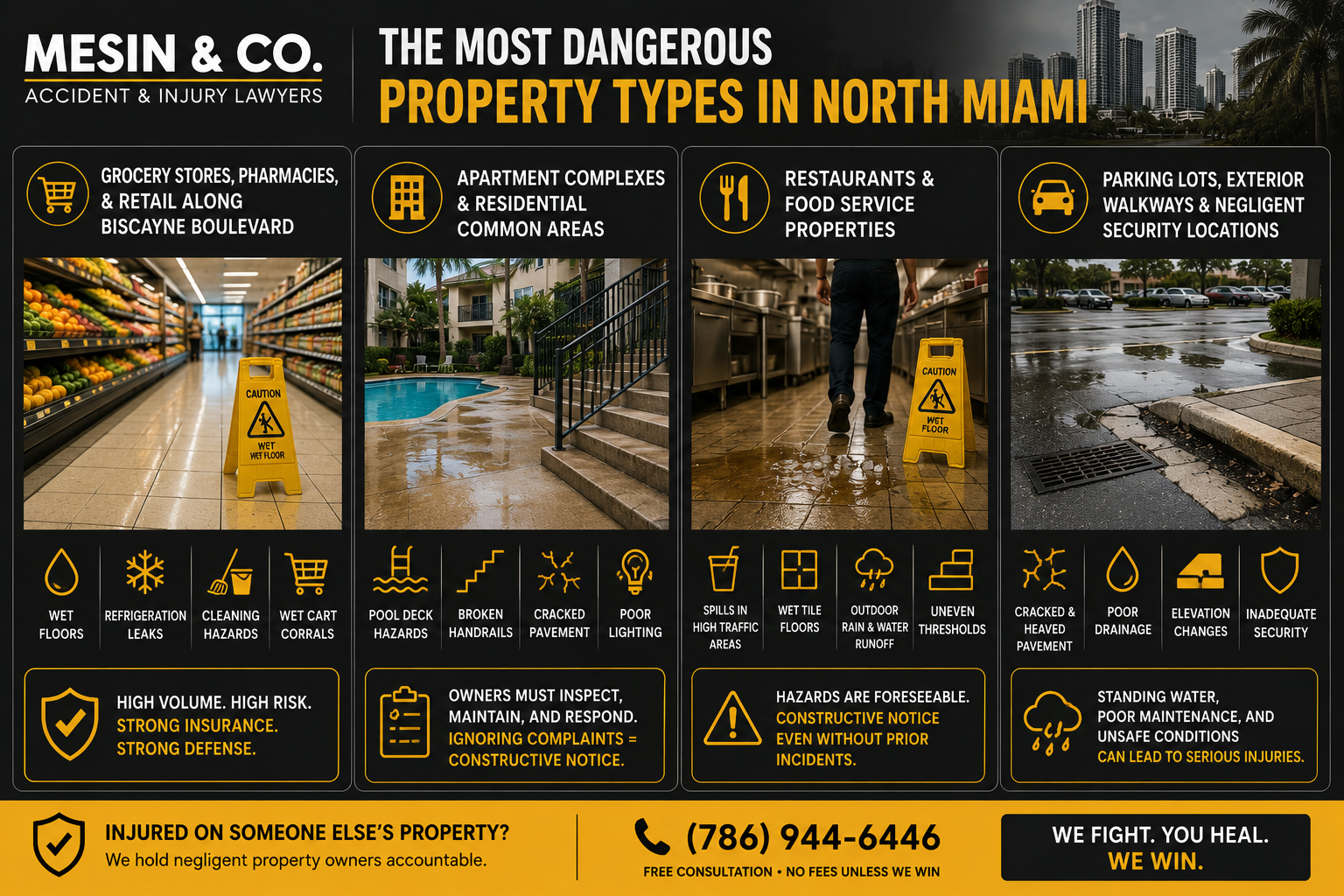
The commercial strip along Biscayne Boulevard in North Miami includes a high concentration of grocery stores, pharmacies, dollar stores, and retail establishments that serve large daily volumes of customers. Produce sections create predictable wet floor hazards. Refrigeration units leak condensation onto tile floors in the dairy and frozen food aisles. Cleaning and restocking operations during business hours leave wet surfaces without adequate warning signage. Outdoor cart corrals accumulate water after rain and create slipping hazards at the entrance to covered areas. These properties carry substantial insurance coverage and have legal teams experienced in defending fall claims, which underscores the importance of having an attorney who is equally prepared to counter those defenses.
Apartment Complexes and Residential Common Areas
North Miami has a substantial rental housing market, and the common areas of apartment complexes generate a specific category of premises liability claims. Pool decks with inadequate non-slip surfacing, stairwells with broken or missing handrails, parking lots with cracked and uneven pavement, inadequately lit exterior walkways, and laundry facilities with persistent moisture issues are recurring hazard locations in multi-family residential properties. Tenants and their invited guests are business invitees with respect to common areas maintained by the property owner. Landlords have an ongoing duty to inspect and maintain these areas, and documented maintenance complaints that went unaddressed are powerful evidence of constructive notice in cases arising from apartment complex falls.
Restaurant and Food Service Properties
Restaurant environments present a collection of slip and fall hazards that are both foreseeable and preventable. Kitchen staff carrying food and beverages creates constant spill risk in service paths. Tile floors that are attractive from a design standpoint become dangerous when wet. Outdoor dining areas in North Miami accumulate standing water from afternoon rain and irrigation runoff. Entrances and thresholds between different flooring materials create tripping hazards when surfaces are uneven or transitions are worn. Bars and lounges face the additional complication of ice and beverage spills in high-traffic areas with low lighting. The foreseeability of these conditions in food service settings supports constructive notice arguments even without a specific prior incident at the exact location.
Parking Lots, Exterior Walkways, and Negligent Security Locations
Exterior premises hazards are among the most underappreciated in slip and fall practice. Cracked and heaved pavement in parking lots creates tripping hazards that property owners see every day and can document easily. Speed bumps that have deteriorated, drainage grates at grade level that catch shoe heels, and unmarked elevation changes between parking surfaces and walkways all generate falls that result in serious injuries. In North Miami, where afternoon thunderstorms are a near-daily occurrence during wet season, standing water in poorly drained parking lots and walkways is a recurring condition. Property owners who fail to address known drainage deficiencies, maintain pavement surfaces, and mark or repair elevation changes can be held liable when those conditions cause a fall.
The Surveillance Footage Window: Why 72 Hours Changes Everything
In premises liability cases, surveillance footage from the property’s own camera system is often the single most important piece of evidence available. It can show the exact moment the fall occurred, how long the hazardous condition existed before the fall, whether employees or managers walked past the hazard without addressing it, and the physical condition of the fallen victim immediately after the event. Almost every commercial property in North Miami operates camera systems that record continuously. Most of those systems overwrite their recordings on cycles ranging from 48 hours to 14 days.
The moment Mesin & Co. is retained on a North Miami slip and fall case, we send a litigation hold letter to the property owner demanding immediate preservation of all surveillance footage from the relevant date and cameras. We also send spoliation warnings notifying the property owner that destruction of that footage after receiving notice will result in a request for adverse inference jury instructions at trial, which allows the jury to assume that the destroyed footage would have been unfavorable to the property owner. Courts in Florida have imposed significant sanctions for surveillance footage spoliation in premises liability cases, and the threat of those sanctions is often enough to ensure preservation. Victims who wait days or weeks to consult an attorney frequently lose access to the footage that would have made their case.
The Injuries That Follow Serious Falls in North Miami
The consequences of a serious fall are regularly underestimated at the scene and in the immediate aftermath. Adrenaline masks pain, and the embarrassment many people feel after a public fall creates pressure to minimize the incident. The injuries that emerge in the hours and days following a fall can fundamentally alter the injured person’s life.
Hip Fractures and Their Consequences for Older Victims
For adults 65 and older, hip fractures are a leading cause of loss of independence and, in a significant percentage of cases, death within one year of the injury. The CDC estimates that more than 300,000 Americans over 65 are hospitalized for hip fractures annually. Hip fracture repair typically requires surgical fixation or total hip replacement, followed by weeks of inpatient rehabilitation and months of outpatient physical therapy. Functional limitations after hip fracture are common, and many older adults who lived independently before the fall require assisted living or home care assistance afterward. These cases carry substantial economic damages that reflect not just the immediate medical costs but the long-term care needs the injury creates.
Spinal, Back, and Knee Injuries
Falls that result in impact to the lower back, tailbone, or knees are among the most common serious premises liability injuries in working-age adults. Herniated discs resulting from fall impact can produce chronic radiating pain, numbness, and functional limitation that require years of treatment and, in many cases, surgical intervention. Vertebral compression fractures, particularly common in people with osteoporosis, can cause permanent height loss, postural changes, and chronic pain. Knee injuries including meniscal tears, ACL ruptures, and patellar fractures often require surgical repair and extended rehabilitation, with permanent range of motion limitations being a documented outcome in a significant percentage of cases. For victims whose work involves standing, walking, lifting, or physical labor, knee and back injuries can eliminate the ability to return to their prior occupation.
Head and Brain Injuries From Falls
When a fall victim strikes their head on the floor, a shelf, a display fixture, or another hard surface, traumatic brain injury is a real possibility at any age. The rotational acceleration that occurs when the head stops suddenly while the brain continues to move within the skull produces diffuse axonal injury that may not appear on initial CT imaging. Cognitive symptoms, headaches, memory problems, personality changes, and difficulty concentrating that persist beyond the first weeks after a fall should prompt neurological evaluation and documentation. Mesin & Co. works with neurological and neuropsychological specialists who understand how to document fall-related TBI in the context of premises liability litigation.
Contact a North Miami Slip and Fall Lawyer
If you were injured in a fall on someone else’s property in North Miami, North Miami Beach, or the surrounding communities of Miami-Dade County, the steps you take in the first days after the incident determine what evidence will be available and how strong your case will be. Mesin & Co. acts immediately to preserve surveillance footage, document the hazard, and build the notice case that Florida law requires. Eugene Mesin handles every premises liability case on a contingency fee basis with no upfront costs and no fees unless compensation is recovered. Call (786) 944-6446 or visit mesinco.com to speak with the firm today.

Russian-Speaking Services
Eugene Mesin is fluent in Russian and welcomes inquiries from Russian-speaking clients throughout Florida