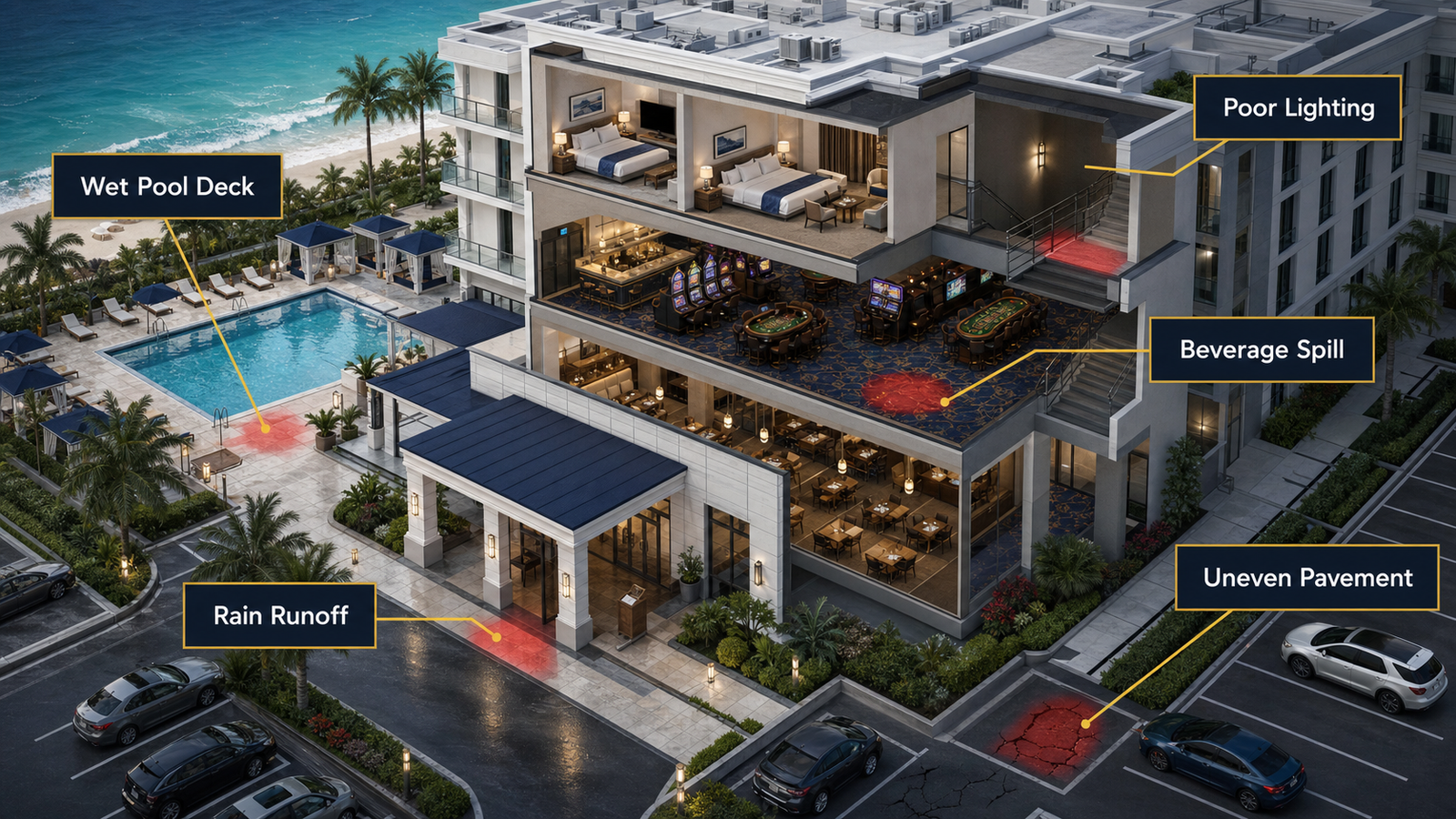
Hollywood, Florida’s economy runs on hospitality. The beachfront hotel corridor stretching from the Broadwalk north to Dania Beach includes dozens of properties ranging from boutique resorts to large branded hotel chains. The Seminole Hard Rock Hotel and Casino operates the most extensive commercial complex in Broward County, with a hotel tower, casino floor, concert venue, restaurants, and pool facilities that collectively attract millions of visitors annually. The restaurants, bars, and retail establishments lining Hollywood Boulevard and the Broadwalk add another layer of commercial premises to the mix. Each of these properties owes a legal duty to the people who visit them, and each generates the conditions that produce slip and fall accidents: wet pool decks, casino floors maintained under specific conditions that prioritize appearance over traction, restaurant surfaces subject to constant spill risk, and hotel common areas where maintenance may not keep pace with guest volume.
The National Safety Council reported 42,114 fall deaths in 2022, and the CDC estimates that fall injuries cost the American healthcare system more than $50 billion annually. In Hollywood’s hospitality-dense environment, premises liability cases arise at a rate that reflects the city’s unique commercial profile. Florida’s slip and fall law, however, creates significant legal hurdles that require expert navigation. Mesin & Co. handles premises liability cases in Hollywood and throughout Broward County with a thorough understanding of what Florida law requires and what the hospitality industry’s duty of care actually demands. Call (786) 944-6446 for a free consultation.
The Hospitality Industry’s Premises Liability Exposure in Hollywood
Hotel Pool Decks: The Most Dangerous Common Area in South Florida
Hotel pool decks in Hollywood present a premises liability profile that is distinct from other commercial floor surfaces. Constant water runoff from the pool, from guests dripping as they walk between the pool and lounge chairs, and from tropical rain events creates a near-perpetual wet surface condition in and around the pool area. Hotel operators know this. The industry standard for pool deck surfacing specifically calls for non-slip aggregate or textured materials that maintain adequate friction when wet. When a hotel installs or maintains a pool deck surface that becomes dangerously slippery when wet, and a guest falls and is injured, the hotel’s decision to use that surface is both actual and constructive notice of the hazard. Mesin & Co. investigates pool deck surface specifications, maintenance records, and prior incident reports in every Hollywood hotel slip and fall case.
Casino Floor Conditions at the Seminole Hard Rock
Casino floors present a specific and underappreciated premises liability environment. The Seminole Hard Rock’s gaming floor is a large, high-traffic commercial space maintained under conditions designed to maximize player comfort and extended stays: controlled lighting, strategic carpet patterns that direct foot traffic, and beverage service that places drinks in the hands of moving patrons throughout the floor. Spilled drinks on casino carpet, condensation from beverage glasses on hard floor surfaces near slot machine banks, and wet floors near the casino’s restaurant and bar areas create hazard conditions on a continuous basis. Florida’s notice requirement under Section 768.0755 asks whether the establishment had actual or constructive knowledge of the specific hazard. In a casino that operates 24 hours a day with drink service throughout the floor, the foreseeability of recurring wet floor conditions supports constructive notice arguments that differ from a typical retail environment.
Restaurant and Bar Premises on the Broadwalk and Hollywood Blvd
The restaurant and bar properties along Hollywood’s commercial corridors present the classic slip and fall hazard profile: tile floors that are attractive when dry and treacherous when wet, outdoor dining areas subject to standing water after rain, kitchen egress points where staff carry food and beverages across customer paths, and bar areas where spilled drinks on hard floors create conditions that appear clean but are dangerously slick. Florida’s dram shop history and beverage service records that Mesin & Co. pursues in Hollywood drunk driving cases are separate from but related to the premises liability analysis: the same establishments that over-serve patrons also have surface conditions that create fall hazards.
Florida’s Notice Requirement Applied to Hospitality Properties
Actual Notice in a Hotel or Casino Setting
Actual notice in a hotel or casino means that someone with authority at the property knew about the specific hazard before the fall occurred. A housekeeping log entry noting a wet floor near the pool area, a maintenance request submitted for a carpet seam that had lifted in a casino walkway, a guest complaint about a slippery surface documented in the front desk log, or a floor manager who walked past the hazard during their rounds all constitute actual notice. Hotel and casino operations generate extensive internal documentation: incident reports, maintenance logs, housekeeping records, and security reports. Obtaining these records through discovery or public records requests is one of the first steps Mesin & Co. takes in every Hollywood hospitality premises case.
Constructive Notice and the High-Traffic Hospitality Standard
Constructive notice requires proving the hazard existed long enough that reasonable inspection and maintenance should have discovered it. The standard for what constitutes reasonable inspection varies with the type of property and the volume of traffic it serves. A casino that operates 24 hours a day with thousands of daily visitors and beverage service throughout the floor is held to a more rigorous inspection standard than a small retail store with occasional customers. Florida courts have recognized that the duty of care is calibrated to the foreseeable risk, and a property that invites thousands of daily guests into an environment where wet floors are predictable must implement inspection and cleaning protocols that match that risk level. The absence of any documented cleaning schedule or the existence of a schedule that is not followed creates constructive notice liability when a foreseeable hazard goes unaddressed.
The Surveillance Advantage in Hotel and Casino Cases
The Seminole Hard Rock Casino operates one of the most comprehensive surveillance systems of any commercial property in Florida. Casino surveillance is required by state gaming regulations and covers virtually every square foot of the gaming floor, entrances, bars, and high-traffic transition areas. This surveillance is both the plaintiff’s greatest potential evidence asset and the most rapidly lost evidence in a casino fall case. Mesin & Co. sends litigation hold letters to the casino’s security department within hours of being retained in a Hard Rock premises case. Florida courts have imposed spoliation sanctions against casino operators who allow surveillance footage to overwrite after receiving notice of a fall incident. The same rapid preservation approach applies to hotel and restaurant camera systems throughout Hollywood’s hospitality corridor. For broader context on the surveillance preservation issue in South Florida cases, see the Hollywood car accident lawyer page.
The Legal Categories of Visitors and What Each Is Owed
Business Invitees: The Full Duty of Care
Hotel guests, casino patrons, restaurant diners, and retail shoppers are all business invitees, the category of visitor to whom Florida property owners owe the highest duty of care. The business invitee duty requires the property owner to maintain the premises in a reasonably safe condition, conduct regular inspections to discover hazards, and either repair dangerous conditions or warn invitees about them before they are injured. In a high-traffic hospitality environment, reasonable inspection means inspection intervals that are calibrated to the volume of traffic and the foreseeability of hazards, not a once-daily walkthrough. Mesin & Co. uses the business invitee standard and the specific inspection protocols, or lack thereof, documented in each property’s records to establish the gap between what was required and what was done.
Modified Comparative Negligence and the “Should Have Seen It” Defense
Under Florida’s 2023 modified comparative negligence reform, a fall victim found to be more than 50 percent at fault cannot recover any compensation. Property owners and their insurers in Hollywood hospitality cases routinely argue that the hazard was open and obvious, that the victim was not paying attention, or that reasonable care for the victim’s own safety would have prevented the fall. Mesin & Co. challenges these arguments with evidence that the hazard was not visible in the lighting conditions present at the time of the fall, that warning signs were absent or inadequate, and that the victim was exercising reasonable care for their surroundings. The fact that a person did not see a hazard that a reasonable person under the same conditions would also have missed is not comparative fault. It is evidence that the hazard should have been addressed by the property before the victim arrived.
Injuries and Recovery in Hollywood Premises Liability Cases
Hip Fractures and Their Consequences in South Florida’s Senior Population
Hollywood’s senior population and the elderly tourist demographic that visits the city’s hotels are disproportionately vulnerable to hip fractures in fall events. The CDC estimates that more than 300,000 Americans over 65 are hospitalized for hip fractures annually, and that one in five hip fracture patients dies within a year of the injury. Hip fracture repair at Memorial Regional Hospital requires surgical fixation or total hip replacement, followed by inpatient rehabilitation and extended outpatient physical therapy. For elderly victims who lived independently before the fall, the transition to assisted living or home health care following a hip fracture represents a substantial economic loss that is properly calculated as part of the damages case.
Knee, Back, and Spinal Injuries From Hotel and Casino Falls
Working-age adults who fall on hotel or casino premises most frequently sustain knee, back, and lumbar spine injuries from the impact or from the contorted positions adopted when trying to catch themselves. Meniscal tears, ACL ruptures, disc herniations, and vertebral compression fractures all require extended treatment and produce permanent functional limitations in a significant percentage of cases. For victims who work in physically demanding occupations, these injuries can permanently alter career trajectory and earning capacity. Mesin & Co. builds the full economic damages picture for every Hollywood premises liability client, including occupational capacity analysis for victims whose injuries affect their ability to return to their prior work.
Brain Injuries From Falls in Commercial Settings
Head impact on tile, marble, or concrete floor surfaces in hotel lobbies, casino floors, and restaurant dining rooms can produce TBI that presents in the hours and days following the fall rather than at the scene. Cognitive symptoms, persistent headaches, and behavioral changes that develop after a commercial premises fall require neurological evaluation and documentation. Mesin & Co. works with neurological and neuropsychological specialists to document fall-related TBI in Hollywood premises liability cases, ensuring that late-presenting neurological injury is captured before any settlement is finalized. For the full range of TBI documentation the firm applies across practice areas, see the Hollywood wrongful death lawyer page. Call (786) 944-6446 or visit mesinco.com today.

Russian-Speaking Services
Eugene Mesin is fluent in Russian and welcomes inquiries from Russian-speaking clients throughout Florida