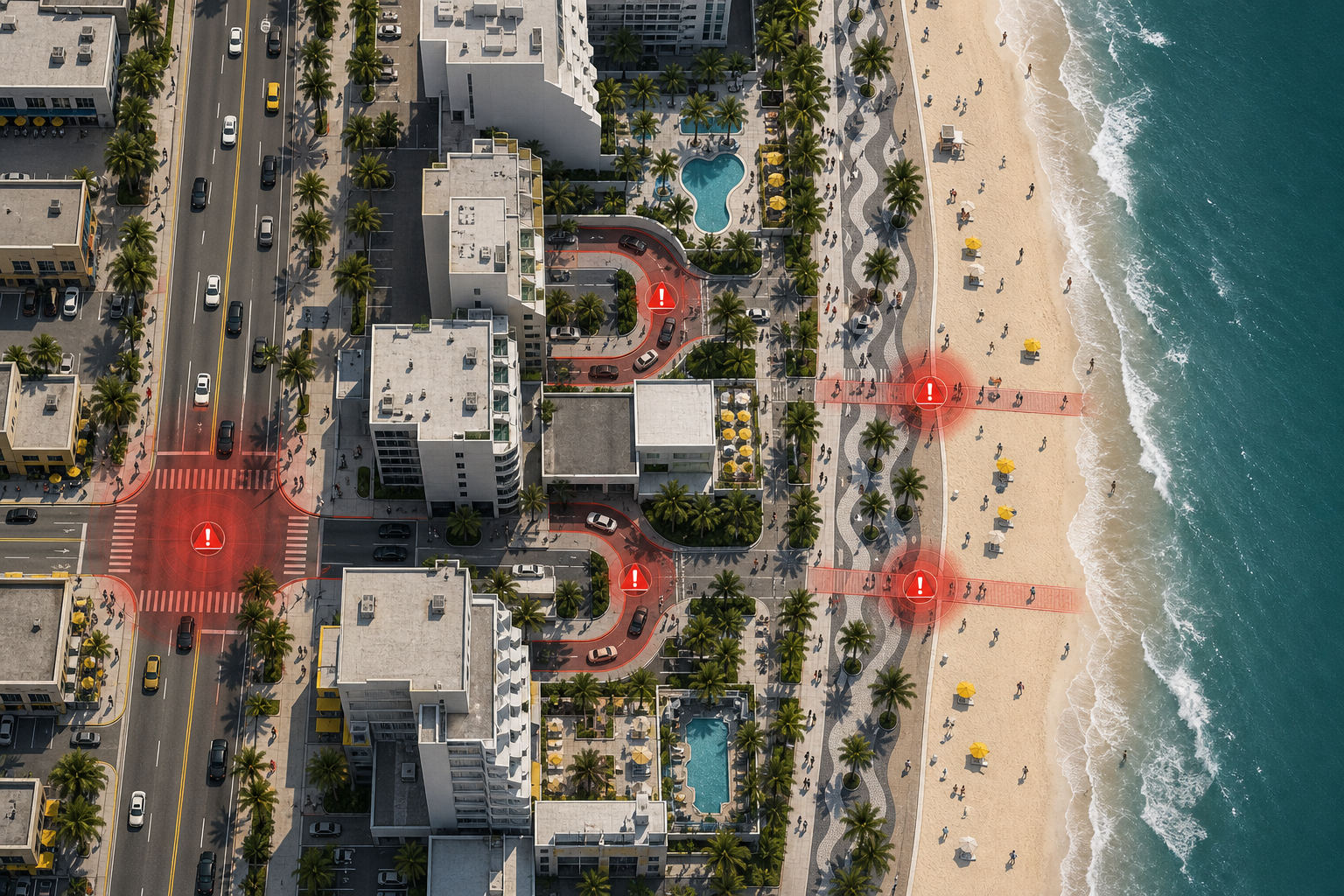
Hollywood Beach draws more pedestrian traffic than almost any other location in Broward County. The Hollywood Beach Broadwalk, a 2.5-mile oceanfront promenade running from the Georgia Street beach access south to Hallandale Beach, is one of Florida’s most visited public spaces and generates constant foot traffic that spills over from the Broadwalk itself onto the adjacent road network. Hollywood Boulevard east of US-1, lined with restaurants, souvenir shops, and beach-access businesses, is a pedestrian-heavy commercial strip where vehicle speeds and pedestrian density create a persistent conflict. The city’s hotel corridor along A1A adds a valet and drop-off zone dimension to the pedestrian hazard profile that is unique to the tourism industry.
Florida’s pedestrian fatality rate is the worst in the country. Smart Growth America‘s Dangerous by Design report has ranked Florida first or second nationally for pedestrian danger in consecutive editions, and Broward County routinely appears in the state’s most dangerous counties for foot traffic. In 2022, Florida recorded 895 pedestrian fatalities statewide. Hollywood’s combination of permanent residents, seasonal visitors, and daily beach tourists creates a pedestrian vulnerability profile that is more diverse and more complex than most Florida cities. Mesin & Co. represents pedestrian accident victims in Hollywood and throughout Broward County. Call (786) 944-6446 for a free consultation.
Hollywood’s Three Pedestrian Danger Zones
The Broadwalk Vehicle Conflict Points
The Hollywood Beach Broadwalk is a non-motorized zone along the beachfront, but the roads that provide access to it are not. Pedestrians moving between the Broadwalk and the beachside businesses, hotels, and parking areas must cross vehicle travel lanes at multiple points along the beach corridor. The intersection of Ocean Drive and Hollywood Beach Boulevard, the crossing at the Margaritaville Hollywood Beach Resort, and the access points near Johnson Street and Polk Street are locations where pedestrian crossing activity is high and driver attention is divided between navigation, parking availability, and the visual environment of the beach. Vehicle-pedestrian conflicts at these locations are a documented pattern in Hollywood Police Department crash records.
Hollywood Boulevard East of US-1
The commercial strip along Hollywood Boulevard between US-1 and A1A is where the city’s pedestrian activity is densest during evening and weekend hours. Restaurant patrons, bar-goers, and beachgoing tourists cross Hollywood Boulevard at marked and unmarked locations throughout this corridor. Vehicles traveling at the 35-mile-per-hour posted speed are moving fast enough to cause fatal injuries in a pedestrian strike. Drivers distracted by looking for parking, loading and unloading passengers, or navigating to specific businesses are the primary threat. The stretch of Hollywood Boulevard immediately east of Young Circle, where US-1 and Hollywood Boulevard converge and traffic volumes are highest, is a consistently elevated-risk location for pedestrian-vehicle conflicts.
Hotel Drop-Off Zones and Valet Operations
Hollywood’s beachfront hotel corridor includes numerous properties with valet parking and hotel drop-off zones that introduce specific pedestrian hazards. Vehicles stopped or slowly moving through valet lanes create conflict points with pedestrians using the sidewalk or crosswalk adjacent to the hotel entrance. Valet drivers moving vehicles quickly between the drop-off area and the parking structure may not yield to pedestrians in hotel access crossings. Property owners have a duty to design and maintain their drop-off and valet operations in a manner that does not create unreasonable danger to arriving guests and passersby. When this duty is breached and a pedestrian is struck in a hotel access area, the property owner’s liability runs parallel to the vehicle operator’s. For premises-based pedestrian liability analysis, see the Hollywood slip and fall lawyer page.
Hollywood’s Elderly Population and Its Pedestrian Vulnerability
Broward County’s Senior Demographic and Traffic Risk
Hollywood and the surrounding communities of Broward County have a substantial permanent senior population. Neighborhoods including Emerald Hills, Boulevard Gardens, and the communities surrounding Hollywood Hills Road include a high concentration of older adults who walk as their primary local transportation mode. The CDC documents that adults over 65 account for a disproportionate share of pedestrian fatalities relative to their share of the walking population. Slower crossing speeds, reduced peripheral vision, and delayed reaction time all contribute to elevated risk for older pedestrians. Insurance defense attorneys in Hollywood pedestrian cases involving elderly victims often argue that the pedestrian’s own age-related limitations contributed to the crash. Mesin & Co. challenges these arguments with traffic engineering analysis establishing that the pedestrian was acting within normal parameters for a person of their age and that the driver’s speed and inattention were the primary causes of the collision.
Calculating Damages for Older Pedestrian Victims
The damages analysis in a pedestrian accident case involving an older adult differs from the working-age adult framework in important ways. Lost earning capacity is not typically a primary component for retired victims. Instead, the economic damages focus on the full cost of medical treatment, the cost of in-home care or assisted living that the injury necessitates, and the replacement value of services the victim previously performed for themselves and their household. Non-economic damages for pain and suffering, loss of enjoyment of life, and loss of independence are particularly significant when serious injuries force an older adult out of the active lifestyle they maintained before the crash. Florida law does not discount these damages based on age, and Mesin & Co. builds the full economic and non-economic case regardless of the victim’s age.

Florida Law and Pedestrian Accident Claims in Hollywood
Driver Duty to Yield Under Florida Statute 316.130
Florida Statute Section 316.130 requires drivers to yield the right-of-way to pedestrians in marked crosswalks and at intersections where the pedestrian has a walking signal. The statute also imposes a general duty to exercise due care to avoid striking any pedestrian regardless of location. A driver who strikes a pedestrian in a marked crosswalk on Hollywood Boulevard has violated an explicit statutory duty, and that violation is negligence per se: the driver’s failure to comply with the statute establishes negligence without requiring the plaintiff to prove that a reasonable person would have acted differently. Mesin & Co. identifies and pleads statutory violations as part of its standard Hollywood pedestrian case preparation. For the general negligence framework applicable across vehicle types, see the Hollywood car accident lawyer page.
Government Liability for Dangerous Pedestrian Infrastructure
When a pedestrian crossing lacks adequate signalization, crosswalk markings, or sight line clearance, and that deficiency contributes to a crash, the City of Hollywood, Broward County, or Florida DOT may bear liability under the Florida Tort Claims Act. Government liability for defective road design requires compliance with pre-suit notice requirements under Florida Statute 768.28, including written notice delivered to the appropriate agency within three years of the incident. The six-month investigative period following notice, combined with Florida’s two-year statute of limitations for personal injury claims, creates a compressed timeline that makes early attorney retention essential in cases involving potential government liability. Mesin & Co. identifies government liability exposure and meets all procedural requirements as a standard component of every Hollywood pedestrian case investigation.
The Comparative Negligence Challenge for Pedestrians in Tourist Areas
Insurance defense attorneys in Hollywood pedestrian cases frequently argue that the pedestrian was crossing outside a designated crosswalk, was distracted by a phone, was wearing dark clothing at night, or was otherwise contributing to their own injury. In Hollywood’s tourist-heavy environment, where pedestrians routinely cross Hollywood Boulevard mid-block to access the beach or restaurants on the opposite side, these arguments are raised with particular frequency. Mesin & Co. counters with surveillance footage, traffic engineering analysis, and eyewitness testimony that establishes the driver’s speed, distraction, and failure to exercise the due care that Florida law requires regardless of exactly where the pedestrian was crossing.
Emergency Response and Medical Care After a Hollywood Pedestrian Crash
Pedestrian crash victims in Hollywood are transported to Memorial Regional Hospital at 3501 Johnson Street, Broward County’s Level I Trauma Center, for serious injuries. The trauma team at Memorial Regional handles the full range of pedestrian impact injuries: pelvic fractures, femur fractures, traumatic brain injury, internal organ damage, and thoracic trauma. The medical record chain that begins at Memorial Regional is the foundation of the economic damages case, and Mesin & Co. coordinates with the hospital’s medical records department from the start of representation to ensure complete documentation. Call (786) 944-6446 or visit mesinco.com to speak with Eugene Mesin about your case today.

Russian-Speaking Services
Eugene Mesin is fluent in Russian and welcomes inquiries from Russian-speaking clients throughout Florida