Fort Lauderdale holds the title of the “Yachting Capital of the World,” a distinction backed by the fact that it hosts more registered boats per capita than any other city in the United States and is home to hundreds of marinas, yacht clubs, and waterfront commercial properties lining the Intracoastal Waterway, the New River, and its network of residential canals. That maritime identity creates a premises liability landscape that is not found in any other Florida city. Waterfront restaurants, marina facilities, charter boat operations, and Intracoastal-adjacent commercial properties operate in environments where water on walking surfaces is not a foreseeable occasional hazard but a constant and predictable operating condition. The Centers for Disease Control and Prevention reports that falls cost the U.S. healthcare system approximately $50 billion annually, with 42,114 fall deaths recorded in 2022. In Fort Lauderdale’s waterfront commercial environment, the question is not whether wet surfaces will occur, but whether property owners have managed them adequately.
Mesin & Co. represents Fort Lauderdale slip and fall victims, holding waterfront property owners, marina operators, and commercial landlords accountable when their failure to maintain safe premises causes injury. Attorney Eugene Mesin, a Marine Corps veteran and University of Florida Levin College of Law graduate, approaches premises liability cases with the same systematic discipline he applied during military service. The firm investigates the property owner’s actual knowledge of the hazard, their inspection practices, their incident history, and the measures they had in place to prevent foreseeable falls. Call (786) 944-6446 for a free consultation.
Fort Lauderdale’s Waterfront Properties and Their Duty of Care
Marina Docks, Boat Ramps, and Gangway Hazards
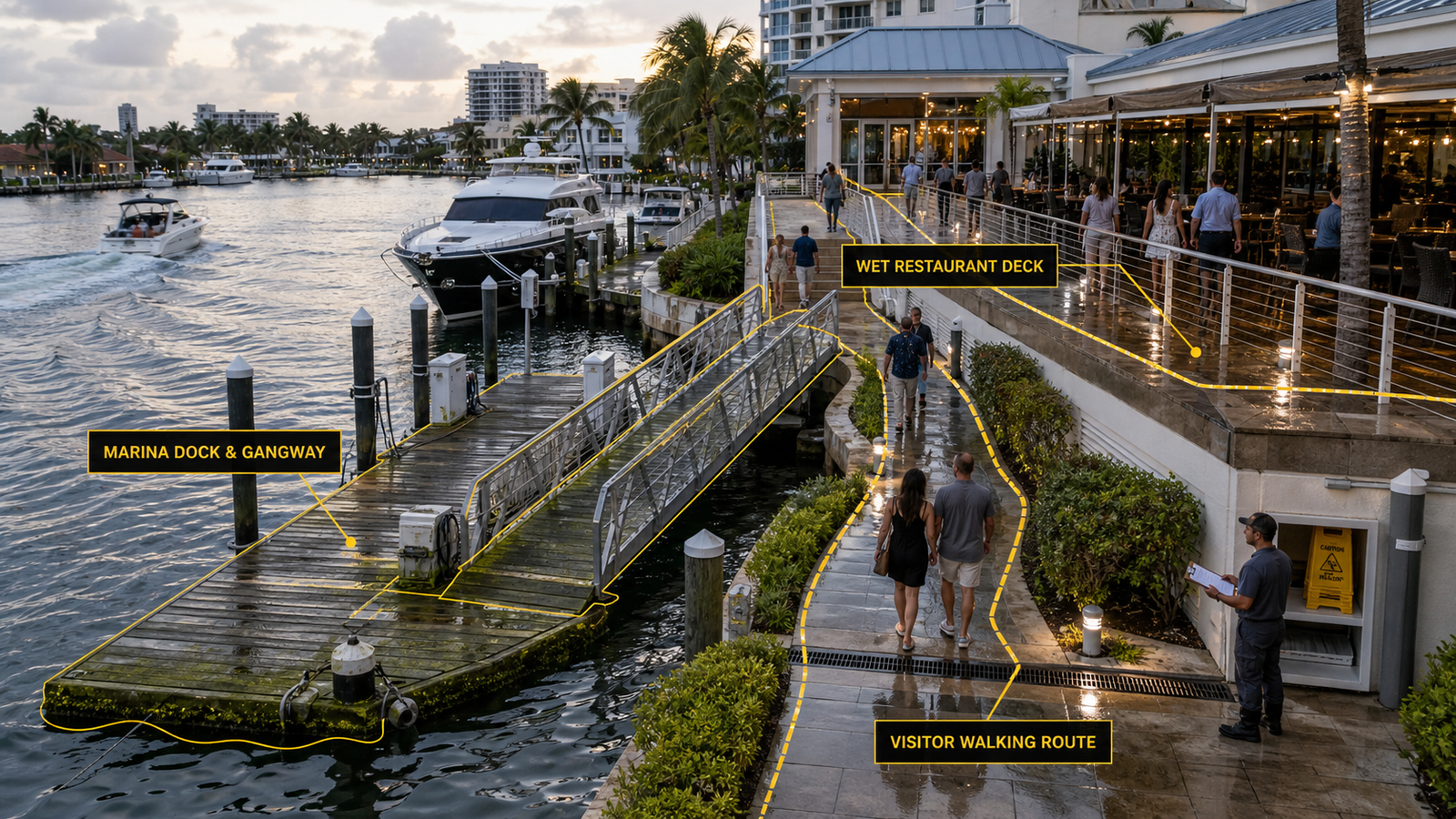
Marina docks and boat ramps in Fort Lauderdale present a category of fall hazard that is fundamentally different from an indoor grocery store or an office building lobby. The dock surface is in continuous contact with seawater through spray, wake wash, and tidal variation, creating a biological growth environment where algae, mildew, and marine organisms colonize untreated wood and composite deck surfaces within weeks of installation. A dock that appears visually clean may have a surface coating of wet algae that is invisible in low light but that provides almost no friction to a pedestrian wearing typical boat shoes or sandals. The gangway, which connects the dock to the shore or to a floating dock platform, adds an additional hazard: it moves with the vessel it serves, creating an unstable surface that changes angle with the tide and wake action.
Florida law classifies marina patrons as business invitees, the highest category of protection available under the state’s premises liability statute. A property owner who invites paying customers onto marina facilities owes those customers a duty to inspect the premises regularly, to identify and correct or warn of dangerous conditions, and to maintain the property in a condition that is reasonably safe for the use for which it is intended. A marina operator who allows algae-covered dock surfaces to remain untreated when the hazard is foreseeable and correctable has breached this duty. The breach becomes actionable when a business invitee falls on those surfaces and sustains injury that would not have occurred if the duty of care had been met.
Waterfront Restaurant Decks and the Perpetually Wet Surface Problem
Waterfront restaurants along Fort Lauderdale’s Intracoastal Waterway, the Las Olas Isles canals, and the New River typically feature outdoor deck seating that extends over or immediately adjacent to the water. These deck surfaces are exposed to rain, humidity, spray from passing vessels, and condensation from cold beverage glasses placed on table surfaces that drip onto the deck below. In South Florida’s climate, with its afternoon summer thunderstorms and year-round humidity, a waterfront restaurant deck is wet for a significant portion of every operating day. A restaurant owner who installs a deck surface with inadequate drainage, uses materials that become dangerously slippery when wet, or fails to use anti-slip treatments on a deck that is predictably and repeatedly wet has created a premises condition that is not a random event: it is an inherent feature of the property’s design and location.
When a restaurant patron slips on a waterfront deck in Fort Lauderdale and sustains injury, the premises liability analysis under Florida law requires establishing that the property owner had either actual knowledge of the dangerous condition or constructive knowledge of it, meaning they would have known about it had they exercised reasonable care in inspecting the property. In the context of a perpetually wet waterfront restaurant deck, the constructive knowledge argument is particularly strong because the hazard is not the product of a random spill or a one-time weather event but of the property’s inherent characteristics. A reasonable inspection would have revealed the wet condition at virtually any time the property was operating.
Intracoastal Properties and the Visitor Invitee Standard
Fort Lauderdale’s Intracoastal-adjacent commercial properties, including the waterfront hotels, charter fishing operations, dinner cruise terminals, and private club facilities along the waterway, draw visitors from throughout South Florida and from across the country. These visitors are business invitees who are owed the highest duty of care under Florida premises liability law. Many of them are not familiar with the specific hazards of waterfront walking surfaces: they are wearing footwear appropriate for a restaurant or a city sidewalk, not for a wet marina dock or a vessel gangway. A commercial property owner who knows their clientele includes visitors unfamiliar with the marine environment has a heightened obligation to ensure that the walking surfaces these visitors will use are maintained to a level of safety appropriate for someone without specialized marine experience.
The Riverwalk Commercial Corridor
Outdoor Dining Transitions and Surface Elevation Changes
Fort Lauderdale’s Riverwalk pedestrian promenade along the New River includes substantial outdoor dining infrastructure associated with the restaurants, cafes, and event venues that line both banks of the river through the downtown district. These outdoor dining areas typically involve transitions between multiple surface types: the concrete Riverwalk pathway, elevated deck platforms associated with individual restaurants, lower-grade terrace areas, and approaches to the river’s edge. Each transition point between surface types represents a potential trip and fall hazard, particularly when the transition involves an elevation change that is not visually apparent in low lighting conditions or when the surfaces are wet from rain or riverside spray.
A restaurant or venue operator on the Fort Lauderdale Riverwalk has a duty to maintain all surfaces within its premises, including the outdoor transition areas that guests use to access seating or to move between the venue’s interior and exterior spaces, in a safe condition. The duty extends to ensuring that elevation changes are marked or illuminated, that wet surfaces are managed with appropriate drainage or anti-slip treatments, and that areas where guests are likely to walk in low lighting are adequately lit. Failure to meet these obligations when a guest falls and sustains injury creates a valid premises liability claim against the Riverwalk venue.
Post-Rain Standing Water and Drainage Deficiencies
Fort Lauderdale receives an average of approximately 62 inches of rain per year, with the majority of that rainfall concentrated in afternoon and evening thunderstorm events during the May through October wet season. Outdoor commercial properties that lack adequate drainage infrastructure accumulate standing water on their walkways, parking lots, and access paths within minutes of a heavy rain event, creating slip hazards that persist for hours after the rain stops. A property owner who knows that their outdoor surfaces are prone to standing water accumulation after rain events has constructive knowledge of a recurring hazardous condition, and a failure to install adequate drainage or to close affected areas during and after rain events may constitute the negligence that triggers liability when a patron falls.
Event Venue Liability on the Riverwalk
The Broward Center for the Performing Arts and the adjacent outdoor performance venues along the Fort Lauderdale Riverwalk host large-scale events that bring thousands of attendees onto the Riverwalk and adjacent commercial properties in a compressed time window. Post-event crowds departing from these venues in the evening, often in wet conditions from riverside humidity or recent rain, create slip and fall risk concentrations in the outdoor transition areas between the venue and the adjacent parking infrastructure. An event venue that knows it will release a large crowd onto wet outdoor surfaces in the evening has an obligation to inspect and address those surface conditions before the event ends and the crowd begins to depart. Failure to conduct that pre-departure inspection and address identified hazards is negligence that the venue cannot escape by arguing that the crowd simply chose to walk on a wet surface.
How Florida’s Notice Law Applies to Perpetually Wet Environments
The Mode of Operation Theory in Maritime Commercial Settings
Florida Statute 768.0755 establishes that a business owner can be held liable for a transient foreign substance on a floor only if the plaintiff establishes that the owner had actual or constructive knowledge of the dangerous condition. In a typical grocery store slip and fall, constructive knowledge requires showing that the substance was on the floor long enough that a reasonable inspection would have discovered it. In Fort Lauderdale’s waterfront commercial settings, however, the mode of operation theory offers an alternative path to establishing liability: when a business operates in a manner that makes foreseeable the regular presence of slipping hazards on walking surfaces, the foreseeability of the hazard itself can substitute for proof of how long the specific hazard existed. A marina that operates boats generating continuous wake wash onto dock surfaces, a waterfront restaurant that serves beverages on a deck exposed to the elements, and a charter fishing operation where wet clients return from boats to shore through a gangway are all operating in a mode that makes wet surfaces continuously foreseeable.
When Actual Notice Is Irrelevant Because the Hazard Never Goes Away
The constructive notice standard under section 768.0755 asks whether a reasonable inspection would have discovered the dangerous condition in time to allow its correction before the plaintiff’s fall. In cases where the dangerous condition is perpetual rather than transient, the time-on-floor analysis becomes meaningless. A dock surface covered with algae that grows continuously because the dock is always wet is not a condition that a reasonable inspection at one point in time would discover and that a diligent maintenance team could correct before the next person slips: it is a continuous condition that requires a systemic remediation, not a periodic mop-up. An attorney handling a Fort Lauderdale waterfront slip and fall case must frame the liability argument to reflect the continuous nature of the hazard rather than the standard transient-spill analysis that defense attorneys will attempt to apply.
Constructive Notice and the Reasonable Inspection Standard
Even in cases where the hazard is not perpetual but is periodic and recurring, constructive notice under section 768.0755 can be established through evidence of how frequently the specific type of hazard arises in the specific commercial setting. A waterfront restaurant that conducts a morning inspection of its deck and finds it dry, but that has no inspection protocol for the afternoon period when wake activity from the Intracoastal increases deck wetness, has a constructive notice problem with respect to afternoon slip and fall incidents. The reasonable inspection standard is calibrated to the foreseeable hazard frequency, and for Fort Lauderdale’s waterfront properties, foreseeable hazard frequency is high enough that reasonable inspection requires more than a once-daily walkthrough. Documenting the property’s actual inspection practices through discovery, and comparing those practices to the standard of care applicable to waterfront commercial properties in South Florida, is central to establishing constructive notice in these cases.
Building and Winning a Fort Lauderdale Premises Liability Case
Evidence From Marina and Waterfront Property Incident Records
Property owners are required to maintain records of all incidents that occur on their premises, and for large commercial properties like marinas, waterfront hotels, and major Riverwalk venues, those incident records may contain prior falls at the same location that establish the property owner’s actual knowledge of a recurring hazard. Obtaining these records requires either a voluntary request or formal litigation discovery, and a property owner who refuses to produce incident records voluntarily faces discovery motions and potentially adverse inference sanctions for withholding evidence. The incident records, when obtained, can be devastating to the defense: a prior fall at the same location reported to the property manager months before the plaintiff’s injury establishes beyond dispute that the owner had actual knowledge of the dangerous condition and failed to correct it.
Surveillance at Marinas, Docks, and Riverwalk Properties
Fort Lauderdale’s commercial waterfront properties increasingly use surveillance camera systems for security purposes, and those cameras often capture footage of the fall event itself as well as the condition of the surface in the period immediately preceding the fall. Obtaining this footage before the property’s standard retention period expires is a time-critical task that must begin within hours or days of the incident. An attorney who sends a formal preservation notice to the property owner immediately upon being retained, identifying the camera locations and the specific time period of interest, creates a legal obligation to preserve the footage and potential spoliation liability if the footage is allowed to overwrite before production. Security footage that shows the hazardous surface condition, the property owner’s employees walking past the area without addressing it, and the fall itself is often the most compelling single piece of evidence in a premises liability case.
Expert Testimony on Marine Commercial Property Safety Standards
Fort Lauderdale marina and waterfront premises liability cases sometimes require expert testimony on the specific safety standards applicable to marine commercial properties, including the standards established by industry organizations like the Association of Marina Industries, the applicable Florida Building Code provisions for waterfront commercial construction, and the OSHA standards for marine terminals. An expert with credentials in marine facility safety management can explain to a Broward County jury what industry-standard inspection protocols look like, what anti-slip surface materials are recommended for Fort Lauderdale’s climate, and how the defendant’s property management practices departed from those standards in ways that caused the plaintiff’s fall. Mesin & Co. retains the right experts for the specific property type involved in each case, giving every Fort Lauderdale premises liability client the strongest possible evidentiary foundation. For pedestrian accident claims in adjacent public spaces, see the Fort Lauderdale pedestrian accident lawyer page. For wrongful death claims arising from fatal falls, see the Fort Lauderdale wrongful death lawyer page. The firm’s results page documents outcomes across a range of premises liability and personal injury claims. Call (786) 944-6446. There is no fee unless the firm recovers for you.

Russian-Speaking Services
Eugene Mesin is fluent in Russian and welcomes inquiries from Russian-speaking clients throughout Florida