Florida is the most dangerous state in the country for pedestrians, ranked first in Smart Growth America’s Dangerous by Design report. The state recorded 895 pedestrian fatalities in 2022, and Fort Lauderdale’s specific street environment contributes to that toll in ways that distinguish it from other South Florida cities. Brightline’s high-speed intercity rail service, which began operations through Fort Lauderdale in 2018 and expanded to more frequent service in subsequent years, introduced grade crossing hazards in a downtown corridor that had no prior experience with high-speed rail. The city’s rapid development in the Flagler Village district has displaced pedestrians from their established routes and forced them onto temporary footpaths through active construction zones. These are not generic pedestrian danger factors: they are Fort Lauderdale-specific conditions that require attorneys with local knowledge to investigate and litigate effectively.
Mesin & Co. represents Fort Lauderdale pedestrian accident victims, pursuing recovery from every responsible party: the distracted driver, the negligent property owner, the construction contractor who failed to maintain safe pedestrian paths, and the government entity that designed or maintained defective crossing infrastructure. Attorney Eugene Mesin, a Marine Corps veteran and University of Florida Levin College of Law graduate, approaches pedestrian cases with the understanding that the physical and economic consequences of a vehicle-pedestrian crash are typically more severe than almost any other category of personal injury claim. Call (786) 944-6446 for a free consultation.
The Brightline Crossing Problem
Grade Crossings and High-Speed Rail Hazard
Brightline operates intercity passenger rail service between Miami and Orlando, with a station at 200 W. Broward Blvd. in downtown Fort Lauderdale. Unlike traditional commuter rail systems that operate at speeds compatible with at-grade pedestrian crossings, Brightline trains travel at speeds up to 125 mph on express segments, reducing the time available for a pedestrian at a grade crossing to perceive, assess, and respond to an approaching train. The Brightline corridor passes through Fort Lauderdale on tracks that were previously used for lower-speed freight service, and the grade crossings along the corridor were designed for slower traffic and are now experiencing high-speed passenger rail operations that change the risk calculus for every pedestrian who crosses the tracks at grade.
Fort Lauderdale’s street grid intersects the Brightline corridor at several points between the central station and the city limits, and each intersection is a potential pedestrian hazard. Crossing gates, warning lights, and bells provide advance notice of approaching trains, but pedestrians who are unfamiliar with the rail line’s operating speed, who enter a crossing after the gates begin to descend, or who miscalculate the train’s speed and distance are at catastrophic risk. The consequences of being struck by an intercity passenger train traveling at high speed are typically fatal, which means that Brightline crossing cases almost always arise in the context of a wrongful death claim rather than a personal injury claim.
NTSB Data on Brightline Pedestrian Incidents
The National Transportation Safety Board and the Federal Railroad Administration maintain databases of grade crossing incidents involving injury or fatality, and Brightline’s record since it commenced operations has been scrutinized by safety advocates and federal regulators. The available data reflects a recurring pattern of incidents at certain crossing locations that have prompted requests for upgraded safety equipment, additional warning systems, and in some cases grade separation to eliminate the at-grade crossing entirely. An attorney handling a Brightline crossing case must obtain the complete FRA incident history for the specific crossing, the crossing’s safety equipment inspection records, the Brightline operations data showing train speeds and braking distances through the Fort Lauderdale corridor, and any correspondence between Brightline, the FRA, and local authorities regarding crossing safety improvements that were recommended but not implemented.
Railroad and Government Liability at Crossing Points
Railroad crossing liability in Florida can attach to multiple parties depending on the ownership and operational structure of the crossing. Brightline as the train operator, the railroad track owner if different from the train operator, the state or local government that maintains the road crossing the tracks, and the contractor responsible for maintaining the crossing safety equipment may all bear legal responsibility for a crossing crash. The Florida Statutes impose specific maintenance and inspection obligations on both railroad operators and road authorities with respect to grade crossings, and documentary evidence of failures to meet those obligations is the foundation of a crossing liability case. Federal preemption issues can arise when a plaintiff argues that a crossing’s warning systems were inadequate but the existing systems conform to federal standards: an attorney experienced in rail crossing litigation knows how to navigate these preemption arguments without abandoning the case.
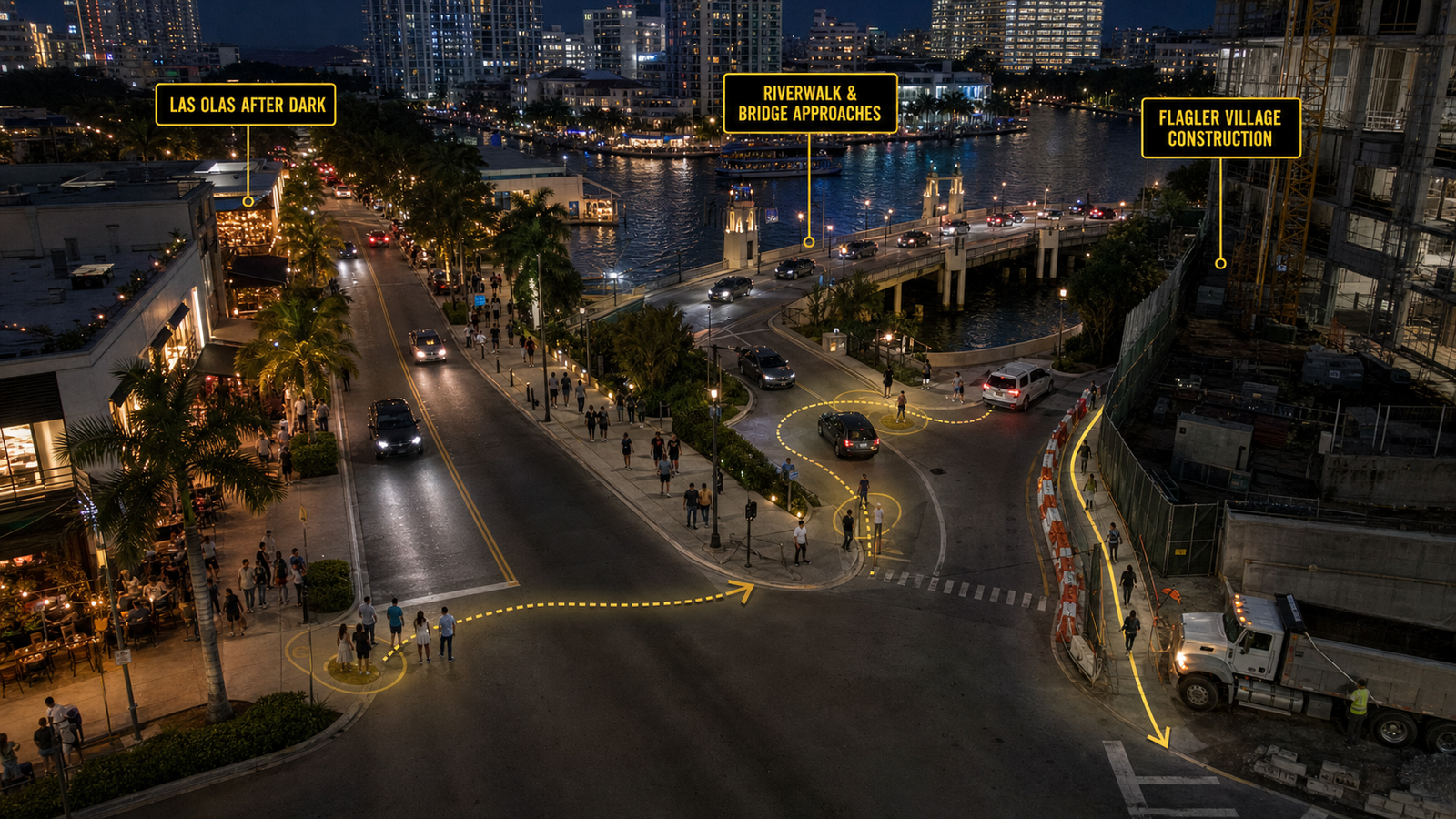
Downtown Fort Lauderdale’s Pedestrian Conflict Zones
Las Olas Boulevard After Dark
Las Olas Boulevard’s concentration of restaurants, bars, and entertainment venues generates foot traffic that peaks between 10 p.m. and 2 a.m., particularly on weekends and during the spring break season. Pedestrians move between venues on both sides of Las Olas, often crossing mid-block in locations without marked crosswalks or signal protection. The entertainment venue lighting that illuminates the storefronts and outdoor dining areas creates a contrast effect that leaves the roadway itself relatively darker than the sidewalk environments, reducing driver visibility of pedestrians in the travel lane. Drivers who have been drinking at Las Olas venues, or who are distracted by the entertainment environment rather than focused on the road, are overrepresented in Las Olas after-dark pedestrian crash data.
A pedestrian struck by a vehicle on Las Olas after midnight faces a complex comparative fault analysis. Florida Statute 316.130 defines pedestrian duties, including the prohibition on crossing mid-block where traffic signal-controlled intersections exist within certain distances. Defense attorneys will argue that a pedestrian who crossed mid-block on Las Olas was contributorily negligent. Countering that argument requires establishing that the driver’s speed, impairment, or distraction was the predominant cause of the crash and that a pedestrian crossing in that location, while possibly in technical violation of the traffic code, was visible to a reasonably attentive driver in time to avoid the collision. The physical evidence from the crash site, particularly skid mark analysis and vehicle damage patterns, is essential to this argument.
The Riverwalk Corridor and New River Bridge Approaches
Fort Lauderdale’s Riverwalk is a pedestrian promenade along the north and south banks of the New River, running through the heart of the downtown entertainment district. The Riverwalk connects outdoor dining venues, performance spaces, the Broward Center for the Performing Arts, and residential towers, and it generates substantial pedestrian traffic that must cross several vehicular roadways at its intersections with the downtown street grid. The Brickell Avenue and SW 2nd Avenue crossings of the New River, adjacent to the Riverwalk, create vehicle-pedestrian conflict zones where drivers exiting the downtown core after events at the Broward Center or the adjacent restaurants are not fully attentive to pedestrians continuing along the Riverwalk path.
The New River swing bridges that carry vehicular traffic along the Riverwalk corridor present an additional pedestrian hazard. When the bridge opens for marine traffic, the pedestrian crossing is blocked, and pedestrians who attempt to cross during the bridge opening or who misjudge the timing of the bridge closing cycle may be caught in a zone with both vehicular and maritime hazards. The approaches to these bridges, where pedestrians transitioning from the Riverwalk path to the adjacent sidewalk system cross driveways, parking lot exits, and food service delivery areas, generate vehicle-pedestrian conflicts that do not appear in standard intersection crash data because they occur in what is technically private property or mixed-use space adjacent to the public right of way.
Flagler Village Construction Traffic and Displaced Walkers
The Flagler Village development boom has had a direct and measurable impact on pedestrian safety in the district north of downtown Fort Lauderdale. Sidewalks along North Andrews Avenue, Sistrunk Boulevard, and the connecting cross streets have been intermittently closed during the construction of adjacent towers, requiring pedestrians to use temporary wooden or concrete barrier pathways that place them within feet of construction vehicle traffic. These temporary pedestrian routes are often inadequate in width for two pedestrians to pass each other, lacking illumination during evening hours, and in several documented cases have terminated without warning at construction fence lines, forcing pedestrians into the roadway to continue past the construction zone.
Florida Pedestrian Law and Your Rights After a Crash
Florida Statute 316.130 and the Driver’s Duty to Yield
Florida Statute 316.130 governs pedestrian rights and responsibilities in the state, and its most important provision for personal injury litigation is the driver’s affirmative duty to yield the right of way to pedestrians in marked crosswalks and at intersections with pedestrian control signals. A driver who strikes a pedestrian who is lawfully in a crosswalk has violated this statutory duty, and that violation is evidence of negligence per se in a subsequent civil case. The statute also imposes a duty of due care on drivers toward pedestrians even outside marked crossings, requiring drivers to exercise the care a reasonable person would exercise to avoid striking any person on the roadway. The per se negligence argument is powerful: it removes the question of whether the driver was negligent and focuses the jury’s inquiry on causation and damages.
Comparative Negligence and the Jaywalking Argument
The primary defense in Fort Lauderdale pedestrian crash cases is comparative negligence: the argument that the pedestrian was partially or wholly responsible for their own injury by crossing outside a crosswalk, crossing against a signal, wearing dark clothing at night, or failing to watch for approaching vehicles. Under Florida’s modified comparative negligence standard adopted in 2023, if a jury finds the pedestrian more than 50 percent responsible for the crash, the pedestrian recovers nothing. Defeating this defense requires demonstrating through physical evidence, surveillance footage, and witness testimony that the driver’s speed, impairment, distraction, or sight-line failures were the dominant causal factors in the crash regardless of the pedestrian’s technical position in the roadway.
Government Liability for Defective Crossing Infrastructure
When a pedestrian crash occurs because a crosswalk was inadequately marked, a pedestrian signal was malfunctioning, a crosswalk ramp was missing or damaged, or a sight obstruction at an intersection blocked the driver’s view of the approaching pedestrian, the government entity responsible for the infrastructure may bear liability. Government liability claims in Broward County require pre-suit notice under Florida Statute 768.28, filed with the appropriate state or local agency. The government’s liability is capped under the statute, but the cap is subject to legislative waiver for cases of exceptional severity, and an attorney who handles government liability cases will know whether a waiver request is appropriate in a given case.

Injuries and Recovery for Fort Lauderdale Pedestrian Victims
Trauma Care at Broward Health Medical Center
Pedestrians struck by vehicles at typical Fort Lauderdale traffic speeds, even at 30 to 35 mph on a surface street, routinely sustain traumatic brain injuries, thoracic injuries, pelvic fractures, and lower extremity fractures requiring surgical intervention. Broward Health Medical Center’s Level I Trauma Center at 1600 S. Andrews Avenue provides the immediate surgical and critical care that these injuries require. The volume of pedestrian trauma cases treated at Broward Health generates medical records that are detailed and clinically sophisticated, and an attorney who knows how to work with trauma surgeons, neurologists, and rehabilitation specialists to translate those records into a coherent damages narrative has a significant advantage in a Broward County pedestrian case. The emergency department record, the surgical notes, and the discharge summary are the foundation, but the long-term follow-up records are equally important.
The Economic Damages Case for Working-Age Victims
When a working-age Fort Lauderdale resident is struck by a vehicle and suffers permanent injuries that affect their ability to return to work or to work in the same capacity, the economic damages case can be substantial. A nurse at Holy Cross Health who sustains a traumatic brain injury with cognitive sequelae that prevents a return to nursing, a construction foreman who sustains pelvic and lower extremity injuries that prevent a return to jobsite supervision, or a maritime industry professional who sustains injuries that prevent offshore work: these are specific economic harm scenarios that a forensic economist can quantify with precision. The lost earning capacity calculation must account for the victim’s specific occupation, earnings history, career trajectory, and the full working life remaining at the time of the crash.
Non-Economic Damages and the Long-Term Impact
The non-economic damages available in a Fort Lauderdale pedestrian case include compensation for pain and suffering, mental anguish, loss of enjoyment of life, and the long-term disruption of personal relationships and activities that severe pedestrian injuries produce. A traumatic brain injury victim who can no longer enjoy the outdoor activities, social engagements, and family relationships that characterized their pre-crash life has suffered real losses that Florida law recognizes and compensates. Presenting these damages requires a comprehensive narrative built from medical records, psychological evaluations, family member testimony, and the victim’s own account of what their life was like before the crash and what it has become afterward.
Mesin & Co. represents Fort Lauderdale pedestrian accident victims from initial consultation through final resolution of the claim. The Fort Lauderdale bicycle accident lawyer page addresses the closely related category of cyclist crash claims, which share many of the same liability and damages issues as pedestrian cases. The Fort Lauderdale slip and fall lawyer page addresses premises liability claims that arise when a pedestrian is injured on private property rather than in the public right of way. The firm’s results page documents the outcomes that thorough preparation and aggressive advocacy produce. Call (786) 944-6446 for a free consultation. There is no fee unless the firm recovers for you.

Russian-Speaking Services
Eugene Mesin is fluent in Russian and welcomes inquiries from Russian-speaking clients throughout Florida