Hollywood’s coastal geography creates a riding environment that attracts motorcyclists year-round. A1A runs the length of the city’s beachfront, offering ocean views and a direct connection to Fort Lauderdale to the north and Hallandale Beach to the south. The Hollywood Beach Broadwalk corridor is one of the most visually distinctive stretches of Florida’s coastal road network. But riding these roads comes with hazards that are unique to the beach environment and that are consistently underestimated by both riders and the drivers who share the road with them. Sand deposits blown or washed from the beach onto A1A create traction conditions that are manageable in a four-wheel vehicle and catastrophic on two wheels. Tourist drivers navigating to beach parking lots check their phones, miss traffic signals, and make abrupt turns into hotel driveways without adequate mirror checks. And the seasonal concentration of unfamiliar vehicles on the road compounds a risk environment that Florida’s statistics already rank among the most dangerous in the country.
Florida reported 657 motorcycle fatalities in 2022, sustaining its position as one of the most dangerous states for riders in the nation. Broward County accounts for a significant share of that total. The NHTSA has found that motorcyclists face approximately 24 times the fatality risk per mile traveled compared to passenger car occupants. Those numbers are not abstractions for the families who contact Mesin & Co. after a serious crash on A1A or Hollywood Boulevard. Call (786) 944-6446 for a free consultation with no fees unless compensation is recovered.
The Coastal Road Hazards That Set Hollywood Apart
A1A: Where Scenic Riding Meets Hidden Surface Danger
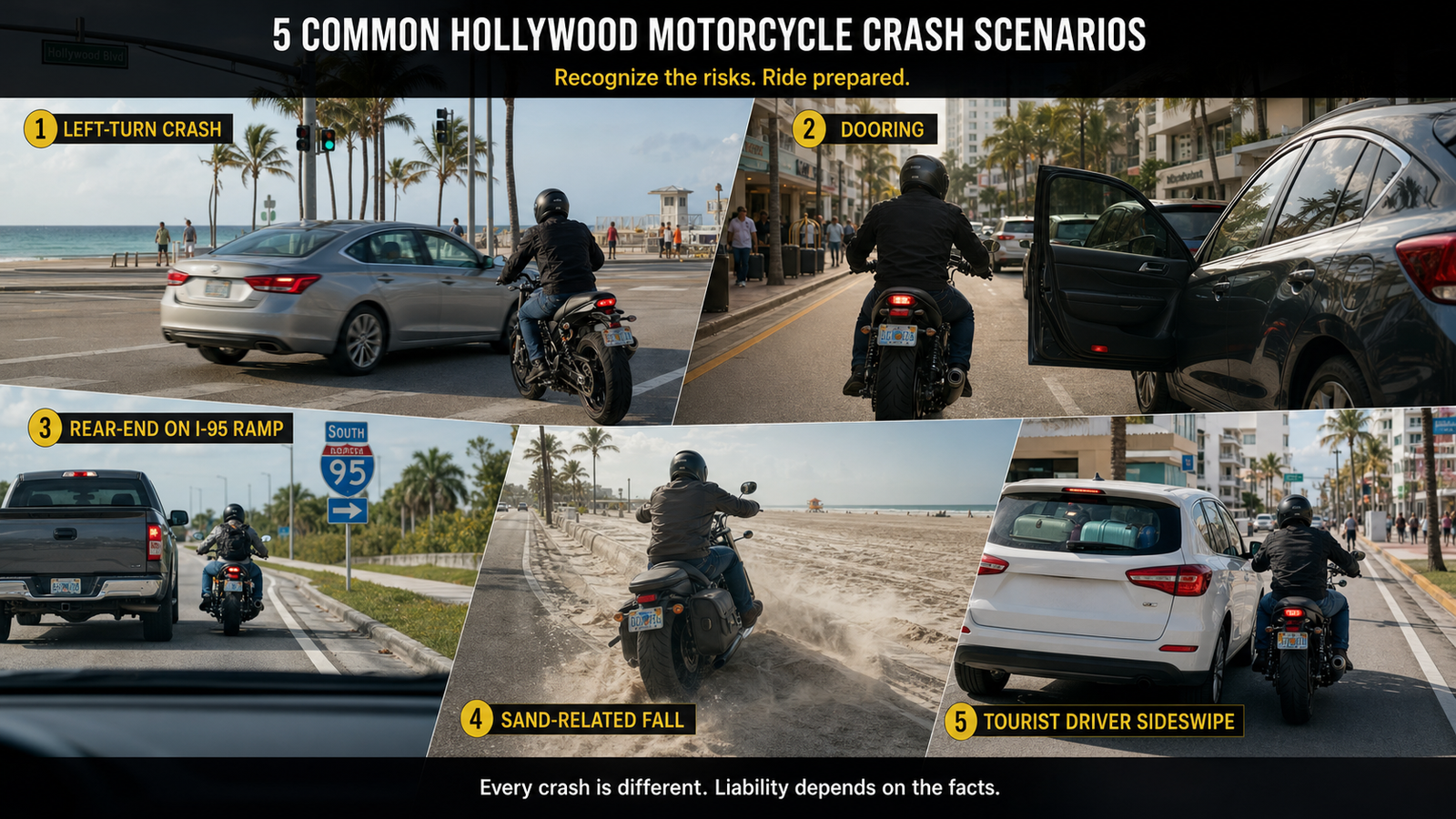
A1A through Hollywood runs between the Atlantic Ocean to the east and the beachfront hotel corridor to the west. The road surface along this stretch is subject to sand accumulation that worsens after high winds, heavy surf, or street cleaning operations that push sand from the Broadwalk onto the roadway. Sand on pavement reduces friction to a fraction of normal levels and provides no warning to a rider whose front wheel encounters it mid-corner or during braking. At any speed above 20 miles per hour, a sand patch in a turn can produce an immediate lowside fall with no recovery opportunity. Florida DOT and the City of Hollywood have documented recurring sand accumulation conditions on A1A in previous maintenance reports, and failure to clear sand from the roadway promptly can support a government liability claim alongside the individual driver’s negligence. Mesin & Co. investigates road condition evidence in every A1A motorcycle crash case it handles.
Tourist Driver Behavior at Beach Access Intersections
The hotel driveways, beach access turnoffs, and parking lot entrances that line A1A and the approach roads to Hollywood Beach create a constant stream of turning vehicle conflicts for motorcyclists. Tourist drivers making their first visit to the area are focused on locating their hotel entrance, reading street signs, or following GPS directions rather than checking mirrors and clearing adjacent lanes before turning. The left-turn crash, in which a vehicle turns left across the path of an oncoming motorcycle, accounts for a disproportionate share of serious motorcycle fatalities nationally and is particularly prevalent at the beach access intersections along this corridor. A driver who turns left into a hotel entrance in front of a motorcycle traveling A1A northbound has failed the fundamental duty of yielding to oncoming traffic, and that failure is the foundation of the liability case.
The Broadwalk Zone and Urban Riding Conflicts
Hollywood Boulevard east of US-1 represents a different hazard environment than A1A. The transition from moving vehicle traffic to the slower, more chaotic environment near the Broadwalk produces unpredictable speeds, double-parked delivery vehicles, hotel luggage carts blocking lanes, and pedestrian overflow from the Broadwalk onto the road surface. Riders navigating this zone face the same door-zone hazard from parked vehicles that affects cyclists, combined with the higher speed and lesser maneuverability of a motorcycle. A vehicle door opened into a motorcyclist’s path in this zone is a foreseeable event given the volume of parking activity, and the vehicle operator who opens without checking is liable for the consequences. For additional context on how Hollywood’s beach corridor generates these claims, see the firm’s Hollywood bicycle accident lawyer page.
The Insurance Landscape for Hollywood Motorcycle Riders
PIP Does Not Cover Motorcycle Accidents in Florida
Florida’s Personal Injury Protection no-fault system does not apply to motorcycle accidents. Riders injured in crashes have no automatic PIP source to cover immediate medical bills unless they own a separate automobile with PIP coverage on that policy. This means that after a serious motorcycle crash on A1A or Hollywood Boulevard, the injured rider may face substantial out-of-pocket medical costs before any liability claim is resolved. Memorial Regional Hospital‘s trauma facility provides critical emergency care, but the financial architecture of a motorcycle injury case is fundamentally different from a car accident case and requires an attorney who understands how to structure the claim from the ground up without PIP as a foundation.
Uninsured Tourist Drivers and the UM Coverage Question
Hollywood’s tourism-driven traffic means that a meaningful percentage of drivers on A1A and in the beach corridor are operating rental cars or out-of-state vehicles. Florida’s uninsured motorist rate, estimated at approximately 20 percent by the Insurance Research Council, applies to this population as well. When a tourist driver causes a motorcycle crash and is uninsured or underinsured, the rider’s own uninsured motorist coverage is the primary financial resource available. Riders who carry UM coverage on their motorcycle policy can make claims against their own insurer for the same damages they would seek from the at-fault driver: medical bills, lost wages, pain and suffering, and future losses. Mesin & Co. reviews every available insurance policy in every Hollywood motorcycle case, including homeowner and renter policies that may include relevant coverage.
The Helmet Law and Comparative Fault in Broward County
Florida does not require motorcycle riders age 21 and older to wear a helmet provided they carry at least $10,000 in medical benefits coverage. Insurance defense attorneys in Broward County cases routinely argue that an unhelmeted rider’s head injuries were caused or exacerbated by the failure to wear a helmet, using this argument to push the rider’s share of comparative fault above the 50 percent bar that would eliminate recovery under Florida’s 2023 modified comparative negligence reform. Mesin & Co. challenges these arguments with biomechanical and medical expert testimony focused on the specific causation question: not whether helmets generally reduce injury risk, but whether this particular helmet, worn by this particular rider, would have prevented the specific injuries sustained in this specific crash. That targeted analysis is what defeats the comparative fault argument in litigation.
Catastrophic Injuries on Hollywood Roads
Road Rash in the Florida Climate
Road rash in South Florida carries infection risks that amplify the injury’s severity. The combination of open wounds from asphalt abrasion, Florida’s humidity and heat, and the environmental organisms present in a coastal environment creates conditions under which wound infections develop rapidly. Debridement, skin grafting, and wound management that might proceed straightforwardly in a cooler, drier climate require more aggressive intervention in South Florida. Extended wound care hospitalization, repeated surgical procedures, and permanent scarring are common outcomes in serious Hollywood motorcycle crash road rash cases. These documented outcomes are properly reflected in both the economic and non-economic damages components of the claim.
Spinal Injuries From High-Speed Beach Road Crashes
A1A crashes that involve significant speed, whether from tourist drivers accelerating between hotel driveways or from lane-change conflicts near the I-95 connector, produce the kind of spinal injury profile seen in high-velocity motorcycle crashes generally: compression fractures, burst fractures, herniated discs at multiple levels, and in the most severe cases, spinal cord injuries resulting in permanent neurological deficits. The Hollywood wrongful death lawyer page addresses cases where spinal injuries on Hollywood roads prove fatal. For survivors of spinal injuries, the economic analysis requires life care planning expertise that projects the full cost of ongoing treatment, adaptive equipment, and functional support over the victim’s remaining life expectancy.
Traumatic Brain Injury in Coastal Motorcycle Crashes
Helmeted riders sustain traumatic brain injuries at a lower rate than unhelmeted riders, but helmet use does not eliminate TBI risk. The rotational forces generated when a helmeted head strikes the road surface or a vehicle can produce diffuse axonal injury that presents clinically in the days and weeks after the crash rather than at the scene. Hollywood motorcycle crash victims who report persistent headache, cognitive difficulty, mood changes, or sleep disruption after an apparently survivable crash should undergo formal neurological evaluation. Mesin & Co. works with neurological specialists to document TBI in every Hollywood motorcycle case where head impact occurred, ensuring that late-presenting neurological injury is captured in the damages record before any settlement is finalized. For more on TBI documentation across practice areas, see the firm’s Hollywood pedestrian accident lawyer page.
Speak With a Hollywood Motorcycle Accident Lawyer Today
Mesin & Co. represents motorcycle accident victims throughout Hollywood, Hallandale Beach, Dania Beach, and Broward County. Eugene Mesin is a Marine Corps veteran who understands the discipline required to fight for a fair outcome in cases where insurers routinely undervalue riders’ injuries. All cases are handled on a contingency fee basis. Call (786) 944-6446 or visit mesinco.com today.

Russian-Speaking Services
Eugene Mesin is fluent in Russian and welcomes inquiries from Russian-speaking clients throughout Florida