
Florida is the most dangerous state in the country to ride a motorcycle. According to the Florida Department of Highway Safety and Motor Vehicles (FLHSMV) Crash Dashboard, Florida recorded 588 motorcyclist fatalities in 2025, highlighting the serious risks riders face every time they take to Florida’s roads. The National Highway Traffic Safety Administration has consistently found that motorcyclists are approximately 24 times more likely to die in a crash per mile traveled than occupants of passenger vehicles. Those numbers are not abstract statistics for the riders and families who contact Mesin & Co. after a serious accident on North Miami roads. They represent the reality of what happens when a careless driver fails to see a motorcycle on Biscayne Boulevard or turns left across traffic on NE 125th Street without checking their mirrors.
Motorcycle accident cases in Florida carry legal complications that most general personal injury attorneys are not fully prepared to handle. The no-fault insurance system that applies to car accidents does not apply to motorcycles. Comparative fault rules are used aggressively by insurance companies to minimize payouts to riders. And the injury profile in motorcycle crashes is, on average, significantly more severe than in comparable car accidents. Mesin & Co. handles motorcycle accident cases in North Miami with a thorough understanding of these complications and the experience to overcome them. Eugene Mesin is available for a free consultation at (786) 944-6446.
Motorcycle Crash Patterns in North Miami and Miami-Dade County
Miami-Dade County consistently ranks among the top Florida counties for total motorcycle crashes and fatalities. In 2025, Miami-Dade recorded more than 1,200 motorcycle crashes resulting in injuries, a figure that reflects both the volume of riders and the hazardous road conditions that make South Florida particularly dangerous for two-wheeled vehicles. North Miami’s road network concentrates several of the most crash-prone conditions into a relatively compact geographic area.
The Left-Turn Crash: Florida’s Most Lethal Motorcycle Collision Type
Across Florida and nationally, the single most common cause of fatal motorcycle crashes is a vehicle turning left across oncoming traffic. The driver misjudges the motorcycle’s speed, fails to see it at all, or assumes the rider will slow down. The motorcycle has no time to stop and no steel cage to absorb the impact. This crash type happens repeatedly at the commercial intersections along Biscayne Boulevard in North Miami, where drivers exiting parking lots and side streets frequently cut across the northbound and southbound lanes without adequate visibility checks. The intersection of Biscayne Boulevard and NE 125th Street, one of the city’s most heavily trafficked crossings, is a documented location for this type of event.
Road Hazards That Cars Absorb and Motorcycles Cannot
Potholes, raised pavement seams, sand deposits, wet paint, and storm drain grates are nuisances for car drivers and life-threatening hazards for motorcycle riders. North Miami’s roads, particularly along older surface streets in the city’s interior, include sections with deteriorated pavement, uneven patching, and drainage issues that deposit sand and debris across travel lanes after heavy rain. A rider encountering an unexpected surface change at speed has fractions of a second to react, and the physics of a two-wheeled vehicle do not allow for the same emergency maneuvering that a four-wheeled car can execute. When a defective road condition contributes to a motorcycle crash, the City of North Miami or Florida DOT may be a liable party in addition to any other drivers involved.
Lane-Change and Blind-Spot Crashes on Multi-Lane Roads
Motorcycles occupy a narrower visual footprint than any other vehicle on the road, which makes them genuinely harder to spot in mirrors. Drivers on Biscayne Boulevard and on the approach and departure ramps connecting to I-95 frequently change lanes without adequate mirror checks, moving into a lane already occupied by a motorcycle. The disparity in vehicle size means the rider absorbs the full force of the impact. Sideswipe crashes at highway speed and at the speeds typical of Biscayne Boulevard arterial traffic produce severe injuries even when both vehicles remain upright.
The Florida Insurance Gap That Every Motorcyclist Must Understand
One of the most important legal facts about motorcycle accidents in Florida is one that catches injured riders completely off guard: Florida’s no-fault Personal Injury Protection (PIP) system does not apply to motorcycles. PIP coverage, which pays 80 percent of medical bills and 60 percent of lost wages up to $10,000 after a car accident, is not available to motorcycle riders under Florida law. This means that after a crash, a motorcycle rider has no guaranteed source of immediate medical bill payment unless they carry their own private health insurance or have purchased optional medical payments coverage on their motorcycle policy. The practical consequence is that riders often face substantial out-of-pocket medical costs immediately after an accident before any liability claim is resolved.
Why Uninsured and Underinsured Motorist Coverage Is Critical for Riders
Florida has one of the highest rates of uninsured drivers in the country. The Insurance Research Council has estimated that approximately 20 percent of Florida drivers carry no automobile liability insurance, and many others carry only the minimum coverage amounts required by law. For a motorcyclist who suffers serious injuries in a crash caused by an uninsured or minimally insured driver, uninsured motorist (UM) and underinsured motorist (UIM) coverage on the rider’s own motorcycle policy is often the only meaningful source of compensation available. Riders who carry UM and UIM coverage can make claims against their own policy when the at-fault driver’s coverage is absent or insufficient. Eugene Mesin handles UM and UIM claims as part of his motorcycle practice and understands how to maximize recovery under these policies. See the North Miami car accident lawyer page for additional context on Florida’s insurance structure.
Florida’s Helmet Law and Its Effect on Your Claim
Florida does not require motorcycle riders aged 21 and older to wear a helmet, provided they carry at least $10,000 in medical benefits coverage. This creates a legal issue in injury claims that insurance companies use aggressively. Under Florida law, a defendant can argue that a rider’s failure to wear a helmet contributed to the severity of their head injuries, potentially reducing the rider’s recovery under the state’s modified comparative negligence standard. The legal framework for this argument is contested, and courts have limited its application in certain circumstances, but the argument is raised routinely and can affect settlement negotiations. Mesin & Co. addresses this issue head-on in every case involving an unhelmeted rider, marshaling medical and biomechanical expert testimony to contest causation between helmet non-use and the specific injuries sustained.

Modified Comparative Negligence and the Bias Against Motorcycle Riders
Florida’s shift in 2023 to a modified comparative negligence standard under HB 837 has significant consequences for motorcycle accident claims. Under this rule, any plaintiff found to be more than 50 percent at fault for their own accident is completely barred from recovering compensation. For motorcycle riders, this rule operates against a backdrop of persistent cultural and institutional bias that makes comparative fault arguments particularly dangerous.
How Insurance Companies Build Fault Arguments Against Riders
Insurance adjusters assigned to motorcycle accident claims frequently begin their investigation looking for ways to assign fault to the rider rather than their insured driver. Common arguments include claims that the rider was speeding, was not maintaining proper lane position, was riding aggressively, or was wearing gear that limited their visibility. These arguments are often built on incomplete information gathered in the chaotic aftermath of a crash, and they can be challenged effectively when a thorough independent investigation is conducted promptly. Mesin & Co. works with accident reconstruction experts who analyze physical evidence, skid marks, vehicle damage patterns, and road geometry to establish an objective account of how the crash occurred. This is the same rigorous investigative approach applied in North Miami truck accident cases where fault allocation is similarly contested.
Witness Testimony and Surveillance Footage in Bias Rebuttal
Eyewitness accounts of motorcycle crashes are often limited by the speed of the event and the fact that most bystanders are watching from angles that do not capture the full sequence. Surveillance cameras along commercial corridors in North Miami, particularly on Biscayne Boulevard, provide objective video evidence that can confirm or contradict driver and witness accounts. Mesin & Co. acts quickly to secure this footage before it is overwritten. When surveillance footage captures the moments before a crash, it routinely shows that the rider was operating lawfully and that the at-fault driver initiated the dangerous maneuver, directly undermining the comparative fault arguments insurers rely on.
The Injury Profile of a North Miami Motorcycle Crash
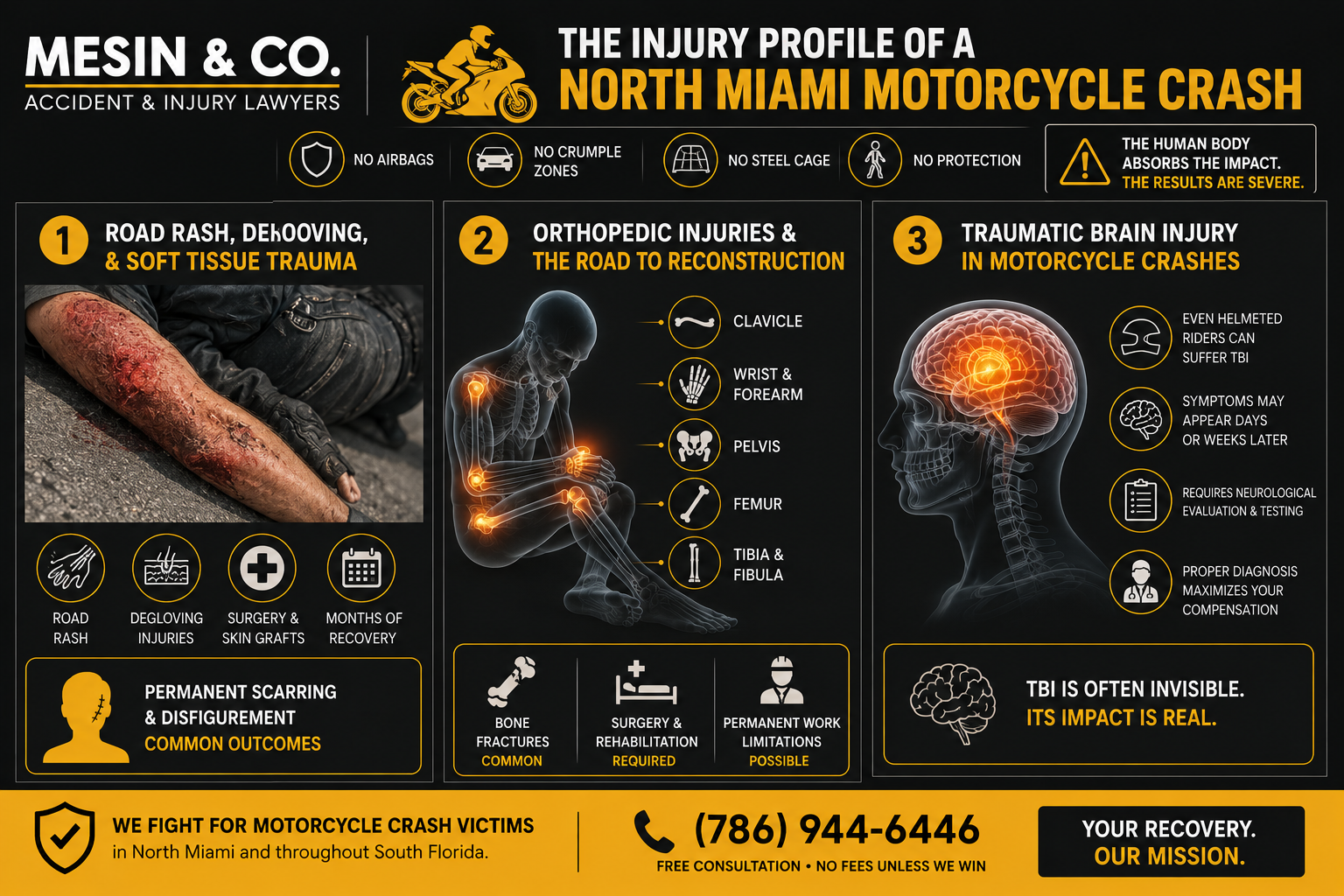
Motorcycles offer no occupant protection beyond what the rider wears. No airbags. No crumple zones. No steel cage. The human body absorbs impacts that a car would distribute across engineered safety systems, and the results are predictably severe. The injury types that Mesin & Co. sees most frequently in North Miami motorcycle accident cases reflect both the physics of the collisions and the road conditions specific to this area.
Road Rash, Degloving, and Soft Tissue Trauma
Road rash occurs when a rider makes contact with the road surface after being thrown from the motorcycle. At speeds above 30 miles per hour, asphalt behaves like a grater against exposed skin, and even through riding gear, the friction and abrasion can produce injuries that extend through multiple layers of tissue. Severe road rash requires debridement, skin grafting, and extended wound care. Degloving injuries, in which the skin is separated from the underlying tissue over a large surface area, are among the most serious soft tissue injuries in trauma medicine and require intensive surgical intervention. Recovery is measured in months, not weeks, and permanent scarring and disfigurement are common outcomes. These documented outcomes are central to the non-economic damages calculation in every motorcycle case.
Orthopedic Injuries and the Road to Reconstruction
Bone fractures are nearly universal in serious motorcycle crashes. The most common sites are the clavicle, wrist and forearm, femur, tibia, and fibula. Riders who lay down a bike at speed or who are struck broadside frequently sustain pelvis fractures, which carry significant complications and long recovery timelines. Open fractures, in which bone penetrates the skin, carry infection risk and require surgical fixation followed by extended rehabilitation. For riders who work in physically demanding occupations, the question of permanent work capacity limitation is a critical component of the economic damages case.
Traumatic Brain Injury in Motorcycle Crashes
Even helmeted riders sustain traumatic brain injuries in high-impact crashes. The rotational forces generated when a rider’s head strikes the ground or an object can produce diffuse axonal injury that does not appear on initial CT imaging but manifests in cognitive, behavioral, and neurological symptoms over days and weeks. For unhelmeted riders, the risk is significantly greater. TBI in motorcycle crash survivors often goes undiagnosed in the acute phase because emergency physicians focus on visible trauma. When cognitive or neurological symptoms emerge after discharge, documenting the connection to the crash requires careful neurological evaluation and, in many cases, neuropsychological testing. Mesin & Co. works with neurological specialists to ensure that TBI is properly identified and documented in every case where it may be present.
What to Do After a Motorcycle Accident in North Miami
The actions you take at the scene and in the hours immediately after a motorcycle crash have a direct effect on both your medical outcome and the strength of your legal claim.
- Call 911. A police report documents the crash, the parties, and the road conditions. Request that responding officers note the road surface conditions and any relevant environmental factors.
- Accept emergency medical treatment. Adrenaline masks pain after a crash. Injuries that do not feel serious at the scene, including internal injuries, spinal injuries, and TBI, may not present symptoms for hours. Refuse transport only if you are genuinely uninjured and have confirmed this with medical personnel.
- Document everything you can. Photograph both vehicles, the road surface, the debris field, skid marks, and any traffic control devices in the area. Get the names and contact information of every witness.
- Do not discuss fault at the scene. Do not apologize, accept partial blame, or speculate about what happened with the other driver, their passengers, or law enforcement beyond providing factual information.
- Do not give a recorded statement to any insurance company. The at-fault driver’s insurer will call quickly. Decline to give a recorded statement until you have spoken with an attorney.
- Contact Mesin & Co. Time matters in motorcycle cases. Evidence disappears. Adjuster narratives form. Call (786) 944-6446 for a free consultation before taking any further steps with insurance companies.
Serving Motorcycle Accident Victims Across North Miami
Mesin & Co. represents motorcycle accident victims in North Miami, North Miami Beach, Biscayne Park, El Portal, Miami Shores, and throughout Miami-Dade County. Eugene Mesin is a Marine Corps veteran who understands discipline, attention to detail, and the importance of fighting for what is right. He handles every motorcycle case on a contingency fee basis with no upfront costs and no fees unless compensation is recovered. For injuries that have changed your life, you deserve an attorney who will fight as hard as you would. Call (786) 944-6446 or visit mesinco.com to get started today.

Russian-Speaking Services
Eugene Mesin is fluent in Russian and welcomes inquiries from Russian-speaking clients throughout Florida